
Content Strategy
Content strategy services that tell you what to write, fix and drop
Content strategy services that give you a written plan: what to publish, which pages to fix, merge or remove, and which topics to skip.

In every planIncluded in Local or Growth, from $149 a month. Every plan has every feature; they differ by size.
Compare plansHow it works
How we build your content strategy in six steps
A content strategy is a set of decisions, not a list of articles. Step four is the one most teams skip.
Map what people search for, and why
The same search can mean early research, comparing options or ready to buy. Guess wrong and a well-written page is still useless.
You get: A map of the searches that matter, sorted by what people want
Audit what you already have
Every page gets a decision: keep, update, merge or remove. Most quick wins are here, because older sites usually have several pages chasing the same search.
You get: A keep, update, merge or remove decision for every page
Group the topics
One strong page covers the main question and supporting pages back it up without repeating it. Then we plan the links between them.
You get: Topic groups and an internal linking plan
Write the no-list
Topics we won’t cover, and why: no chance of ranking, no link to sales, no in-house expert, or a page that already does the job. It’s what lets someone turn down an idea.
You get: A written no-list with a reason for each topic
Write briefs that give writers direction
Each brief says why the piece exists, what question it answers, what it must say that ranking pages don’t and which expert we need to interview.
You get: Briefs that each state why the piece exists
Plan for pages going out of date
Prices, tools and guidance change. A refresh schedule with clear warning signs stops your best pages slipping while everyone chases new work.
You get: An update schedule and checks for slipping pages
The decision underneath
Should this article get written? Four questions
The no-list records the ideas that failed one of these questions, and why. Nobody has to reopen the debate three months later.
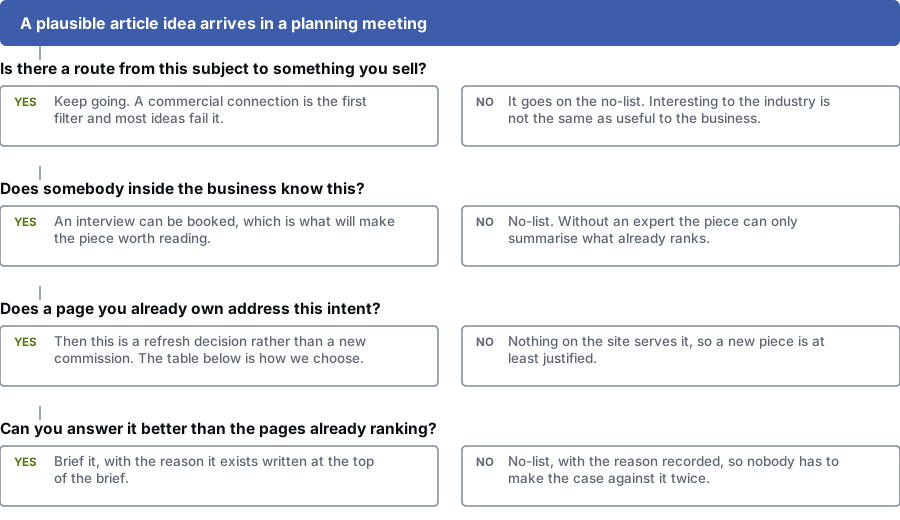
Does this topic link to something you sell?
Yes: Keep going. A link to sales is the first test, and most ideas fail it.
No: No-list. Interesting to your industry isn’t the same as useful to your business.
Does someone in your business know this subject?
Yes: We book an interview. That’s what makes the piece worth reading.
No: No-list. Without an expert, the piece can only repeat what already ranks.
Do you already have a page for this?
Yes: Then update it. The table below shows how we choose.
No: Nothing on your site covers it, so a new piece is worth a look.
Can you answer it better than the pages already ranking?
Yes: Brief it, with the reason it exists written at the top.
No: No-list, with the reason written down, so nobody argues it twice.
Update or write new
Update an existing page, or write a new one?
| Dimension | Update what exists | Write something new |
|---|---|---|
| When it applies | You have a page for this need, and the gap can be fixed | Nothing on your site covers the search, or the current page serves a different need |
| What it costs | Usually a fraction of a new piece, because the structure and links already exist | The full cost: research, expert time, writing, editing, design and links from scratch |
| How fast it shows | Faster. The page already has history, links and Google’s attention | Slower. A new page has to earn its place before you can judge it |
| The risk | A careless rewrite can lose what was working, so we change things carefully and track them | The new page competes with one you already have, and both get weaker |
| What it needs from you | Updated facts, current prices or process details, and a short expert review | A full interview, original material and time from someone who knows the subject |
Quality over volume
Why publishing more won’t fix it
Lots of content shows effort, not progress. Sixty pages that deserve to exist will beat six hundred that mostly don’t.
To hit a volume target, briefs get thinner, expert interviews get skipped and pieces get stitched together from what already ranks. Nobody links to that or quotes it.
It also creates upkeep. Every page will go out of date one day, or compete with something newer. Publish faster than you can maintain, and the next budget goes on cleaning up the last one.
What you get
What your content strategy includes
A working document your team can use without us to make decisions in a Monday meeting.
- A search map showing what people want for each group of searches
- A page-by-page audit of your content, with a decision and a reason for each
- Topic groups showing which page covers which need and how they link
- The no-list: topics we’ve ruled out, and why
- One ranked to-do list mixing updates and new pieces
- Briefs for the first batch of content, each saying why the piece exists
- An interview plan naming which experts we need for which pieces
- An update calendar for the pages worth protecting
- A way to measure content by enquiries and sales as well as visits
Questions
Common questions about content strategy
How is this different from a content calendar?
A calendar says when to publish. A content strategy says whether to publish at all: which topics deserve your effort, what each piece must do for sales and how your pages connect.
A quick test: can someone use the plan to turn down an idea? If not, it’s a schedule.
Will you recommend deleting content we paid for?
Sometimes, but merging is more common. If three thin pages answer the same question, one strong page with the others redirected usually beats all three.
We first show you what each page brings in today: traffic, links and enquiries. We only suggest removing pages that bring in nothing and can’t be improved.
How do you decide between refreshing a page and writing a new one?
We check if you already have a page for that search and how close it is to ranking well. If it’s close and the gap can be fixed, updating is cheaper, faster and more likely to work.
We write new when nothing on your site covers the search, or when the current page serves a different need and forcing the two together would help neither.
How much should we be publishing?
Less than most calendars assume, with more care in each piece. Volume targets produce pages that sum up what already ranks, and nobody links to or quotes those.
We plan around what your team can produce well, including your experts’ time. A slower pace that keeps quality beats a fast one that slips.
What do you need from our team?
Short recorded chats with people who know things, usually a salesperson, someone who delivers the service and one senior expert. No writing homework.
We also ask for your common objections, why you lose deals and the questions support hears again and again. That shows how your customers decide better than any keyword tool.
Are your pages competing with each other?
Most sites that have published for a few years have pages fighting over the same search. We look for those first, because merging them is usually the quickest win.
Prefer to talk it over? Book a free call
References
Sources for content strategy
The official documents and research this page is based on. Platform rules change, so check the source before you act on a detail.
Related
More on content strategy
- the organic programme this feedsA content plan needs technical SEO and links working alongside it.
- digital PR campaignsWhere content worth linking to comes from.
- visibility in AI answersClear, well-organised content helps you show up there too.
- how long organic work takes
- the standards we publish to
Where content strategy matters most
More content & digital PR services
Last updated · Published by Zubair Afzal, responsible editor