
Copywriting
Copywriting about your reader’s problem, not your company
Copywriting that starts with your reader’s problem, not your company. We research what’s true about your business, then write it so specifically no competitor could claim it.

In every planIncluded in Local or Growth, from $149 a month. Every plan has every feature; they differ by size.
Compare plansThe usual failures
Four reasons business copy doesn’t persuade anyone
Copy rarely fails because the writing is bad. It fails because of decisions made before anyone wrote a word: what to research, whose words to use, what review would let through.
- The page talks about the company, not the reader.
- It opens with founding dates, team size and a mission statement. The reader arrived with a problem and won’t translate your capability list into an answer. Fix the order: their situation, what it costs them, then what you do about it.
- Adjectives are doing the work facts should do.
- Innovative. Dedicated. Trusted. Writers reach for these when nobody gave them anything concrete. A number, a named process, a stated limit or a real example does more, and a competitor can’t copy it without lying.
- The review process strips out anything specific.
- Every reviewer adds a qualifier and nobody removes one, so six rounds later the interesting claim is safe and unreadable. Decide upfront who makes the final call and where the legal line is.
- Nobody agreed what the page is for.
- A page trying to rank, reassure a customer, brief a journalist and close a sale does none of them well. Pick the one job the page must do and send the others elsewhere.
The test we apply
If a competitor could paste your copy onto their site and nobody would notice, you’re describing a category, not a business. Rewriting the verbs won’t fix that.
We run this test on every page, new or old. It doesn’t ask if the writing is good. It asks if the writing is about anyone in particular.
Passing it takes facts your competitor doesn’t have: how you work day to day, what you turn down, what goes wrong and how you handle it, how customers explain the decision to a colleague. That’s research, which is why research comes first.
What changes in the edit
The same claim, written vague and written specific
| Dimension | Before the research | After the research |
|---|---|---|
| Opening line | A leading provider of integrated solutions for growing businesses | You’ve got three quotes for the same job and no way to tell why one costs double |
| Capability | Comprehensive end-to-end service delivery | We do the survey, the install and the yearly check. No trade to blame but us. |
| Reassurance | Trusted by businesses across the country | The engineer who quoted your job signs it off, not a manager who never saw it |
| Objection handling | Flexible pricing to suit every budget | Below a certain job size, we’re the wrong choice. We’ll say so on the first call. |
| What the reader can check | Nothing | A named process, a stated limit and a claim someone could verify |
| Could a competitor use it? | Yes, word for word | Only by describing a business they don’t run |
Three faults, three fixes
Is the fault the writing or the research?
A page that reads fine and persuades nobody usually has one of three faults. Different people fix each one, at different cost. Rewriting the verbs fixes none of them.
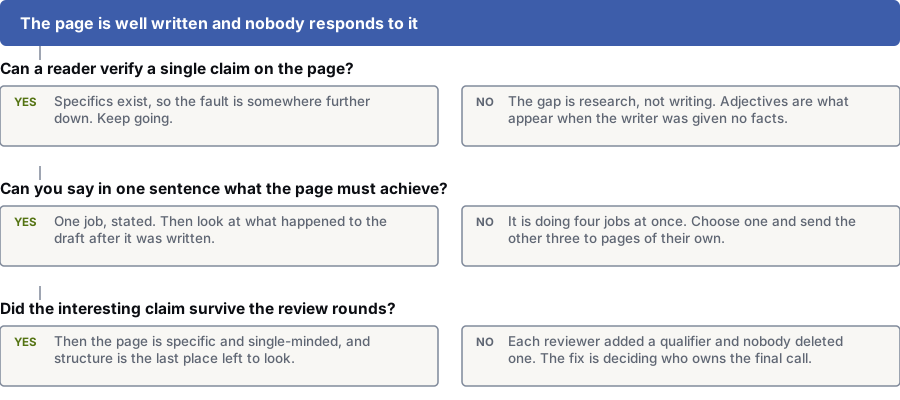
Can a reader check a single claim on the page?
Yes: Good, specifics exist. Keep going.
No: That’s a research gap, not a writing one. Adjectives show up when nobody gave the writer facts.
Can you say in one sentence what the page has to do?
Yes: One job, stated. Now look at what happened after it was written.
No: It’s doing four jobs at once. Pick one. Send the rest to pages of their own.
Did the interesting claim survive the review rounds?
Yes: Then it’s specific and focused. Structure’s the last place to look.
No: Every reviewer added a hedge and nobody cut one. The fix is deciding who has the final call.
Method
Research first. Writing fourth.
Most of the time goes into finding out what’s true, not writing it down. That’s what makes the writing easy.
Talk to the people who talk to customers
Sales and delivery hear the real objections, the real comparisons and the words buyers use. Twenty minutes each, recorded, beats a week reading your website.
You get: Recorded interviews and a bank of usable quotes
Ask how customers explain the decision
Where we can, we ask recent customers how they explained the choice to a colleague. That line is often the strongest available, and rarely the one the business would pick.
You get: Real customer language, sourced and attributed
Agree what each page has to do
One page, one job, in a sentence, before we draft. We also agree what can be claimed, what needs evidence and what won’t survive review.
You get: A one-line purpose and claim limits for every page
Draft the structure before the sentences
Headings first, so we can check the argument before polishing prose. If the headings don’t make sense in order, nicer sentences won’t fix the page.
You get: A structured draft you can follow from headings alone
Cut, then get one expert to check it
We cut hedges, swap adjectives for facts and shorten sentences. Then one expert checks accuracy only, not style. Style feedback from six people turns sharp copy bland.
You get: Edited copy with one named accuracy check
The work
What this covers
- Homepage and core service pages, each written on its own, not templated
- Landing pages matched to the exact campaign sending the traffic
- Product and feature pages for technical products that need translating
- Pricing pages, including the parts most businesses avoid writing
- Email sequences, onboarding messages and lifecycle copy
- Sales decks, proposals and one-page leave-behinds
- Case study write-ups when a real client agrees to be named
- A voice guide built from real sentences, with do-not-write examples
- Edits of drafts your own experts write
Questions
Common questions about copywriting
How is copywriting different from content strategy?
Content strategy decides what should exist: which topics, which pages, what to stop making. Copywriting decides how a page reads once that’s settled.
Hire a writer without deciding what deserves a page, and you get well-written copy for pages that shouldn’t exist.
Our product is technical. Can an outside writer get it right?
Yes, if the writer interviews the people who know it and an expert checks the draft. We’re not experts in your field. Our job is drawing expertise out of people and putting it in order.
What usually breaks technical copy is a review process where three people add hedges and nobody removes any, until a sharp claim says nothing.
What do you need from us before writing?
Three or four short chats: someone in sales, someone in delivery, and ideally two recent customers. Plus your lost-deal reasons and what your support team hears most.
We also need the limits: claims legal won’t sign off, words you must use, anything a regulator expects. Better before we write than in round three.
Will you write in our voice or yours?
Yours. We build the voice guide from sentences your own people have said, not adjectives like “confident” or “approachable”, which no writer can act on.
A working voice guide shows what you’d write and what you’d never write, plus specifics: do you address the reader directly? How much humour? How technical on a first page?
Do you write for search engines or for people?
For people. We check what people search for before we draft, so their words shape our word choices. It doesn’t change who we’re writing for.
Copy that repeats a phrase to hit a target reads badly and doesn’t help you rank either. One sharp sentence beats five stuffed with keywords.
Can you edit copy our team has written?
Yes, and it’s often the better option when your experts write well but not persuasively. We show our reasoning, so the writer improves on their own next time.
If a draft argues the wrong thing, we’ll say so instead of polishing it. Line edits can’t fix a page built on the wrong idea.
Send us the page you like least
On a call we’ll run the competitor test on it and tell you if the problem is the writing or the research underneath. Each needs a different fix and budget.
Prefer to talk it over? Book a free call
References
Sources for copywriting
The official documents and research this page is based on. Platform rules change, so check the source before you act on a detail.
Related
More on copywriting
- digital PR and link building, comparedWhich of the two you’re buying, and what each costs.
- deciding what should be written at allStrategy picks the topic. Copywriting decides how it reads.
- landing pages built around the copyWe draft copy and layout together, or neither works.
- testing what a rewrite changedThe only straight way to judge a new page.
- how we handle claims and sources
Where copywriting matters most
More content & digital PR services
Last updated · Published by Zubair Afzal, responsible editor