
Conversion Rate Optimisation
Conversion rate optimization services: more enquiries, same visitors
Conversion rate optimisation that gets you more enquiries from the traffic you already have. We fix what stops visitors, and A/B test only when your traffic supports it.
Proposed change
ExampleHomepage headline
- Loads fast on phones
- Clear call button
- Quote form works
- Easy to read
In every planIncluded in Local or Growth, from $149 a month. Every plan has every feature; they differ by size.
Compare plansOur position on testing
When we run an A/B test and when we do not
This is the part of CRO that agencies explain least clearly, so we cover it first.
We run a split test when
- The page gets enough conversions for a result within a sensible time, and we have shown you the maths
- The change is uncertain, so a test can settle the question
- It measures a business result, such as an enquiry, not a click on the way to one
- Tracking has been checked from start to finish before the test begins
We will not
- Sell a testing programme to a site without the traffic to support one
- Stop a test early because the numbers look good today
- Call a result a win when the confidence interval crosses zero
- Test something we already know is broken. We fix it.
- Push the conversion rate up while the quality of enquiries falls
The maths behind A/B testing
Why most sites cannot run CRO the way agencies sell it
A split test looks for a difference between two groups that is bigger than the normal noise between them. The smaller the difference and the lower your conversion rate, the more data you need, and there is no way around it.
A site converting at two per cent that hopes to detect a modest improvement needs more conversions per version than most business websites get in three months. Run the test anyway and you either get no clear answer after four months, or stop early because it looked good, which is not a result.
You can still improve conversions; the gains come from a different method. At normal traffic levels, the useful work is watching people try to complete a task, reading the funnel and finding what is broken, then fixing problems where the evidence is strong enough that a test would add nothing.
The sensible order is to fix what is clearly wrong, clarify what is unclear, track what you cannot see, and save testing for the pages and questions where it can give an answer.
A test should not cost you search traffic. We follow Google’s published testing rules every time: show Googlebot the same content as visitors, point test URLs at the original with rel="canonical", use temporary 302 redirects rather than permanent 301s, and end the test once it has an answer.
Choosing a method
Which research method answers which question
Pick the wrong method and your team can end up confidently fixing something that was never the problem.
| Dimension | What it answers well | What it cannot tell you | Traffic needed |
|---|---|---|---|
| Analytics and funnel review | Where people leave, on which device and from which source | Why they left, or what they expected to find | Low. Useful from the first few hundred visits |
| Session recordings | Angry clicks, dead ends, hesitation and form fields people give up on | What people wanted, and whether the behaviour is typical | Low. A few dozen relevant sessions is often enough |
| Moderated user testing | Why a task fails, in the visitor’s own words, while you watch | How common the problem is across all your visitors | None. Five to eight people find most task failures |
| On-site surveys and exit prompts | What visitors came to do and what stopped them | Anything about people who left without answering | Moderate. You need enough traffic to collect answers |
| Customer and sales-team interviews | The objections buyers raise, the words they use and what nearly stopped them | Anything about visitors who never got in touch | None. The most under-used method there is |
| A/B testing | Whether one version beats another, with a confidence level | Why it won, or what would have beaten both versions | High. Hundreds of conversions per version at least |
Common findings
Problems that commonly stop visitors from enquiring
- The form asks for things the enquiry does not need.
- Company size, budget, how you heard about us, or a required phone number from someone who wants an email reply. Every extra field is a reason to stop. Qualifying questions have their place, but they belong after someone agrees to talk to you.
- Something is broken on one device and nobody knows.
- A postcode check that rejects valid postcodes. A submit button that does nothing on an older browser. A date picker you cannot use on a phone. Analytics does not show these as errors, only as a slightly lower conversion rate everyone has learned to live with.
- The first screen never says who the business is for.
- A visitor from a search has one question: do these people handle problems like mine? A headline about excellence and partnership does not answer it. Naming the customer, the problem and the result in plain words is the most dependable copy change there is.
- Nobody says what happens next.
- People hesitate at a form because they do not know what they are signing up for. Will someone call? Who? How soon? Is it a sales call? A clear line next to the button answers that and costs nothing.
- Nothing is tracked after the form.
- Form submissions are tracked and nothing after them is, so nobody can tell whether the pages that bring the most enquiries bring any revenue. The effort ends up aimed at a number that may have little to do with sales.
Two different numbers
One form submission, counted two ways
A page can double its form fills by removing qualifying questions. The sales team then gets the same number of good leads and twice the admin. Which of these two numbers you track decides whether that counts as a win.
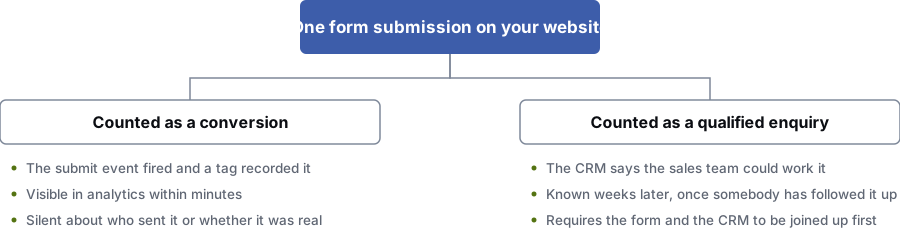
Counted as a conversion
- The submit event fired and a tag recorded it
- Shows up in analytics within minutes
- Says nothing about who sent it or if it was spam
Counted as a qualified enquiry
- The CRM shows the sales team could work with it
- Known weeks later, after someone follows it up
- Needs the form and the CRM to be linked first
How we work
Our conversion rate optimisation process
Make the funnel visible
We check what is tracked and what is not. Where we can, we link form submissions to results in your CRM. Then we find which pages get enough traffic to be worth working on.
You get: Checked tracking and a conversion baseline for each page
Watch people use the site
We run user tests with people who match your customers, and review session recordings on the pages that matter. A handful of sessions is usually enough to show the biggest problems.
You get: Session recordings and a log of the problems we saw
Fix what is clearly broken
Broken steps, mobile problems, form fields you do not need, and pages that never say who you serve or what happens next. We ship the changes and measure them against the baseline.
You get: Shipped changes with before-and-after results
Test only where a test can give an answer
For uncertain decisions on busy pages, we run a test big enough to give a result. We set the measure and the length before it starts, and we report the result, even when there is no clear winner.
You get: A test plan, the result and a plain summary of what it means
Review lead quality every month
Each month we look at qualified enquiries as well as form fills. If the count rose and quality fell, we treat that as a problem.
You get: A monthly conversion review linked to your CRM
Questions
What people ask before starting conversion work
How much traffic do we need before A/B testing is worth doing?
As a rough rule, a page needs several hundred conversions a month before a split test can detect the size of change most edits make in a useful time. Below that, tests run for months and usually end with no clear answer.
The exact number depends on your conversion rate and the size of change you want to detect; small improvements need far more data. We work it out for your pages before suggesting any testing. Often testing is not worth the money yet.
If we cannot test, how do you know a change is an improvement?
We stick to changes where the evidence is clear. If four out of six people in a user test cannot find your pricing, adding a clear link to pricing does not need a test.
When a change is uncertain, we say so, and either leave it or make it as a labelled judgement call. Calling an untested change a proven win is how CRO programmes lose trust.
What gets fixed most often?
Forms, mobile layouts and the first screen. Forms ask for more than the enquiry needs. Errors fail without telling the visitor. Phone numbers cannot be tapped. On a phone, the important content sits three scrolls down.
After that, it is usually clarity. Many pages never say who the business serves or what happens after you send the form. Those are copy problems, and cheap to fix.
Should we optimise for conversion rate or lead quality?
Lead quality, almost always, measured as far down the sales process as your data allows. Removing qualifying questions can double form fills and leave sales with the same good leads and twice the admin.
That means linking form submissions to what happened next in your CRM. If that link does not exist, building it is the first job; without it, every later decision is a guess.
Do you implement the changes or just recommend them?
We implement them. A list of recommendations that sits in a backlog for eight months changes nothing, and finding the problems is the easy half.
If your developers prefer to make the changes, we write the specifications, review their work and check the tracking afterwards.
Find out where your visitors give up
Send us the pages that get most of your traffic. We will tell you whether you have enough visitors for testing and what we would look at first. If the problem is the traffic itself, we will say so.
Prefer to talk it over? Book a free call
References
Sources for conversion rate optimization services
The official documents and research this page is based on. Platform rules change, so check the source before you act on a detail.
Related
More on conversion optimisation
- reading the quotes you get backWhy ten quotes for the same brief can differ tenfold.
- campaign landing pagesWhere A/B testing is most often worth doing.
- analytics and event trackingYou need to see your funnel before any of this works.
- a website that is not generating leadsThe same problem, described by the result you want.
- better-qualified enquiries
- why a website is not convertingFind the cause before you pay for a programme.
Where conversion optimisation matters most
Problems conversion optimisation can fix
More web design & development services
Last updated · Published by Zubair Afzal, responsible editor