
Improve conversion rate
Why your website is not converting: check the traffic before the page
A website that is not converting often has a traffic or tracking problem, not a page problem. Find which of five causes you have before you change anything.
Where enquiries leak
ExampleThe quote form fails on some phones. Fix this before buying more traffic.
Before you change anything
Your conversion rate is probably several numbers averaged together
A conversion rate is a fraction. The top is whatever you decided counts as a conversion; the bottom is whatever visits your tool included. Neither is usually chosen on purpose, which is how a site-wide percentage ends up meaning almost nothing.
One figure mixes people searching your brand name, who already planned to buy, with a broad display campaign. Blog readers sit next to people on your pricing page, mobile visits on a poor connection next to desktop visits from an office. The average moves whenever the mix moves, even if the page is fine.
So don’t start by trying to raise the rate. Split it by traffic source, device, page type, and whether the conversion is an enquiry or something softer like a newsletter sign-up. Often one segment turns out to be dragging everything down.
"Is one per cent bad?" has no answer. Ask instead: "Why does this group convert at a third of the rate of that one, on the same page?"
Find the cause
Five reasons a website doesn’t convert, and the signs of each
Once you’ve split the rate, the cause is usually one of these five, listed roughly in the order worth checking.
- The traffic was never going to convert.
- The page is fine and the audience is wrong. The sign is a low rate from one source and a normal rate from the others, or lots of visits with little scrolling and quick exits. Broad match, display placements, a how-to article or a social post that spread too far all bring people with no plan to buy. Changing the page can’t fix that.
- The page doesn’t follow through on the promise that brought people in.
- This is message match. The ad or search result offered something specific, and the page opens with a general line about the company. The sign is lots of people leaving within seconds, on a page that does fine for other sources. It’s the cheapest problem here to fix, and the most often broken.
- Something is making it hard work.
- This is friction: eleven form fields when three would do, a required phone number, an account before checkout, a page that takes six seconds to become usable on an ordinary phone. The sign is people reaching the point of action and stopping: forms started but not sent, carts not checked out. You can measure it directly.
- They believe you can do it but don’t yet trust you with it.
- This is a trust gap. The sign is a long, engaged visit that ends with no action, often with a detour to your About page. What’s missing is usually specific: no price guide, no named people, no examples of similar work, no answer to the obvious worry, no visible terms. Nicer design can’t replace these, and more sales copy tends to widen the gap.
- The path is broken.
- The form fails silently on one browser. The confirmation never sends. The phone number isn’t tappable on mobile. Payment fails for one card type. The cookie banner covers the button. This is rarer than the other four, but check it first: the fix is free and everyone affected is lost.
Match the fix to the cause
Which fixes work for each conversion problem
The most expensive mistake in conversion work is the right fix for the wrong cause. You get a big invoice and a flat line.
| Dimension | Responds well to | Wasted on it | Where to look for evidence |
|---|---|---|---|
| Wrong traffic | Changes to targeting, keywords and placements, before people reach the page | Any change to the page itself, including a full redesign | Rate by source and campaign, how fast people leave, how far they scroll |
| Broken promise | Rewriting the top of the page to repeat what the ad promised | New photos, animation, layout experiments | Rate by landing page and ad group, exits in the first few seconds |
| Friction | Fewer fields, fewer steps, faster loading, clearer error messages | More persuasive copy above a form nobody can finish | Forms started against forms sent, which field people quit on, phone versus desktop |
| Missing trust | Price guidance, named people, examples of similar work, clear terms | Louder buttons and more "limited time" pressure | Long, engaged visits that end with nothing, trips to the About page |
| Broken path | Testing every step on real devices and fixing what fails | Anything at all until the break is found | Error logs, testing in different browsers, filling in the form yourself |
Where the promise gets lost
How the ad’s promise gets lost between two teams
Matching the page to the ad is the cheapest big fix in conversion work. It’s also the most often broken, because the person who writes the ad and the person who owns the page often report to different managers.
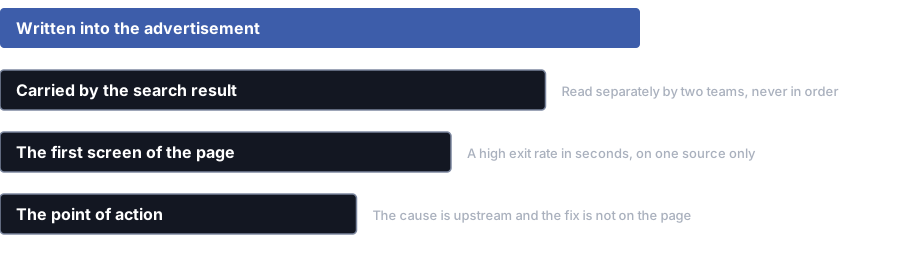
- 1Written into the ad — A specific offer, aimed at a chosen audience. The campaign team owns it and is judged on clicks, not on what happens next.
- 2Carried by the search result — The title a stranger reads on the way in. Read it straight after the ad, the way a stranger would.Two teams read these separately, never in order
- 3The first screen of the page — Where the promise is repeated, or swapped for a general line about the company. Whoever owns the website owns this.Lots of quick exits, from one source only
- 4The point of action — The form or the next step. A visitor whose promise nobody followed through never gets here, and the page takes the blame.The cause is earlier, so the fix isn’t on the page
The order to work in
Do the cheap, certain fixes first
Go through the enquiry steps yourself, on a phone
Use a real phone, mobile data, a browser you don’t normally use and an email address nobody knows, and go all the way to the confirmation. It takes fifteen minutes and finds a broken path often enough to do first.
You get: A finished enquiry, or the exact point it breaks
Split the rate until it stops being an average
Split by source, device, page type and type of conversion, until each group is one kind of person doing one kind of thing. If one group drags the average down, you may have your answer without touching the page.
You get: A rate for each group, instead of one number
Read the promise that brought people in
Put the ad, the search result title and the top of the landing page side by side and read them in that order, as a stranger would. If the page doesn’t clearly carry on from the first two, fix that message match this week.
You get: A check of the ad-to-page promise for your main entry points
Measure where people stop
Track form starts separately from form sends, and each step separately from completions. Forty per cent starting the form and eight per cent finishing is a different problem from nobody starting. The two need opposite fixes.
You get: Step-by-step tracking on the conversion path
Decide what you can fairly test
Work out how many conversions per version you can collect in a sensible time. If it’s a small number, don’t run tests: make reasoned changes one at a time and judge them over quarters. Choose the approach before you start, not after you see results.
You get: A written plan for testing or changes, with its limits noted
How we judge results
How we read a conversion result, and what we won’t call a win
Conversion work is easy to fake. The number moves on its own, and there’s always a change to point at.
What we stick to
- Deciding when to stop and how to judge success before a change goes live
- Reporting results by group, including the groups where things got worse
- Telling you when you don’t have enough traffic to test, and suggesting another way
- Measuring the result that makes you money, not the click before it
- Keeping a dated record of every change, so the trend can be read later
What we will not do
- Quote an industry benchmark as if it were a target for your site
- Call a winner after a few days because the line looked good
- Suggest a redesign as the first answer to a low conversion rate
- Promise a percentage lift before anyone has looked at the traffic
- Report a better rate that came from cutting traffic, without saying so
Questions
Questions about a website that is not converting
What is a good conversion rate?
Nobody can give you a useful number, so treat any figure you’re quoted as marketing, not evidence. A rate depends on what counts as a conversion, which visits are included, what people came to buy, how big the decision is and how your tracking works.
The useful comparison is with yourself: the same page, traffic source and conversion definition, this month against last. Our guide to what a good conversion rate is shows how to set that baseline.
How is this different from a website that generates no leads?
This page is for a site that converts some visitors and should convert more. The question is which of five causes holds the rate down, and the answer usually starts with traffic and tracking, not the page.
If people visit and almost nothing comes through, the cause is usually hidden: a form that doesn’t deliver, tracking that stopped, or an inbox nobody checks. That’s covered on our page about a website not generating leads.
Our rate dropped and nothing on the site changed. What happened?
Look at where your traffic comes from before you look at the page. A new campaign, a broad-match expansion, an article that started attracting a different crowd, or a shift towards mobile will all move the rate without any change to the page.
Then check the tracking. A tag that fires twice, a change to your cookie banner, or a redirect that drops the conversion event can all cause a neat-looking drop that has nothing to do with how people behave.
We do not have much traffic. Can we still test?
Not in the usual way. To spot a small improvement reliably, each version needs more conversions than most sites get in a sensible time. Test anyway and you get a confident-looking result that’s just noise.
Instead, make fewer, bigger changes you can explain, and judge them over a longer period. Lean on session recordings, support questions and sales calls. It’s slower and far more reliable.
Do we need a redesign to improve conversion?
Almost never as a first step. A full rebuild changes hundreds of things at once, so if the rate moves afterwards, nobody can say why.
Redesign when your current site can’t say what you need it to, or can’t be edited without a developer. Otherwise, fix the cause you’ve found and leave everything else alone.
How long should we leave a test running?
Run it for whole weeks, because people behave differently on a Tuesday and a Saturday, and until you reach the number of conversions you chose before you started. Deciding when to stop in advance is what matters.
Stopping when the result looks good is how most in-house testing ends up with a folder of "winners" that never showed up in revenue.
Where to get help
Services that solve this
Conversion Rate Optimisation
Conversion rate optimisation that gets you more enquiries from the traffic you already have. We fix what stops visitors, and A/B test only when your traffic supports it.Website Design, Development & Conversion
Our web design agency builds fast, accessible websites you own, planned for Google and for enquiries before design starts.Marketing Analytics & Attribution
Marketing analytics and attribution you can trust, with a written account of where the data is blind and tests for what attribution can’t answer.
Send us your conversion rate and the traffic behind it
Give us access to your analytics and the three pages that matter most to sales. We’ll split the rate, test the enquiry steps on a real phone, and tell you which of the five causes you have before anyone suggests a change.
Prefer to talk it over? Book a free call
Your BOOSTD score improves within 90 days, or your next month is free. After 6 months, more traffic or leads, or we keep working free (up to 6 free months in any 12 months). Read our guarantee
References
Sources for why is my website not converting
The official documents and research this page is based on. Platform rules change, so check the source before you act on a detail.
Related
More ways to fix this
- conversion rate optimisation run as a managed programmeWhere what you find on this page becomes a plan of tests and changes. That page covers the service. This one helps you find the cause.
- why benchmarks mislead, and how to build your own baselineThe long answer to the first question below.
- page speed measured on real devicesIf nobody waits for the page to load, its conversion rate hardly matters.
- checking the conversion event is counted correctlyIf the rate dropped and nothing changed on the page, tracking is often the cause.
- traffic arriving but no enquiries at allA different problem: the site brings in nothing, not a low rate.
- the wider question of where customers are lost
Last updated · Published by Zubair Afzal, responsible editor