
Conversion Tracking & Tag Management
Conversion tracking setup that catches what’s wrong with your numbers
We check and rebuild conversion tracking so each conversion fires once, respects consent and survives a checkout on another domain. Get it wrong and every report built on it is wrong.

In every planIncluded in Local or Growth, from $149 a month. Every plan has every feature; they differ by size.
Compare plansThe test
Four questions any conversion number has to survive
If a figure can’t answer all four, it isn’t measuring what its reader thinks it is.
What did you decide to count?
A conversion is a choice, not an observation. Every form submission, or only real enquiries? A purchase at order or once payment settles? Write the choice down, or the argument about whose number is right never ends.
Does it fire exactly once?
The most common fault. A thank-you page tag fires again on a refresh. Two people who never spoke add the same event in the container and in the page code. The count inflates smoothly and nothing looks broken.
What happens when consent is declined?
A banner that doesn’t govern the tags lets measurement carry on regardless, which is a compliance problem. One that blocks everything makes conversions vanish for a share of visitors with no explanation.
Does it survive the journey crossing a domain?
Checkouts and booking engines often sit on another domain. Without cross-domain measurement, the visitor arrives as a new person, the session splits, and your own website shows up as a leading referrer.
Reconciling
Three counts of the same period, and what the gaps mean
Analytics, each advertising platform and your CRM will never match exactly, because they count different things over different windows. The size and direction of the gap is most of the diagnosis.
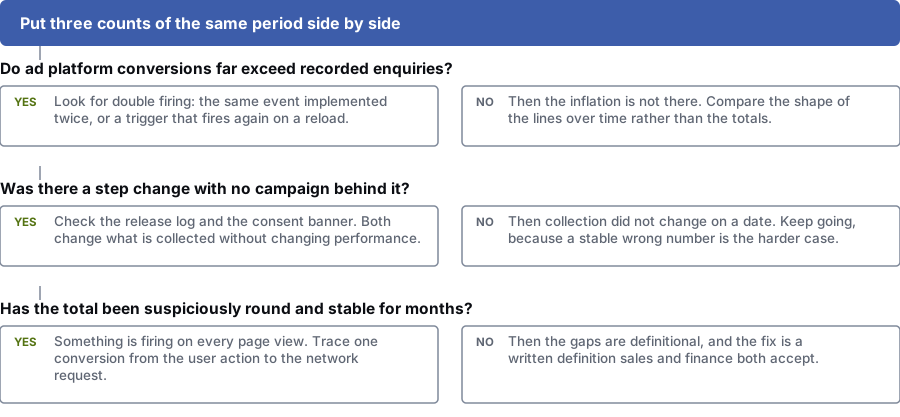
Do ad platform conversions far exceed recorded enquiries?
Yes: Look for double firing: the same event built twice, or a trigger that fires on a reload.
No: Then the inflation isn’t there. Compare the shape of the lines over time instead.
Was there a step change with no campaign behind it?
Yes: Check the release log and the consent banner. Both change what’s collected, not performance.
No: Then collection didn’t change on a date. A stable wrong number is the harder case.
Has the total been suspiciously round and stable for months?
Yes: Something is firing on every page view. Trace one conversion from the click to the network request.
No: Then the gaps are definitional. The fix is a written definition sales and finance both accept.
How it breaks
The failures that don’t look like failures
Each can run for months before anybody looks. None produces an error or an empty report.
- The conversion count includes page refreshes.
- The tag fires on arrival at a confirmation page. A visitor refreshes, or returns from their history, and each visit records another conversion. The inflation is smooth enough that nothing looks anomalous.
- The same event is implemented twice.
- An agency added the conversion in the tag container; a developer later added it in the page code. Neither knows about the other, and the number roughly doubles from a date nobody has connected to it.
- Conversions dropped when the consent banner launched.
- A consent platform went live and correctly blocked tags until consent was granted. Reported conversions fell, the drop was blamed on seasonality, and budgets were set against a number that had changed meaning, not performance.
- Your own domain is one of your biggest referral sources.
- Nearly always missing cross-domain configuration. A visitor moves to a booking or checkout system on another domain and is recorded as a fresh arrival referred by you. Paid and organic look worse, direct looks unaccountably strong.
- A release quietly removed the trigger.
- The confirmation page URL changed, or a button class was renamed, and tracking that relied on it stops firing without an error. The gap surfaces weeks later, when the missing period can only be annotated, not recovered.
Where collection happens
Collecting in the browser, or on a server you control
| Dimension | Client-side collection | Server-side collection |
|---|---|---|
| Where the request is built | In the visitor’s browser, by JavaScript running on your page | On a server endpoint you control, which forwards to each destination |
| What you gain | Fast to deploy, compatible with almost every tag out of the box | Control over what each platform receives, fewer third-party scripts, longer-lived identifiers |
| What it does not change | A declined consent choice still limits what may be collected | A declined consent choice still applies, and a wrongly defined event is still wrong |
| Effect on the page | Every added tag is more script for the browser to load | Less work in the browser, in exchange for infrastructure to run and monitor |
| What it costs | Implementation time, and maintenance when the site changes | Implementation time, plus hosting and upkeep every month |
| When we recommend it | Most sites, most of the time, done properly | When signal quality, page weight or data control justify the cost |
What we check
The audit, item by item
Most engagements start here. It’s cheap, fast, and usually explains a discrepancy somebody has argued about for a year.
- Every tag, trigger and variable in the container listed, with what it does
- Each conversion traced from click to network request, observed rather than assumed
- Duplicate detection: the same event in the container and in page code, or in two containers
- Refresh and repeat-view behaviour tested on every confirmation page
- The consent platform checked against the tags it’s meant to govern, granted and denied
- Consent mode verified, with modelled conversions identified separately from observed ones
- Cross-domain configuration checked wherever a journey leaves the main domain
- Campaign tagging reviewed, since inconsistent UTMs corrupt attribution
- Ad platform conversion actions checked against analytics and CRM for the same period
- Data retention and thresholding settings reviewed, so no report surprises anyone later
- A written definition of each conversion that sales and finance both accept
Consent
What happens to the data when somebody declines
A consent banner isn’t a measurement setting by itself. It records a choice. Whether that choice governs anything depends on whether the tags are wired to respect it, and a surprising number aren’t.
When they aren’t, you have a compliance exposure, and your numbers include people who asked not to be measured.
The blunt alternative is to block every tag until consent is granted. That’s defensible, with a visible cost: for every visitor who declines, you see nothing. No source, no journey, no conversion.
Consent mode sits between the two. It changes how tags behave instead of removing them. Where permission is denied, Google tags don’t read or write the identifiers they normally would, and send a limited signal instead. Google then models a portion of the missing conversions, so reporting reflects some of the activity consent removed from view.
Two things matter more than the setup. Modelled conversions are estimates, not counts, so label them wherever they appear. And modelling isn’t recovery: it doesn’t restore individual people, and shouldn’t be presented as though the consent choice had no effect.
Automated bidding optimises towards the conversion signal you send it. If that signal is missing buyers or double-counting them, the platform optimises towards a distorted picture of your customers, expensively, for as long as you leave it.
How we work
Changing the measurement without losing the history
Document before changing anything
Every tag, every trigger, what each one sends. Nothing gets deleted for looking unused, because the one nobody recognises sometimes feeds a report somebody senior relies on.
You get: A documented map of the current setup with faults marked
Agree the definitions with the people who argue about them
What counts as a conversion, which are primary or secondary, and how each maps to what sales and finance call a lead or an order. Signed off before implementation.
You get: A written conversion definition, agreed across teams
Rebuild on a data layer, not the page
Events pushed deliberately by the site, with the parameters that matter, instead of tags guessing from URLs and button text. A routine front-end change can no longer silently disable measurement.
You get: A data layer specification, implemented and tested
Run new alongside old, then compare
Where the platforms allow, the new setup runs in parallel with the old one on the same traffic, so switching over is an evidenced decision.
You get: A parallel-run comparison and a migration decision
Annotate, monitor and hand over
The change date recorded in reporting, alerts for conversions that stop arriving, and documentation for whoever comes next.
You get: Monitoring, annotations and handover documentation
Questions
What teams ask when the numbers stop agreeing
How would we know if our conversion tracking is wrong?
Compare three numbers for the same period: what analytics reports, what each ad platform reports, and what your CRM or order system recorded. They’ll never match exactly, but the size and direction of the gaps tell you a lot.
Ad platform conversions far above recorded enquiries usually means double-firing. A sudden step change with no campaign behind it usually means a site release. A total that’s suspiciously round and stable for months usually means something fires on every page view.
What does consent mode do?
It lets your tags respond to the choice a visitor made in your consent banner. When consent is granted, tags behave normally. When it’s denied, Google tags don’t read or write the identifiers they otherwise would, and send a limited signal instead.
Google then models some of the missing conversions. That’s legitimate, but it’s an estimate, not a count, so a report that mixes the two without labels will rightly get challenged by finance.
Consent mode isn’t a way to keep collecting from people who said no. A vendor describing it that way is describing a compliance problem.
Do we need server-side tagging?
Sometimes, and less often than it’s recommended. It gives control over exactly what data leaves for each platform, resilience against browser limits on cookies, and fewer third-party scripts in your visitors’ browsers.
It doesn’t recover consent-declined data, doesn’t fix a badly defined event, and costs money every month. We recommend it only when signal quality, page weight or data control justify the cost.
Why do our numbers drop when a visitor moves to our booking system?
Usually because the booking system sits on another domain, and without cross-domain measurement the arrival counts as a new visit. The original source is lost, one session becomes two, and the conversion is credited to a referral from your own website.
The fix is configuration, not a rebuild: declare the domains to each other and pass the identifier across. The tell-tale sign is your own domain showing up as one of your biggest referral sources.
Can you fix this without breaking what currently works?
That’s the main constraint on how we work. Nothing gets deleted for looking unused. We document each tag, run the replacement alongside the existing setup where the platform allows, and compare the two before switching anything off.
Where a change is unavoidable, we make it on a set date and annotate the reporting, so nobody later mistakes an implementation change for a change in performance.
Our developer set this up. Why would we need anyone else?
Often you don’t, and where a developer has built a data layer properly, we’d rather build on it than replace it.
The usual gap is definition, not technical skill. A developer builds what was asked for. Whether a form submission and a quote request count as the same conversion, and how either matches what sales calls a lead, is a commercial decision rarely made before the tags are written.
Find out whether your conversions have been wrong all year
Send us access and we’ll trace your main conversions from click to network request, compare the totals with your own records, and tell you what’s double-counted, missing or firing on the wrong thing.
Prefer to talk it over? Book a free call
Your BOOSTD score improves within 90 days, or your next month is free. After 6 months, more traffic or leads, or we keep working free (up to 6 free months in any 12 months). Read our guarantee
References
Sources for conversion tracking setup
The official documents and research this page is based on. Platform rules change, so check the source before you act on a detail.
Related
More on conversion tracking
- how to measure marketing ROIHow this work gets judged, and the baseline it needs first.
- reading the numbers once they are collectedThat page is about interpretation. This one is about collection.
- our campaign tagging toolInconsistent UTMs break attribution before any tag is involved.
- improving the rate itself
- how the site is built underneath
Where conversion tracking matters most
Problems conversion tracking can fix
More leads & reviews services
Last updated · Published by Zubair Afzal, responsible editor