
Serving Arizona remotely
SEO and digital marketing in Arizona, where summer runs the calendar
Arizona is one of the few states where the weather does not just affect demand, it reverses it. SEO and digital marketing in Arizona has to follow categories that peak when everywhere else goes quiet, or a national seasonal template spends the budget in the wrong half of the year.
Prefer to talk it through? Book a strategy call
The market
What makes Arizona different
Arizona has been gaining residents from other states for years, and the arrivals bring no local habits with them. For consumer categories that is a structural advantage: a large share of the market is choosing a supplier for the first time rather than replacing one they already trust.
Summer heat is severe enough to reorganise the economy around it. Cooling, electrical, plumbing and pool services run their year in reverse of the national pattern, tourism empties out of the desert cities and moves north, and outdoor construction shifts its hours rather than its volume.
A large retired and semi-retired population changes both what is bought and how it is bought. Decisions are frequently made with an adult child on the call, price sensitivity coexists with a strong preference for reassurance, and telephone contact remains dominant in categories that have gone digital elsewhere.
Semiconductor investment around the Phoenix metro has attached a heavy industrial supply chain to a state better known for retirement and tourism, bringing construction, specialist engineering and technical staffing demand that did not exist here at this scale before.
A calendar in reverse
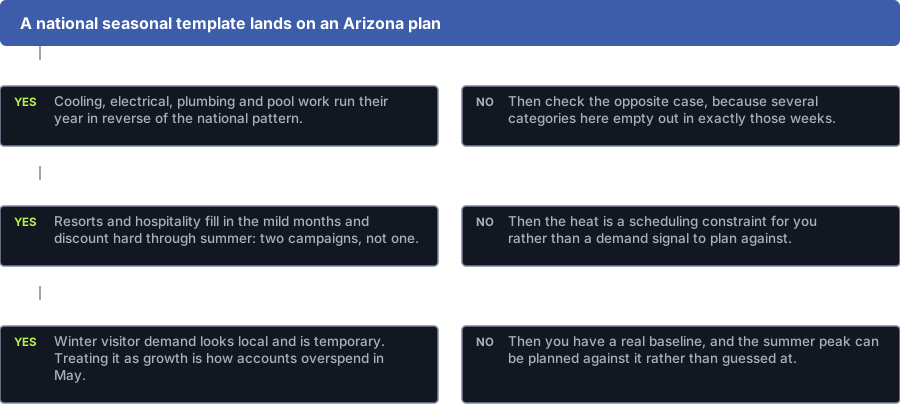
A national seasonal plan spends the Arizona year backwards
Here the heat organises the economy. Some categories run their year when the rest of the country goes quiet, others empty out in the same weeks, and winter visitors inflate volume that then leaves.
Does the category sell relief from the heat?
Yes: Cooling, electrical, plumbing and pool work run their year in reverse of the national pattern.
No: Then check the opposite case, because several categories here empty out in exactly those weeks.
Does it sell somewhere pleasant to be?
Yes: Resorts and hospitality fill in the mild months and discount hard through summer: two campaigns, not one.
No: Then the heat is a scheduling constraint for you rather than a demand signal to plan against.
Is the volume you are budgeting seasonal visitors?
Yes: Winter visitor demand looks local and is temporary. Treating it as growth is how accounts overspend in May.
No: Then you have a real baseline, and the summer peak can be planned against it rather than guessed at.
Who is here
Who does business in Arizona
Cooling and mechanical trades are the defining local category. Their commercial year is compressed into a few brutal months, which makes scheduling, pricing and maintenance-plan retention more important to the profit line than lead volume ever is.
Senior living, home care and allied health providers serve an older population across a wide geography, selling to families as much as to patients, which puts clarity, reassurance and accessible design ahead of persuasion.
Veterinary practices, pest control, pool care and landscaping form a dense recurring-revenue layer where the customer is bought once and kept for years, so retention economics should drive what an acquisition campaign is allowed to cost.
Hospitality and resort businesses run an inverted season of their own, filling in the mild months and discounting hard through the summer, which means two entirely different campaigns rather than one campaign at two budgets.
Search behaviour
How search works in Arizona
Search is not uniform across markets. Engine share, language, device mix and local platforms all shift what a strategy in Arizona should prioritise.
- Emergency intent spikes with the temperature rather than with the calendar. A run of extreme days produces cooling failures within hours, and the searches that follow are urgent, mobile and almost entirely indifferent to brand.
- Because so many residents are recent arrivals, category searches without a brand name attached carry more weight here than in settled markets. The map pack and the first few organic results do the work that word of mouth does elsewhere.
- Spanish-language search is significant across the state and heaviest in Tucson, Yuma and parts of the Phoenix metro, and in trades categories it is routinely served by nobody who has written a proper page in it.
- Winter visitors search with intent that looks local but is temporary, which inflates volume for months in specific categories and then disappears. Treating that as growth and budgeting against it is a reliable way to overspend in May.
Strong fit
Industries with the clearest opportunity in Arizona
Sectors worth a look in Arizona
- Air Conditioning marketingBuild the installation calendar in the spring shoulder, and stop paying peak prices in July for demand you have no technicians left to serve.
- Senior & Home Care marketingReach the adult child doing the research, earn the enquiry and the visit without trading on guilt, and turn tours into move-ins and care hours that hold.
- Veterinary Clinics marketingGrow the preventative side that can be planned, be findable during the ten minutes an emergency lasts, and answer the cost question openly enough to survive a market where owners now compare prices.
- Home Renovation & Remodelling marketingBe the company a homeowner has quietly followed for four months, so the quote conversation starts from trust and portfolio rather than from price.
Where to start
Services that fit businesses in Arizona
Google Ads
Search is demand capture. The person is already looking, so the work is making sure you pay for the ones who intend to buy, land them on a page that matches what they asked, and measure which of them turned into revenue.
Landing page design
A landing page exists for one campaign and one action. Its first job is message match — saying back to the visitor what the ad said to them. Everything else on the page either supports that or is costing you money.
Conversion tracking
This is the collection layer: what fires, when, how many times, and whether it survives a consent banner, a checkout on somebody else’s domain and a browser that stopped honouring the cookie. When it is wrong, every report built on top of it is wrong too, quietly, for months at a time.
SMS marketing
Text messages get read, which is precisely why the channel is so easy to ruin. Most of this page is about consent, opt-outs, quiet hours and restraint, because those are the decisions that determine whether SMS is still working for you in the second year rather than the first month.
Constraints
Marketing rules in Arizona
- The Arizona Consumer Fraud Act governs deceptive practices in connection with the sale or advertisement of goods and services, and is enforced by the Attorney General. Claims about price, savings, warranties and availability need substantiation that exists before the advert runs.
- Contractors are licensed through the Arizona Registrar of Contractors, and licensing bodies here take a view on how a licence is represented in advertising. Confirm with the Registrar and with your own advisor what your trade must display, and we will build the pages and ads around that answer.
- Federal rules carry most of the rest: substantiation and endorsement standards from the FTC, CAN-SPAM for email, and the TCPA for calls and texts, which matters here because so many trades run outbound reminder programmes for maintenance contracts. None of this is legal advice, and consent language is a question for your counsel.
Primary sources
Where to read the rules for Arizona
The statutes and regulators behind the rules above. They are the authority, not this page, and none of this is legal advice.
- Consumer protection enforcement under the Arizona Consumer Fraud Act
Arizona CFA
Consumer protection enforcement under the Arizona Consumer Fraud Act
Source: Arizona Attorney General
- The federal rules for commercial email: identification, honest subject lines and opt-out
CAN-SPAM
The federal rules for commercial email: identification, honest subject lines and opt-out
Source: Federal Trade Commission
- FCC rules under the TCPA for marketing calls and text messages
47 CFR 64.1200
FCC rules under the TCPA for marketing calls and text messages
How we work here
We serve Arizona remotely, and we say so
We deliver Arizona work from well outside Arizona. There is no suite in Scottsdale or Tempe, nobody on this team has ever endured a July here on your behalf, and no in-state number appears anywhere on our invoices.
For seasonal categories we plan the year as two or three distinct campaigns with their own budgets and their own targets, rather than dividing an annual figure by twelve and funding the quiet months at the expense of the loud ones.
When a client is already at capacity we will say that more traffic is the wrong purchase, and we would rather spend the retainer on retention, pricing pages and maintenance-plan conversion than on ads that generate calls nobody can take.
Questions
Working with us from Arizona
Our season is three months long. How should we budget?
Not evenly. Build the year as separate campaigns with separate budgets — a pre-season phase that captures maintenance and replacement decisions, a peak phase priced for urgency, and a shoulder phase that costs very little and keeps the site healthy.
An annual figure divided by twelve funds impressions in the months when nobody is buying and runs short in the weeks when everybody is.
We are already fully booked in summer. Why market at all?
Because the purchase that matters in peak season is usually not the emergency call. It is the maintenance agreement, the replacement quote and the customer who comes back next year, and those are won by being visible while the urgency is real.
If capacity is the constraint, the better advice is to raise price and tighten the service radius before spending more on acquisition. We would rather say that than sell you traffic you cannot serve.
How do we reach people who have just moved to the state?
By competing for the plain category search rather than for a brand term. Recent arrivals have no supplier in mind, so they type what they need and choose from the map pack and the top few results.
That makes profile completeness, review volume, response speed and a clearly stated service area worth more than advertising aimed at people who already know your name.
Do winter visitors distort our reporting?
In tourism, hospitality and several health categories, badly. Volume climbs for months as the seasonal population arrives and falls away when they leave, which makes any month-on-month comparison misleading.
We set a seasonal baseline and compare like periods year on year, so a quiet June is not read as a failure and a busy February is not read as growth.
Do you operate from Arizona?
No, and nothing on this page should be read as suggesting we do. No office, no resident staff, no Arizona telephone number.
We work on Mountain time where that suits you, deliver into accounts you own, and arrange anything requiring physical attendance through a local supplier at a separately quoted cost.
Talk to us about growing in Arizona
Start with the free Growth Scan: an indicative read of your website and the few things to fix first, with no sign-up. BOOSTD is in early access, so the market question — who is winning the searches that matter in Arizona, and whether the opportunity justifies the investment — is worked through with our team on a strategy call. If it does not, we will say so.
Prefer to talk it through? Book a strategy call
If we don't deliver the work we agreed to deliver for reasons within our control, you don't pay for the undelivered work. Read our guarantee
References
Sources
The primary documents and published research this page relies on. Platform rules change, so check the source before acting on a detail.
More to explore
Elsewhere in United States
Last updated · Published by Zubair Afzal (responsible editor), on owner authorisation