
Senior & Home Care marketing
Senior care marketing for the person searching: the daughter, not the resident
Almost nobody researching a care home or a home care package is the person who will receive the care. It is an adult child, often three hundred miles away, often at midnight, often three days after a fall. Everything about the marketing follows from that one fact.
Prefer to talk it through? Book a strategy call
Search behaviour
Senior care searches, grouped by intent
Urgent, after a fall or a discharge
Written at speed, often at night, usually by somebody who has never had to do this before.
- care home near me availability now
- emergency respite care after hospital discharge
- how quickly can someone move into a care home
- home care starting this week near me
- mum cannot live alone anymore what do i do
Cost and funding
The question families ask first and providers answer last, and the reason most enquiries stall.
- how much does a care home cost per week
- who pays for care home fees
- cost of live in care per week
- does insurance cover home care
- care home fees when selling a house
Comparing and checking
Verification behaviour: the family has a shortlist and is now looking for reasons to remove names from it.
- best care home for dementia near me
- care home inspection report [town]
- care home reviews [town]
- is assisted living better than home care
- questions to ask when visiting a care home
Understanding the options
The earliest stage, months before any enquiry, and where a provider becomes the trusted source.
- difference between assisted living and nursing home
- signs a parent needs care at home
- what is respite care
- how to talk to a parent about moving into care
- what does a home care visit include
These are examples of how customers in this market search, drawn from keyword research and public search data. They are illustrative, not a volume claim: we size the demand in your area before recommending anything.
What usually goes wrong
Where senior care marketing tends to fail
Senior care is the only category in healthcare where the person searching is almost never the person receiving the service. It is an adult child, usually in their fifties, frequently in another city, and frequently doing it at night after a telephone call about a fall.
That one fact rewrites the brief. It changes the audience, the reading level, the device, the hour of the day, the emotional register and the entire content requirement. Material written for the resident will be read by nobody who makes the decision.
- The site speaks to the resident and the decision is made by their children.
- Copy addressed to your golden years is being read by somebody researching on behalf of a parent who does not want to move, has not agreed to any of this, and may not know the search is happening. That reader needs something different in kind: how the decision is normally made, how to raise it with a parent, what the funding routes are, what the notice periods are, and what happens if it does not work out. Providers that write for the family get enquiries from families who have already done their thinking.
- The consideration runs for months and the decision takes four days.
- Families research quietly for a long time, saying nothing and enquiring nowhere, and then something happens. A fall, a hospital discharge that will not be delayed, a spouse who cannot cope any longer. At that point the whole decision compresses into a few days, and the provider they contact is the one they have been reading for months. Marketing built only for the urgent window arrives with no trust behind it, and marketing built only for the early window never asks for anything.
- Nobody will say what it costs.
- Cost is the first question every family has and the one providers most consistently refuse to answer, usually because the real figure depends on assessed need. That is an argument for a band and an explanation, not for silence. Weekly fee ranges by care type, what is included, what is charged separately, how funding assessments work locally and what happens when private funds run out are all publishable. Providers that publish them receive fewer enquiries and far more that convert, because families who were never in range have excluded themselves instead of spending a fortnight finding out.
- The marketing trades on guilt.
- Fear-based copy performs in the short term here and is the fastest available route to a damaged reputation and a regulator letter. Families arrive already carrying guilt about a promise they made years ago and can no longer keep. Adding to it is both wrong and commercially self-defeating: it produces enquiries from people who are not ready and cancellations after the visit. What converts is calm, concrete and respectful of the resident as an adult with a view of their own.
- Enquiries are counted and tours are not.
- The decisive event is not the form fill, it is the visit. A family who walks the building, meets the staff and sees a room converts at a completely different rate from one that never came. Providers tracking enquiries alone cannot see where they lose people: the call returned the next day, the tour that could not be offered until the following week, the family who arrived and found nobody expecting them. Enquiry to tour and tour to move-in are the two numbers this business is run on.
Buying behaviour
How senior care customers decide
Strategy follows this, not the other way round. Everything on this page is downstream of how the decision gets made.
- The family shortlists on evidence they can verify independently: inspection and regulator ratings, complaints history, staff turnover, and how long the manager has been in post.
- The visit decides it. Smell, noise, whether residents are engaged or parked in front of a television, and whether staff greet residents by name will overturn everything the website said.
- Distance is measured in visiting frequency rather than in miles. The real question is whether an adult child can get there after work on a Wednesday, and whether a sibling further away can manage a weekend.
- A specific need narrows the list fast. Dementia, nursing rather than residential care, mobility support, a particular language or faith, or the ability to keep a couple together will eliminate most options before anything else is weighed.
- Honesty about cost, and about what happens when circumstances change, earns disproportionate trust, because so few providers offer it and every family has heard a story about fees rising.
- Reviews are read for the things a visit cannot reveal: how the provider communicated during an illness, whether call bells were answered, and how the end of a life was handled.
Who is searching
Months of quiet reading, then one very fast week
The provider contacted during the urgent week is usually the one that became familiar during the quiet months. Almost nobody publishes for the quiet months.
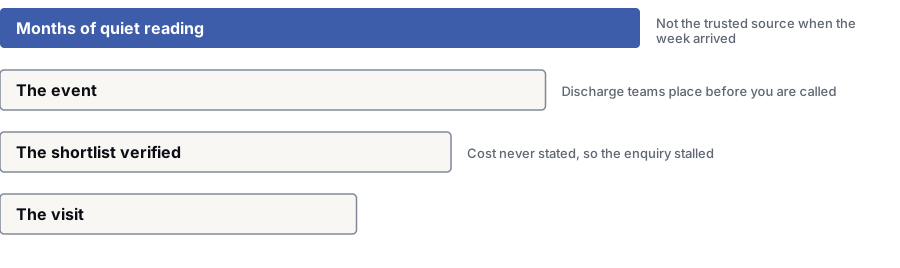
- 1Months of quiet reading — Nothing is enquired and a great deal is read. The provider contacted later is usually the one that became familiar during this stage.Not the trusted source when the week arrived
- 2The event — A fall, a hospital admission, a diagnosis, or a spouse who can no longer cope at home. Months of thinking compress into days.Discharge teams place before you are called
- 3The shortlist verified — Regulator ratings, complaints history, staff turnover, and how long the manager has been in post. Evidence the family can check without you.Cost never stated, so the enquiry stalled
- 4The visit — Smell, noise, whether residents are engaged or parked in front of a television, and whether staff greet people by name. It overturns everything above.
Where the money goes
The senior care marketing channels that earn their place
In priority order for this business, not a menu. Anything not on this list is something we would need a specific reason to recommend.
Be the source they read for three months
The searches families make long before enquiring are about how the decision works, not about your building: what separates assisted living from nursing care, how funding assessments run, how to raise it with a parent who has refused. Answering those calmly and completely is how a provider becomes the name a family already trusts when the urgent week arrives, and almost no operator publishes it.
A site usable at midnight by somebody frightened
The reader is often over fifty, on a phone, tired and upset. That means large type, high contrast, plain language, weekly fee bands in figures, real photographs of the actual building rather than stock imagery, and an enquiry route offering a call back within the hour and a specific visit date. Each of those is a conversion decision, not a design preference.
Reviews and inspection outcomes, handled honestly
Families check regulator ratings, inspection reports and reviews before they ever call, and a poor inspection is not fixed by hiding it. What works is publishing what happened, what changed and what the current position is, alongside a steady flow of recent family feedback gathered properly. Responses must never confirm that a named individual lives in or receives care from the service.
Cover for the week the decision compresses
Urgent placement and immediate availability searches are low volume, high value and impossible to time, which is what paid search exists for. Keep it to real urgency and availability terms, land on a page stating the care types, the fee band and a telephone number a person answers, and be careful with audience targeting because inferred health interest is a sensitive category on most platforms.
Enquiry handling, tours and the numbers that matter
Most of the loss happens between the enquiry and the visit: a call returned the next day, a tour offered for the following week, a family nobody followed up. Measuring response time, enquiry to tour, tour to move-in and occupancy by care type, then repairing the handover between marketing and the people answering the telephone, produces more admissions than additional traffic would.
Measurement
Senior care numbers we report on, and what we ignore
Sessions are not on this list. These are the numbers that tell you whether the marketing is producing customers.
- Enquiries by source, separated into urgent and early-stage research
- Enquiry to tour conversion, and median time from enquiry to first human response
- Tours completed, and tour to move-in conversion by care type
- Occupancy and its trend, which is the number this business is run on
- For home care, weekly hours started and hours still running after ninety days
- Average length of stay, and the reasons recorded for a placement ending
- Referrals received from discharge teams, social workers and case managers
- Acquisition cost per move-in, set against the expected value of a placement
- Elapsed time from enquiry to move-in, split by whether the enquiry was urgent
The website
What a senior care website has to do
- Weekly fee bands by care type, stated in figures, with what is and is not included
- A plain explanation of funding routes and what happens when private funds run out
- Current availability, or a plain statement of the waiting position
- Real, dated photographs of the actual building, rooms and communal spaces
- The registered manager named, with tenure, and the current inspection outcome linked
- Content written for an adult child, including how to raise the subject with a parent
- Large type, high contrast and plain language, tested on a phone late at night
- A tour booking route offering specific dates, and a call-back promise that is kept
- For home care, what a visit includes, minimum visit length, and how carers are matched
Constraints
Senior care advertising rules: what is allowed, and what is not
Care providers are registered and inspected by a national or regional regulator, and in most markets what may be said about a service is tied to what the provider is registered to deliver. Describing nursing care, dementia care or specialist support the registration does not cover is a regulatory matter rather than a copywriting one.
Inspection ratings and reports may be quoted, and in several markets must be displayed, but they have to be current and complete. Presenting a superseded rating, quoting a favourable line from a report that concluded otherwise, or omitting a requirement notice is treated seriously by regulators and by families who will find the original document in a minute.
This audience is legally and ethically a vulnerable one, and marketing to vulnerable people carries additional obligations under most consumer protection regimes. Pressure tactics, artificial scarcity, fear-based messaging about what will happen if a family does not act now, and manufactured urgency are the specific risks. A family in crisis cannot give the same considered attention as an ordinary consumer, and the marketing has to be built on that assumption rather than exploit it.
Testimonials and case examples raise a consent question that does not arise elsewhere. Where a resident lacks capacity, a relative generally cannot consent on their behalf for marketing purposes, and consent given at admission is not consent to appear in an advertisement two years later. Photographs of residents, quotes from families, and any reply to a review must avoid confirming that a named person lives in or receives care from the service.
Fee information, contract terms, notice periods and the treatment of deposits and top-up payments are consumer contract matters with disclosure requirements of their own, entirely separate from the care regulations. Advertising a weekly figure that most residents do not pay is where providers most often get into difficulty.
Where the service involves medicines management, clinical support or anything requiring a registered nurse, outcome claims are restricted as they are for any health provider. All of this differs by regulator and by market and changes regularly. We write to the constraints we understand apply to you and flag what needs review, but the provider must confirm its position with its own regulator. Nothing we produce is legal, medical or care advice.
Primary sources
The senior care rules above, at source
The rules this page refers to, linked to the regulator or rule-maker that publishes them. Which apply depends on where you operate, and they change, so check the current version.
- Registered providers in England must display their most recent CQC rating at their premises and on their websites.
CQC regulation 20A
Registered providers in England must display their most recent CQC rating at their premises and on their websites.
Source: Health and Social Care Act 2008 (Regulated Activities) Regulations 2014 (England), regulation 20A
- Consumer law advice for care home providers on fees, upfront charges, contract terms and information.
CMA care homes advice
Consumer law advice for care home providers on fees, upfront charges, contract terms and information.
Source: Competition and Markets Authority (UK), Care homes consumer protection case
Questions
Senior care marketing questions, answered
Families ask what it costs before anything else. What should we publish?
Bands, and an explanation of what moves them. The real figure depends on an assessment of need, which is a reason for a range rather than for silence, and silence is the most common reason a provider is removed from a shortlist.
Providers publishing weekly bands, what is included, what is charged separately and what happens when private funds run out usually see fewer enquiries and a far higher share reaching a visit. Families who were never in range have excluded themselves rather than occupying a fortnight of your time.
Our marketing is aimed at older people. Is that wrong?
It is aimed at the wrong reader in most cases. The person searching, comparing, calling and visiting is usually an adult child or another relative, and the resident often has not agreed to any of it yet.
That does not mean writing about older people as though they are not there. What works treats the resident as an adult with preferences of their own, and treats the family as the person who needs the practical information: funding, notice periods, how to start the conversation, what happens on the first day.
How should we handle a poor inspection result online?
Address it directly rather than hoping it goes unfound. Families check regulator reports before they call, and a provider that says nothing looks worse than one that explains what happened.
Publish what the finding was, what has changed since, who is accountable and what the current position is. Then make sure the visit and the enquiry handling support that account. Attempting to obscure an inspection outcome is a compliance risk and the fastest way to lose the families who were still considering you.
Can we use a photograph or a quote from a resident?
Only with properly obtained consent, and capacity is the question that decides it. Where a resident cannot give informed consent, a relative agreeing on their behalf is generally not sufficient for marketing use.
Consent also expires in practice even where it does not in law. Something agreed during a good week two years ago should be reconfirmed before it is used again, and any image or quote should be reviewed if the resident circumstances have changed. Confirm your position with your regulator and your own adviser before building campaigns around resident content.
Are our enquiries poor quality, or is something else going wrong?
Look at the gap between enquiry and visit before blaming the enquiries. In most services the loss is in response time and tour availability rather than in who is getting in touch.
A family in the compressed week will contact three or four providers. The one that answers within the hour and offers a visit the next day frequently gets the placement, regardless of which had the better website. That is an operational fix with a marketing return.
Find out what is winnable for your senior care business
Start with the free Growth Scan: an indicative read of your website and the few things to fix first, with no sign-up. BOOSTD is in early access, so the fuller picture for your senior care business — your area, your competitors and the searches that matter — is worked through with our team on a strategy call. If we do not think we can move it, we will tell you.
Prefer to talk it through? Book a strategy call
If we don't deliver the work we agreed to deliver for reasons within our control, you don't pay for the undelivered work. Read our guarantee
References
Sources
The primary documents and published research this page relies on. Platform rules change, so check the source before acting on a detail.
More to explore
Guides that answer the same questions
More in healthcare
Last updated · Published by Zubair Afzal (responsible editor), on owner authorisation · Reviewed quarterly — next review: