
Healthcare, Dental & Clinics
Marketing for practices and clinics, inside the rules that apply
Dental practices, cosmetic dentistry and medical clinics share a catchment, a trust problem and a regulator. They do not share a business model — one is selling a discretionary purchase, another is trying to answer the phone less. These pages are written separately.
Prefer to talk it through? Book a strategy call
The category
Healthcare, Dental & Clinics: what the businesses have in common
Healthcare is the category where the marketing constraints are real and the commercial differences underneath them are largest. Two practices can share a street, a regulator and a patient demographic and still need opposite strategies.
What decides that is mostly who pays. When the patient pays personally and the treatment is optional, the decision is long, comparative and price-aware. When an insurer or a public system pays and the need is not optional, the decision collapses to whoever is open, nearby and accepting people.
The pages below are written separately for that reason. A cosmetic dentistry practice and a walk-in clinic have almost nothing in common except the rules they advertise under.
Who pays, and whether it is optional
Healthcare divides on who pays and whether the patient can decline
Two practices can share a street, a regulator and a catchment and still need opposite strategies. What decides it is whether the patient is spending their own money on something they chose to want.
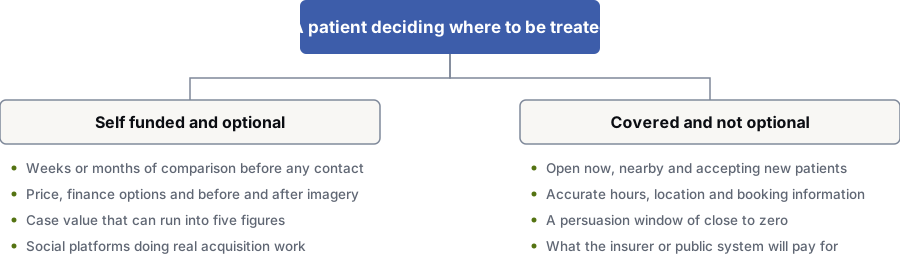
Self funded and optional
- Weeks or months of comparison before any contact
- Price, finance options and before and after imagery
- Case value that can run into five figures
- Social platforms doing real acquisition work
Covered and not optional
- Open now, nearby and accepting new patients
- Accurate hours, location and booking information
- A persuasion window of close to zero
- What the insurer or public system will pay for
Where they split
Where one healthcare strategy stops working
These differences are the reason the pages below are written separately rather than as one page with the business type swapped out.
- Elective and self-pay treatment behaves like a considered retail purchase. The patient deliberates for weeks or months, compares providers, cares about price and finance, and responds to imagery and social platforms in a way no other part of healthcare does.
- Primary and urgent care behaves like a directory lookup. Somebody needs a clinic that is open, nearby and accepting patients, the persuasion window is effectively zero, and the entire job is being findable with accurate information.
- Some practices are competing for patients and others are competing for clinicians. A clinic that cannot recruit a physician has a marketing problem, but the audience is a doctor deciding where to work, not a patient deciding where to go.
- Case value spans three orders of magnitude, from a subsidised consultation to a full-arch reconstruction, which changes what a new patient is worth and therefore what it is rational to spend acquiring one.
Questions
Healthcare marketing questions, answered
Our regulator restricts advertising. Is there anything you can actually do?
Yes, and the constraints are narrower than most practices assume. What is usually restricted is testimonials, outcome claims, superlatives and certain uses of imagery. What is almost never restricted is explaining what a treatment involves, what it costs, how long it takes and who will be doing it.
That second category is where nearly all the winnable search demand sits, and it is where most practice websites say nothing at all. Working inside the rules tends to produce better marketing than ignoring them would, because it forces the content to be useful rather than persuasive.
We are already fully booked. Why would we market at all?
Because being fully booked and being profitable are different things. Most practices at capacity are full of appointments that barely cover the chair time while the treatments and consultations that carry the margin have gaps.
The work in that situation is changing the mix and reducing the leakage — no-shows, short-notice cancellations, patients who never rebook. That is marketing, but it looks nothing like a lead generation campaign, and an agency that responds to a capacity problem by proposing more traffic has not listened.
Can you write our content? None of us has time.
We can draft it, and it still needs a clinician to read it. Anything describing a treatment, a risk, a recovery period or an expected outcome has to be checked by someone qualified and registered in your market before it is published.
We build that step into the process rather than treating it as an obstacle. Practically it means a clinician spends an hour or two a month reviewing drafts, not writing them.
Do you take responsibility if our advertising breaches a rule?
No, and no agency can. The registration is the practice, the obligation sits with the registered professional, and the regulator will hold them to it regardless of who wrote the copy.
What we do is draft to the constraints we know apply, flag anything that needs professional judgement, and keep a record of what was approved and when. Anyone offering to carry the compliance risk for you has misunderstood how registration works.
More to explore
Guides that answer the same questions
Other sectors
Last updated · Published by Zubair Afzal (responsible editor), on owner authorisation · Reviewed quarterly — next review: