
Physiotherapy & Allied Health marketing
Physiotherapy marketing agency that keeps patients coming back
Physiotherapy marketing that gets first appointments attended and helps patients finish their course of treatment, where clinics lose the most money.

How they choose
What customers check before they choose
Know how they choose and you know where to show up.
- Distance and timing come first, because a course of treatment means eight or twelve trips. A clinic near work with a 7am slot usually beats a better clinic across town.
- For many patients, whether you bill their insurer directly is a hard filter, checked before anything else on the site.
- They’re choosing a practitioner as much as a clinic. Profiles with qualifications, focus areas and a real photo do more than any page about the business.
- Many still start with a referral from a doctor, a coach or a colleague who got better, and the search that follows checks that recommendation.
- Booking straight away closes it. Seeing the next free slot and taking it without talking to anyone turns a browser into a first visit.
- They read reviews to see whether patients were listened to, and whether anyone was pushed into a long plan they didn’t need. Fear of being oversold is the particular worry.
Past the first appointment
Why a full course of treatment matters more than the first booking
Almost every clinic markets the first appointment and measures itself on it. What matters for revenue is eight or twelve visits, and different things decide those.
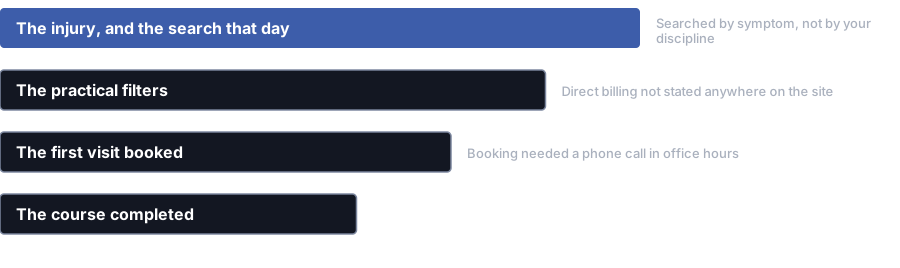
- 1The injury, and a search that day — Triggered by an event, acted on within days, and searched in everyday words before anyone knows which profession treats it.Searched by symptom, not by profession
- 2The practical filters — Do you bill their insurer directly? Is there a 7am slot near work? Both get checked before anything else is read.Direct billing not mentioned on the site
- 3The first visit booked — Seeing the next free appointment and taking it without talking to anyone turns a browser into a patient.Booking needed a phone call in office hours
- 4The course completed — Eight or twelve trips, not one. That is why distance decides more of the revenue than it did the first booking.
Common problems
Spending more on allied health marketing and getting less?
An allied health clinic sells time in small pieces. A physio visit or chiro adjustment is worth a fraction of one dental treatment, so the business only works if the same person comes back another eleven times.
Few marketing plans are built around that. New patients take the budget, while prescribed sessions never attended cost more revenue than any campaign adds.
- Twelve sessions were prescribed and the patient came to three.
- This is the biggest revenue leak in allied health, and it’s rarely counted. The assessment goes well, the patient feels fine and the rest of the course disappears, while marketing logged the enquiry as a win. Count sessions attended against sessions planned, by condition and practitioner, and fix it with a rebooking habit at the desk, not more traffic.
- The next appointment gets booked after the patient has left.
- Clinics that rebook while the patient’s still in the room have fuller diaries than clinics that say “give us a ring”. The best moment is the 30 seconds after treatment, when the practitioner has just explained what happens next. Without a script for it, you rely on someone in pain to organise their own care.
- A practitioner resigned and a third of the caseload went too.
- Patients here are loyal to a practitioner, not a building: they see a named physio, not the clinic on the high street. A resignation is a marketing event with a revenue figure attached. Show the whole team and spread new enquiries across practitioners, and you can absorb it.
- Nobody can book unless they phone during clinic hours.
- Most allied health demand starts with an event: a bad night, a run that went wrong, a flare-up on Saturday. People act straight away, usually out of hours, so without online booking you lose them to whoever can confirm a Tuesday slot at eleven at night.
- Your site never says whether the visit is covered.
- Extended health benefits and insurance decide whether many patients come at all, and how many sessions they finish. Direct billing often decides between two equally good clinics. Say which plans you bill directly, what a visit costs without cover and roughly how many sessions a typical plan allows.
What people search
“Lower back pain wont go away” and similar searches
Symptoms and conditions
The biggest group, searched in everyday words before people know which profession treats it.
- lower back pain wont go away
- shoulder pain when lifting arm
- plantar fasciitis treatment near me
- physio or chiro for sciatica
- how to fix tight hip flexors
Booking and availability
People ready to book now, usually on a phone, often outside the hours anyone answers.
- physio near me open saturday
- walk in physiotherapy appointment today
- chiropractor open sunday near me
- book physio online
- physio appointment this week near me
Cover and cost
Decides whether someone books at all, and how many prescribed sessions they finish.
- does insurance cover physiotherapy
- physio direct billing near me
- how much does a physio session cost
- do i need a referral for physio
- how many physio sessions does insurance cover
Discipline and named practitioner
Later on, often after a referral. Practitioner profiles do most of the selling here.
- sports physiotherapist near me
- womens health physio [city]
- podiatrist for diabetic foot care
- registered dietitian near me
- massage therapist for sciatica
These are example searches from keyword research and public search data. Before we suggest anything, we check how often people search for them in your area.
Where to spend
Spend on local SEO first, then the website
In the order we'd put them. Start at the top.
Win the streets a patient will travel eight times
A course of treatment means repeat trips, so your catchment is smaller than in almost any other health field. Map visibility, early and late slots and steady recent reviews decide most of it. List every discipline and practitioner, because people search by profession and condition.
Booking that shows the next free slot
This is most of your conversion rate. Show live availability by practitioner that works on a phone late at night, let patients reserve a whole course at once and say clearly which insurers you bill directly.
Follow-up that saves the course of treatment
The revenue to recover sits with patients who stopped partway through a plan and patients discharged months ago whose problem is back. Reminders and a set process for missed appointments bring more attended visits per dollar than new-patient ads.
Reviews that name the practitioner, within the rules
Patients choose practitioners, so a review naming one is persuasive, and the most restricted. Ask at the right moment, never offer incentives and reply without confirming anyone is a patient. In several markets, testimonials about registered health professionals are banned outright.
Condition pages people find before they’re referred
People search for a symptom long before a profession. Explain what the problem usually is, what treatment involves and roughly how many sessions it takes; it earns the visit and filters out people you can’t help.
Your website
Turn more visits into enquiries
- Online booking that shows live availability by practitioner and discipline
- The insurers and schemes you bill directly, kept up to date
- A price per session without cover, and what a first assessment costs
- Full profiles for every practitioner, with registration and a photo
- Opening hours that include early, late and weekend slots
- A clear idea of how many sessions a typical course takes
- Condition pages that explain the treatment, not just advertise the clinic
- Parking, transport and step-free access
- Fast pages on mobile — most first bookings happen out of hours
Measuring results
What counts as a result
These numbers show if your marketing brings in customers. Website visits alone don't.
- First appointments attended, kept separate from enquiries
- Treatment visits attended against visits planned, by condition and practitioner
- Rebooking rate before the patient leaves the treatment room
- Course completion rate, and where patients most often stop
- Cost per attended first appointment, against revenue from a completed course
- Share of visits billed directly, and how that affects completion
- Online bookings as a share of all bookings, by hour of day
- Former patients who return after twelve months or more
- Caseload share per practitioner, as an early warning if one leaves
The rules
Keep your ads compliant
Physiotherapists, chiropractors, podiatrists, dietitians and massage therapists are regulated differently from market to market. In some, each profession has its own college or board; in others, several share one regulator and one set of advertising guidelines; in many places massage therapy isn’t regulated by law at all. A multi-discipline clinic may advertise under several sets of rules at once, and the strictest usually governs the shared pages.
Testimonials and patient endorsements about a registered practitioner are restricted or banned in a number of markets, often beyond the website: republished reviews, comments on content the clinic controls and material from anyone paid to promote it. Where reviews may be shown, a reply can confirm that a named person is a patient, which is a confidentiality problem first.
Outcome language is where allied health advertising most often goes wrong. Regulators watch for wording that suggests a condition will be cured, corrected, permanently resolved or treated faster than elsewhere, for claims to treat conditions outside the profession’s recognised scope, and for superlatives like “the leading” or “most experienced” clinic.
Incentives are restricted separately. Free first assessments, discounted session packages and gift offers can breach professional advertising rules, and can also break the terms of insurer or public scheme participation. Some funders treat an incentive as grounds for ending a direct billing arrangement.
A registered practitioner should review any content describing an exercise, technique or condition before it’s published, and photos of patients need documented consent. These requirements differ by regulator and market and change regularly. We write to the rules we understand apply and flag what needs professional judgement. Confirm your position with your own regulator; nothing we produce is medical or legal advice.
Sources
The rulebooks, linked
Each rule above, linked to the body that publishes it. Which ones apply depends on where you work. Rules change, so check the latest version.
- Advertising a regulated health service, physiotherapy and podiatry included, must not use testimonials.
- National Law s133
- Source: Ahpra and National Boards (Australia), Guidelines for advertising a regulated health service
- Registrants must take reasonable steps to make sure promotional activities are accurate and not likely to mislead.
- HCPC standard 9.3
- Source: Health and Care Professions Council (UK), Standards of conduct, performance and ethics
- Titles such as physiotherapist, podiatrist and dietitian may be used only by people registered with the HCPC.
- HCPC protected titles
- Source: Health and Care Professions Council (UK), The professions we regulate
Questions
Allied health marketing questions
Patients drop out halfway through treatment. Is that a marketing problem?
Yes, and it’s the most valuable problem your marketing can fix. Every prescribed session that isn’t attended is revenue you already paid to win, and most clinics never measure it.
The fixes are routine: book the whole course while the patient’s still in the room, and contact anyone who misses two appointments in a row within a day. That usually recovers more attended visits than a new campaign.
One of our practitioners is leaving. What should we do?
Assume some of their patients will leave with them, and plan for it before the notice period ends.
Introduce the replacement while the departing practitioner’s still working, spread new enquiries across the team and make the clinic’s own profile strong enough to stand without any one person.
Should we advertise a free first assessment?
Usually not, and in some markets you may not be allowed to. Several regulators restrict free and discounted clinical assessments, and it can also break the terms of an insurer or funding arrangement.
Free offers also attract the wrong patients: people who come for a free assessment finish fewer sessions than those who paid. Check with your regulator and funders first.
How much does online booking matter?
In allied health, it’s close to your whole conversion rate. People act within hours of an event, usually when nobody answers the phone.
The details matter. Booking that shows the next free slot by practitioner beats a call-back form, and reserving a whole course protects revenue after the first visit.
Can we use reviews that mention a practitioner by name?
It depends on your regulator, and the rules are stricter than most clinics expect. Several jurisdictions restrict testimonials about registered health professionals, even when the patient offered them freely.
Where reviews are allowed, your reply is the risk. Thanking someone for coming in can confirm they’re a patient, so replies must reveal nothing, and a template won’t cover it.
Ready for more enquiries?
Start with the free checkup. It shows what to fix first on your website, with no sign-up. Want the full plan for your allied health business? Book a call, and we'll look at your market, your competitors and the searches that bring in customers.
Prefer to talk it over? Book a free call
Your BOOSTD score improves within 90 days, or your next month is free. After 6 months, more traffic or leads, or we keep working free (up to 6 free months in any 12 months). Read our guarantee
References
Sources for physiotherapy marketing agency
The official documents and research this page is based on. Platform rules change, so check the source before you act on a detail.
Related
More on allied health marketing
- chiropractor website designsNew-patient intake and claims your college accepts.
- physiotherapy website designsDirect billing, intake and booking for clinics.
- marketing for home and residential care
- turning enquiries into booked visits
- marketing for gyms and fitness studiosGyms and clinics refer to each other, and both struggle to keep people coming.
Last updated · Published by Zubair Afzal, responsible editor · We check this page every three months. Next check: .