
Dental Implants marketing
Dental implant marketing agency that books more consultations
Dental implant marketing that answers cost and fear before anyone calls, fills assessments and keeps referring dentists sending cases.

What people search
What people type, like “how much do dental implants cost”
Cost, the question that starts everything
Searched in huge numbers a year before anyone books, and the topic implant websites avoid most.
- how much do dental implants cost
- full mouth dental implants price
- cheapest dental implants near me
- are dental implants covered by insurance
- dental implants monthly payment plan
Fear and the procedure
The second big worry, and the one that decides between two practices with the same price.
- does a dental implant hurt
- how long does implant surgery take
- dental implants under sedation
- bone graft for dental implant recovery
- what can go wrong with dental implants
Going abroad
A serious competitor for the cases that matter most. You can only answer it on accountability.
- dental implants abroad reviews
- who fixes implants done overseas
- is dental tourism safe
- cost of dental implants in another country
- implant failed after treatment abroad
Ready for an assessment
Few searches, very high value, and the only group most implant websites are built for.
- implant dentist near me
- all on 4 dental implants [city]
- implant consultation near me
- best implant dentist [city]
- same day teeth implants near me
These are example searches from keyword research and public search data. Before we suggest anything, we check how often people search for them in your area.
Timing
When people start looking
Patients take longer to decide on implants than any other dental treatment, sometimes living with a gap for years, so a single month of accepted cases misleads.
Demand comes from things getting worse, not wanting something nicer: a failed bridge, a cracked tooth, a denture that won’t stay in. Hard to predict individually, but steady overall.
Case values vary hugely. A single implant and a full-arch reconstruction are different purchases with different buyers — averaging them tells you nothing.
Much of the demand comes through general dentists who don’t place implants. That’s a relationship, not a channel, and it changes when an associate moves on.
Treatment abroad now takes part of the demand in most markets, at the high-value end. Some of those patients come back needing corrective work.
The longest decision in dentistry
From living with a gap to accepting a treatment plan
Years can pass between the first stage and the last. People search for the cost about a year before anyone books, yet implant websites avoid that topic more than any other.
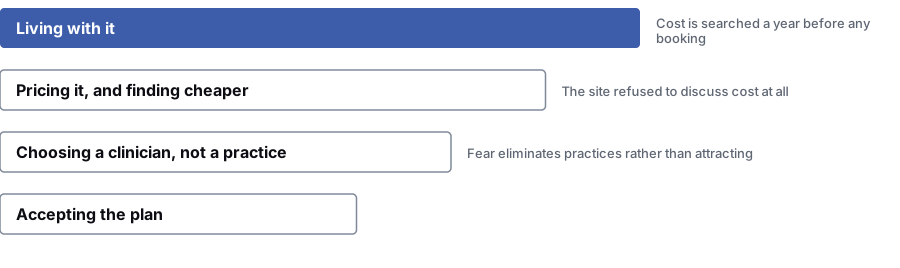
- 1Living with it — A failed bridge, a tooth that finally cracked, a denture that won’t stay in. Things getting worse sets this off, and it can take years.Cost searched a year before any booking
- 2Pricing it, and finding cheaper — Almost everyone has already found a lower quote, including one abroad, and wants to know what the difference buys.The site wouldn’t discuss cost at all
- 3Choosing a clinician — How many cases the surgeon has placed, what they trained in, and whether they will do the surgery themselves.Fear rules practices out
- 4Accepting the plan — Continuity closes it: who reviews the work, who maintains it and who fixes it in year six if something fails.
How they choose
Who decides, and what they look for
Know how they choose and you know where to show up.
- They choose a clinician more than a practice: how many cases the surgeon has placed, and whether they’ll do the surgery themselves.
- They weigh total cost against risk, not just the lowest number. Most have already found a cheaper quote and want to know what it leaves out.
- Once fear and price are settled, continuity decides it — who reviews it, who fixes it in year six if something fails.
- Fear rules practices out. Offering sedation and clearly describing recovery removes a reason not to enquire.
- Examples of the practice’s own cases matter where showing them is allowed — having none is a real disadvantage.
- The assessment does much of the selling. Were images taken? Was the plan written down with staged costs? That decides between two credible practices.
Common problems
Is your dental implant marketing wasting money?
A dental implant case is the biggest single purchase most dental patients make. People buy it like building work: slowly, nervously, with several quotes and a suspicion the cheapest option is cheap for a reason.
Two worries always decide it: it costs more than expected, and surgery is frightening. Answer both clearly before anyone phones, and you compete on different ground from a practice offering a free consultation and hoping.
- Your website won’t name a price for the biggest purchase in dentistry.
- “Cost varies, please call” asks people to give up an hour to learn whether they were ever in range, and they won’t. Show a “from” price per implant, a realistic full-arch range and a monthly finance example. You’ll get fewer enquiries and more accepted plans.
- Fear is treated as a soft topic, when it’s the second big worry.
- Patients who need implants most have often avoided the dentist for a decade, and money isn’t why. They need a factual account of the surgery, what recovery feels like and what happens if an implant doesn’t bond. Write it clearly and you attract patients who need more treatment and care less about price.
- A clinic abroad quotes a quarter of your fee, and your site says nothing.
- Treatment abroad competes hardest for the high-value cases this business depends on, and neither ignoring nor attacking it works. Answer what patients already search: who’s responsible if an implant fails, what the ten-year review costs, what happens when a part needs replacing and the original clinic is two thousand miles away.
- Referring dentists send cases, and nobody manages the relationship.
- General dentists who don’t place implants are your most valuable source of patients, usually left to remember you on their own. They want clear referral criteria, a working form, a quick acknowledgement and confidence the patient comes back to them for everything else.
- You count consultations, not accepted plans.
- Four steps sit between an enquiry and revenue: enquiry, attended assessment, written plan, accepted plan. Most practices measure the first and the monthly total, so they can’t tell whether they’re attracting the wrong patients, losing them at assessment or presenting plans nobody accepts. Only one of those is a marketing problem.
Where to spend
Organic search first, then conversion fixes
In the order we'd put them. Start at the top.
Answer the cost and risk questions others avoid
Cost, pain, how long implants last and treatment abroad get the most searches, months or years before anyone books. Answer them factually and you become the practice patients have been reading, with the only reliable defence against a quote from abroad.
Fix the assessment before the ads
Value leaks away between enquiry and accepted plan. Take a small deposit that comes off treatment, book within days and hand over a written, staged plan on the day.
Reviews that ease the fear, within the rules
Patients considering surgery read reviews to learn whether it hurt and what happened when something went wrong. Collect feedback at the right moment, and reply without confirming that a named person is a patient.
Your website
Is your website losing you work?
- A “from” price per implant and a realistic range for full-arch treatment
- What a bone graft, sinus procedure or extraction adds, as figures
- A monthly finance example that meets your market’s credit disclosure rules
- The clinician placing implants named, with training and case experience
- A factual account of the surgery, anaesthesia options and recovery
- The maintenance and review schedule over ten years, and what it costs
- A calm answer to the overseas price question that doesn’t criticise anyone
- A section for referring dentists, with criteria and a working form
- Assessment booking that takes a deposit and explains what the appointment includes
The rules
Advertising rules to know
Implant advertising draws more scrutiny of outcome claims than any other dental treatment. “Permanent”, “lifetime”, “teeth in a day” and “guaranteed” cause the most trouble, as does any success-rate figure not sourced to published evidence. Calling a clinician a “specialist” or “implantologist” needs the regulator in that market to allow the title.
Sedation and anaesthesia are often restricted topics, since they involve prescription-only medicines that a number of markets ban advertising to the public. A practice can usually explain that sedation is available and what it involves; promoting a named product, or using it as an incentive, needs checking first.
Before-and-after images of implant cases carry the same restrictions as any dental images: documented, specific consent, no retouching, comparable conditions. X-rays and clinical photos are patient records, and using one in marketing needs separate consent.
Patient privacy governs review replies and case examples. Thanking a named reviewer confirms that someone is a patient. A case example detailed enough to identify someone is a disclosure, however the name is changed.
Content comparing your practice with treatment abroad has to stay factual. Explaining review schedules and correction costs is defensible. Saying clinics in another country are unsafe, or that a named provider gets poor results, is not.
Patient finance for a case this size is a regulated credit activity with its own disclosure rules, separate from the dental rules. All of this differs by regulator and market and is revised from time to time. We write to the rules we understand apply and flag anything needing professional judgement; confirm your position with your own regulator. Nothing we produce is legal or clinical advice.
Sources
Go to the source
Each rule above, linked to the body that publishes it. Which ones apply depends on where you work. Rules change, so check the latest version.
- Only dentists on a GDC specialist list may call themselves specialists; no claims creating unjustified expectations.
- GDC advertising
- Source: General Dental Council (UK), Guidance on advertising
- No one may publish an advertisement likely to lead to the use of a prescription-only medicine, subject to exceptions.
- HMR 2012 reg. 284
- Source: Human Medicines Regulations 2012 (UK), regulation 284
- Credit promotions must be clear, fair and not misleading, with a representative example where triggered.
- FCA CONC 3
- Source: Financial Conduct Authority (UK), Handbook CONC 3: Financial promotions
Questions
Dental implant marketing, answered
How do we answer patients quoting us against a clinic abroad?
Answer on accountability and ten-year cost. Never compete on price or criticise the clinic: you can’t win a price match, and running down competitors causes problems of its own.
Explain who reviews the work, what happens if a part fails in year six, and the total cost over a decade. Patients already search for every one of those and find almost nothing.
What do we put on the page about cost?
A “from” price per implant, a realistic full-arch range and what a graft or extraction adds. Nobody will give up an hour to learn whether the biggest purchase in dentistry was ever within budget.
Add a monthly finance example that meets your market’s credit disclosure standard. Practices that publish prices get fewer enquiries and more patients arriving with realistic expectations.
Our general dentist referrals have dried up. Why?
Usually one specific relationship, not a general decline: a report that never went back, a patient who felt kept instead of returned, or an associate who left.
Fix the basics: acknowledge every referral the same day, send a plan and completion report and publish clear referral criteria. Track referrals by practice to catch a drop early.
Is a free implant consultation a good offer?
No. It fills the diary with people who aren’t ready, and some markets restrict it. A small deposit that comes off treatment does the opposite.
If you do offer a free assessment, say exactly what it includes and excludes; a vague free consultation attracts bargain hunters. Check with your regulator first.
When would we expect this to show up in the diary?
Not in the first month. The early signs are assessments attended and written plans given; the decision itself takes months, sometimes years.
One full-arch case can move a monthly total on its own, so we report accepted case value alongside plans awaiting a decision, showing the trend before the revenue arrives.
The four steps
Where implant cases are won and lost, from enquiry to deposit
Four steps sit between an enquiry and any revenue. Most practices count the first one and the monthly total, so the losses in between stay hidden.
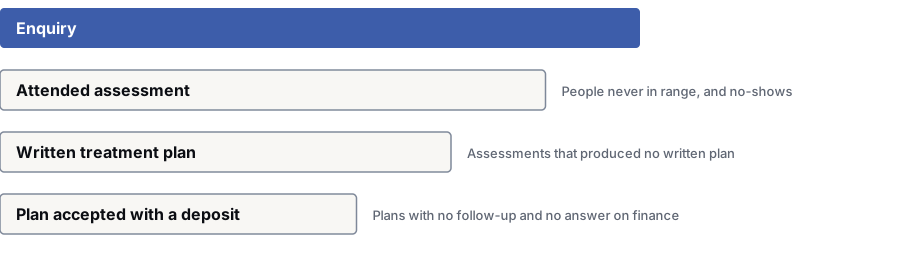
- 1Enquiry — A call, form or referral reaches the practice — usually the only step most practices can report on.
- 2Attended assessment — The patient turns up. A free consultation and a long wait both make this less likely.People never in range, and no-shows
- 3Written treatment plan — Staged costs and the alternatives, handed over on the day, not posted later.Assessments that ended with no written plan
- 4Plan accepted with a deposit — The decision, often months later — the first point any of this becomes revenue.Plans with no follow-up and no finance answer
See how your site stacks up
Start with the free checkup. It shows what to fix first on your website, with no sign-up. Want the full plan for your dental implant business? Book a call, and we'll look at your market, your competitors and the searches that bring in customers.
Prefer to talk it over? Book a free call
Your BOOSTD score improves within 90 days, or your next month is free. After 6 months, more traffic or leads, or we keep working free (up to 6 free months in any 12 months). Read our guarantee
References
Sources for dental implant marketing agency
The official documents and research this page is based on. Platform rules change, so check the source before you act on a detail.
Related
More on dental implant marketing
- marketing for cosmetic dentistry
- marketing for general dental practices
- marketing for orthodontic practices
Guides for dental implant
Other healthcare businesses
Last updated · Published by Zubair Afzal, responsible editor · We check this page every three months. Next check: .