
Medical Clinics marketing
Medical clinic marketing for accurate listings and fewer calls
Medical clinic marketing that gives staff time back: accurate details everywhere patients look, routine questions answered online and help recruiting clinicians.

Timing
When the enquiries come in
Ads barely move clinic demand, which often outstrips supply anyway. The marketing job is nearly always shaping and routing demand.
Walk-in volume swings by the hour and the season, jumping in cold and flu season and around public holidays when other services close. Accurate, live information is the answer.
Family practice capacity opens in steps. A list closes for months, then opens and fills within days. You need an announcement and a waiting list.
Specialist demand comes through referral relationships on its own cycle, changing when a referring practice changes habits or a clinician moves. Published wait times move it more than anything.
Recruitment is national or international. It peaks when training finishes, and every clinic in the market chases the same small pool.
What the search is for
When demand already outstrips supply, marketing routes it
Nobody visits a clinic more because of an ad. Each of these three searches has a different job, and two of them give your staff time back.
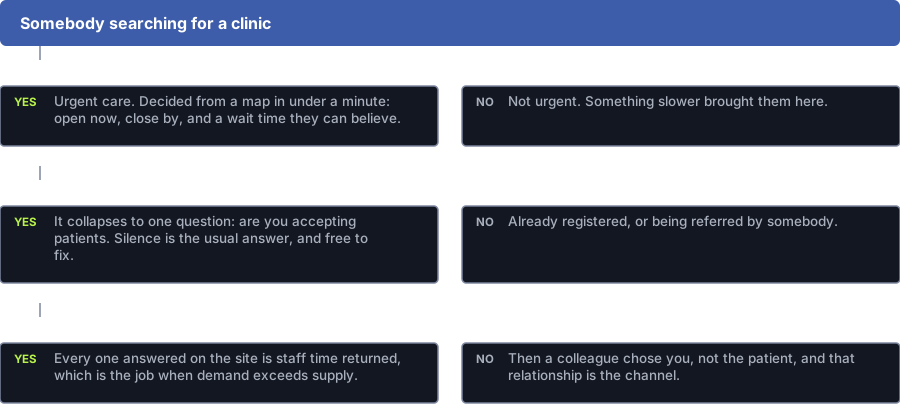
Do they need to be seen in the next hour?
Yes: Urgent care. Chosen from a map in under a minute: open now, close by and a believable wait time.
No: Not urgent. Something slower brought them here.
Are they trying to register with a practice?
Yes: It comes down to one question: are you taking patients? Most sites do not say, and it costs nothing to fix.
No: Already registered, or being referred.
Is this a question reception answers by phone today?
Yes: Each one answered on the site gives staff time back, which is the goal when demand outstrips supply.
No: Then a colleague chose you, and that relationship is the channel.
How they choose
What makes them pick you
Know how they choose and you know where to show up.
- For urgent and walk-in care, people choose from a map in under a minute: open now, close by, a believable wait time. Nobody reads the website first.
- For a family practice, it comes down to one question: are you taking new patients? If yes, all they need is how to register.
- For specialist care, the referring doctor chooses on professional grounds, sometimes with the patient’s input on location and wait time.
- In multilingual areas, language and cultural fit are real reasons to choose. They’re among the few things a clinic can say that change who walks in.
- Practical access beats reputation. Parking, public transport, step-free entry, evening appointments and an easy-to-find building win over a better-reviewed clinic further away.
- Patients read reviews, but most are about waiting, phone answering and reception, not clinical care. Worth knowing before you decide what to fix.
Common problems
Why medical clinic ads and SEO fall flat
Most clinics aren’t short of patients. They’re short of appointments, short of staff, and short of a way to tell people today’s opening hours.
So medical clinic marketing has a different job. When demand already beats capacity, route patients well, make life easier for them and go after what’s scarce.
- Reception answers questions your website should.
- Opening hours. Are you taking new patients? How do I get a repeat prescription or results? What should I bring? Do I need a referral? How long is the wait? These make up most calls, and none needs staff. Publish the answers in patients’ words, and the calls that need staff get answered faster.
- Your hours are wrong everywhere except your own site.
- Your clinic shows up on maps, health system finders, insurer directories, government listings and booking tools. Others edit most of them, and none update themselves, so a short-notice closure reaches your website and nowhere else. Patients arrive at a locked door, and their review tops your profile for years.
- The vacancy you can’t fill is a doctor.
- A clinic that can’t recruit hits a ceiling no patient marketing will lift, yet the recruitment pitch is often one line on a contact page. A physician weighing a role wants panel size and mix, software, overhead arrangement, after-hours duties, support staff and colleagues. That needs its own section, tone and search terms.
- You market to patients, but referrers decide.
- Where care comes through a referral, a family physician picks from a list with no easy way to compare. They need current wait times by procedure, referral criteria, a working form, a named contact and proof that reports come back fast. Most specialist sites publish patient content instead.
- The people who most need your site can’t use it.
- Clinic audiences include many older patients, people with long-term conditions, people less confident online and people whose first language isn’t the local one. Poor contrast, small buttons, unlabelled forms, no keyboard support and no translation shut many of them out. In several markets, accessibility is also the law.
What people search
Searches such as “walk in clinic near me”, grouped by intent
Urgent and walk-in
Chosen from a map in seconds. Accurate hours beat everything else.
- walk in clinic near me
- walk in clinic open now
- urgent care open late near me
- clinic open sunday near me
- walk in clinic wait time
Trying to register
Huge volume where doctors are scarce, and usually no answer on clinic sites.
- doctors accepting new patients near me
- family doctor taking patients [city]
- how to get a family doctor
- gp registration near me
- clinic waiting list new patients
Admin questions
Calls reception shouldn’t have to take. Answer each one on the site and staff get time back.
- prescription refill without appointment
- how to get a copy of my medical records
- do i need a referral to see a specialist
- clinic holiday hours
- how to cancel a clinic appointment
Clinician recruitment
A separate audience that needs its own content. Usually ignored.
- family physician jobs [city]
- locum gp opportunities near me
- clinic associate position available
- nurse practitioner jobs clinic
- medical practice partnership opportunity
These are example searches from keyword research and public search data. Before we suggest anything, we check how often people search for them in your area.
Where to spend
Why the website comes before local SEO
In the order we'd put them. Start at the top.
A site that answers questions so the phone stays quiet
This is your main lever. Publish hours, registration status, prescriptions, results, referral rules and directions clearly, accessibly and in your patients’ languages. Every question answered on the site is a call reception didn’t take.
One accurate record, everywhere it appears
Your clinic appears on maps, health finders, insurer directories and booking tools, mostly run by others. Keeping hours, services, accessibility and closures the same everywhere prevents the worst patient experience: arriving at a clinic that’s shut.
Pages for the questions patients search first
Registration, referrals, what to bring, how long results take and how the local system works get searched constantly and answered badly. For specialist clinics, the same goes for referrers: criteria, wait times and the referral process.
Tracking that doesn’t over-collect
Calls by reason, self-service use, listing accuracy and applications per vacancy are the numbers that matter. Tracking must be set up so pages that hint at a health condition send no identifiable data anywhere.
Your website
What your website needs
- Opening hours, closures and whether you’re taking patients, shown clearly and kept current
- Self-service answers for prescriptions, results, referrals, records and cancellations
- Proper accessibility: contrast, keyboard use, labelled forms, large tap targets
- Content in the languages your local patients use
- Directions, parking, public transport and step-free access described clearly
- A careers section for clinicians, with the details a physician would ask about
- For specialists, a referrer section with criteria, current wait times and a working referral form
- Plain language throughout, easy for someone unwell and in a hurry
- Analytics and ad tags set up so pages that reveal health information don’t leak data
Measuring results
Track the leads that pay
These numbers show if your marketing brings in customers. Website visits alone don't.
- Calls by reason, and the share solved without staff
- Abandoned calls and time to answer at peak times
- Online bookings and cancellations as a share of the total
- Listing accuracy across maps, directories and health finders
- New patient registrations against actual list capacity
- Referrals by referring practice, for specialist clinics
- Applications per open clinical vacancy, and time to fill
- Review themes over time, with access complaints kept apart from clinical ones
The rules
The rules on claims
Health privacy law is the main limit here, and it covers marketing tools as well as clinical records. Analytics, ad pixels, chat widgets, session recording and booking scripts on booking or condition pages can send information that suggests someone’s health condition, and regulators actively enforce this. Plan for it before installing anything.
Treat any case example, patient story or review reply as if confirming someone is a patient is itself a disclosure. Anything identifiable needs documented consent, and removing identifying details has to be done properly; changing a first name isn’t enough.
Advertising by physicians and clinics follows the standards of the relevant medical regulator, which often restrict testimonials, comparisons and superlatives, protected titles and anything implying a treatment result or diagnostic certainty. Published wait times and availability must come from a live system; a wrong figure is both a regulatory and a reputation problem.
Accessibility is a legal duty in several markets and, for this audience, a practical necessity everywhere.
These rules differ by regulator, market and privacy law, and they change often. We build to the rules we understand apply and flag what needs review; the clinic must confirm its position with its own regulator and privacy adviser. Nothing we produce is legal or clinical advice.
Sources
Primary sources for these rules
Each rule above, linked to the body that publishes it. Which ones apply depends on where you work. Rules change, so check the latest version.
- Physician advertising must not contain testimonials or compare the physician with other physicians.
- CPSO Advertising
- Source: College of Physicians and Surgeons of Ontario (Canada), Advertising policy
- Advertising a regulated health service, medicine included, must not use testimonials or be misleading.
- National Law s133
- Source: Ahpra and National Boards (Australia), Guidelines for advertising a regulated health service
- FTC action over health data shared with advertising platforms; the order bars sharing it for advertising.
- FTC v. GoodRx
- Source: Federal Trade Commission (US), GoodRx Holdings case, 2023
Questions
New to medical clinic marketing? Start here
We are already at capacity. What would marketing even do for us?
Take pressure off. In a full clinic, the useful work is moving routine questions off the phone, making your details correct everywhere and cutting no-shows that waste slots others are waiting for.
If recruitment is the real limit, your most valuable marketing is aimed at doctors, and we’d build that before any patient marketing you couldn’t absorb.
Our listings are managed by the health system. Can anything be done?
Usually more than you’d expect. Some records are controlled centrally, but maps, insurer directories, independent health finders and booking tools often accept updates from the clinic or a verified representative.
Start by listing everywhere the clinic appears and who controls each record. Fixing the records you control solves most of the damage.
Is it safe to run analytics or advertising tags on our website?
With care, and not on default settings. The risk is a page that reveals something about someone’s health, like a booking page for a specific service, a condition page or a symptom checker, sending identifiable data to a third party.
Decide page by page what to measure, strip identifiers and keep ad tags off pages that suggest a condition. You lose some detail, and it’s the right trade. Confirm the final setup with your own privacy adviser.
How do we market a clinician vacancy?
Write for the person you want to hire, and answer what they’d otherwise have to ask: panel size and mix, your software, overhead arrangement, after-hours duties, support staff and who else works there.
Most clinic careers pages say the practice is friendly and busy, which fits every clinic, so being specific is your edge. The audience is small, so a well-written page and a few targeted placements beat a broad campaign.
Should we publish our current wait times?
Only if the figure comes from a live system that updates itself. An accurate wait time is one of the most useful things a walk-in clinic can publish, cutting calls and frustration on arrival.
A figure typed in by hand and forgotten is worse than nothing: it causes complaints, damages trust and, in ads, may cause a regulatory problem.
Start with a free checkup
Start with the free checkup. It shows what to fix first on your website, with no sign-up. Want the full plan for your medical clinic business? Book a call, and we'll look at your market, your competitors and the searches that bring in customers.
Prefer to talk it over? Book a free call
Your BOOSTD score improves within 90 days, or your next month is free. After 6 months, more traffic or leads, or we keep working free (up to 6 free months in any 12 months). Read our guarantee
References
Sources for medical clinic marketing
The official documents and research this page is based on. Platform rules change, so check the source before you act on a detail.
Related
More on medical clinic marketing
Last updated · Published by Zubair Afzal, responsible editor · We check this page every three months. Next check: .