
Serving Canada remotely
SEO and digital marketing for Canadian businesses
SEO and digital marketing in Canada has to handle four things a US playbook ignores: concentrated demand, two official languages, strict anti-spam and privacy law, and search results often dominated by American sites.
Prefer to talk it through? Book a strategy call
The market
What makes Canada different
Canada is a large country with a small, concentrated market. Roughly two-thirds of the population sits within a narrow band near the southern border, and a handful of metro areas account for a disproportionate share of commercial search demand. That concentration means national campaigns behave more like a set of metro campaigns than a true nationwide effort.
Search volumes are considerably lower than American equivalents for the same term, which changes what a realistic forecast looks like. A keyword that would justify a dedicated content programme in the United States frequently does not in Canada, and an agency importing US benchmarks will set expectations that cannot be met.
The flip side is that competition is often thinner. Categories that are saturated in comparable US metros still have winnable ground in Canadian ones, particularly outside Toronto and Vancouver, and that gap is where most of the opportunity sits.
Who is here
Who does business in Canada
The bulk of the commercial opportunity is in small and mid-sized businesses: trades and home services, professional practices, clinics, brokerages and regional retail. These are businesses where a single well-executed local search strategy can change the revenue line.
Above that sits a layer of national brands, franchise groups and multi-location operators — dealership groups, clinic networks, restaurant groups — where the problem is structural rather than local. Locations compete with each other, profiles are inconsistent, and the site cannot express a service area properly.
Canada also has a substantial B2B and technology sector, concentrated in Toronto, Waterloo, Montreal, Ottawa and Vancouver, that sells internationally from day one. For those companies the Canadian market is rarely the target, and the strategy is international from the start.
Search behaviour
How search works in Canada
Search is not uniform across markets. Engine share, language, device mix and local platforms all shift what a strategy in Canada should prioritise.
- Google holds an overwhelming share of Canadian search, higher than in the United States. Bing matters mainly for enterprise and government-adjacent audiences where managed Windows environments are common.
- Canadian results are frequently populated by American sites with larger, older domains. Making Canadian relevance explicit — currency, spelling, provincial coverage, local examples, a .ca domain where it fits — is a real ranking and conversion advantage rather than a cosmetic one.
- Spelling matters more than people expect. Canadian English follows British conventions for some words and American for others, and content that gets it wrong reads as foreign to exactly the customer you are trying to convince.
- French-language search is a distinct market, not a translation layer. In Quebec it is the primary market; outside it, the volume is small enough that a full bilingual site is rarely justified for a regional business.
- Postal-code and neighbourhood-level search is common in dense metros, and service-area accuracy matters more here than a broad city-level claim.
Strong fit
Industries with the clearest opportunity in Canada
Sectors worth a look in Canada
- HVAC marketingOwn the emergency searches in your service area, then use the quieter months to build the installation pipeline that carries the margin.
- Roofing marketingBe one of the three companies quoting, and be the one that looks least risky by the time the homeowner decides.
- Plumbing marketingOwn the emergency window, then convert one-off callouts into the higher-value repipe, water heater and bathroom work that carries margin.
- Personal Injury Law marketingLower cost per signed case of the type you want, by qualifying earlier and closing the gap between enquiry and retainer.
- Family & Divorce Law marketingBe the firm they have already been reading for a month by the time they are ready to make the call.
Where to start
Services that fit businesses in Canada
SEO services
SEO services make your business easier to find on Google and Bing for the searches that lead to enquiries. They suit owners and marketing leads who need qualified leads, not just traffic. Included: technical fixes, local SEO, demand mapping, content, authority building and reporting tied to enquiries.
Local SEO
Local search is decided by different signals than the rest of SEO — proximity, profile quality, review behaviour and how clearly your service area is defined. We work all of them, for single locations and for multi-location businesses.
Web design & development
Web design and development plans a site for search and conversion before design starts, then builds it fast, accessible and yours to own. It is for businesses whose site looks fine but does not bring in enquiries. Included: SEO structure, UX, design, build, migrations, Core Web Vitals, accessibility and conversion work.
Brand strategy & identity
Brand strategy and development make a business easier to choose: positioning, naming, visual identity and messaging built to do a commercial job. It is for businesses that are hard to tell apart, have outgrown their name or are merging brands. Included: strategy, identity systems, messaging, naming, rebrands and brand architecture.
Constraints
Marketing rules in Canada
- Canada's Anti-Spam Legislation (CASL) is stricter than the American equivalent. It requires express or clearly demonstrable implied consent before sending commercial electronic messages, mandates identification and unsubscribe requirements, and carries meaningful penalties. Practically, it means Canadian email programmes have to be built on consent from the start rather than retrofitted.
- Privacy is governed federally by PIPEDA, with Quebec, Alberta and British Columbia operating their own provincial regimes. Quebec's Law 25 in particular has tightened consent and transparency requirements considerably, and it applies to businesses handling the personal information of Quebec residents regardless of where the business sits.
- Quebec's French language legislation affects commercial communications, signage and, in practice, marketing materials directed at Quebec consumers. Any business marketing into Quebec should take advice on what applies to them rather than assuming an English site is sufficient.
- Several regulated professions — legal, medical, dental, financial — are governed provincially, so advertising rules differ across provinces for the same profession. We flag where this affects a page; the professional obligation stays with the practice.
Primary sources
Where to read the rules for Canada
The statutes and regulators behind the rules above. They are the authority, not this page, and none of this is legal advice.
- Canada's Anti-Spam Legislation: consent, sender identification and unsubscribe rules for commercial messages
CASL
Canada's Anti-Spam Legislation: consent, sender identification and unsubscribe rules for commercial messages
- The federal private-sector privacy law that applies where no provincial statute takes its place
PIPEDA
The federal private-sector privacy law that applies where no provincial statute takes its place
- Charter of the French Language (CQLR c C-11), as amended in 2022
Bill 96
Charter of the French Language (CQLR c C-11), as amended in 2022
Source: LégisQuébec
How we work here
We serve Canada remotely, and we say so
We serve Canadian businesses remotely. Calls, workshops and reporting run over video, and delivery does not depend on anyone being in the same city — which for search, web and brand work it does not.
Where a project needs physical presence — photography, a site visit, an in-person workshop — we arrange it explicitly and quote it rather than pretending it is covered by a retainer. Being direct about that is easier than maintaining an office we would rarely use.
We work in Eastern and Pacific time comfortably. We handle reporting, invoicing and contracts in Canadian dollars for Canadian businesses.
Where the line is
What we cover in Canada, and what we do not
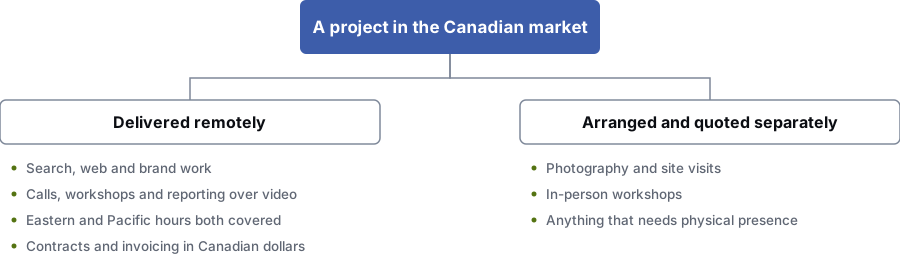
Delivered remotely
- Search, web and brand work
- Calls, workshops and reporting over video
- Eastern and Pacific hours both covered
- Contracts and invoicing in Canadian dollars
Arranged and quoted separately
- Photography and site visits
- In-person workshops
- Anything that needs physical presence
Questions
Working with us from Canada
Do we need a French version of our website?
It depends on where your customers are and what the law requires of you. If you market to Quebec consumers, take advice — language obligations there are real and go beyond marketing preference.
Outside Quebec, the commercial case is usually narrower than agencies suggest. Rather than translating everything, the useful exercise is identifying which pages are researched in French by buyers in your category. For most regional businesses that is a small subset, and doing that subset properly beats machine-translating the whole site.
American sites outrank us for our own market. Can that be fixed?
Often, yes, and it is one of the more winnable problems in Canadian search. Those sites usually have larger domains but weaker relevance — they cannot serve the customer, do not price in Canadian dollars and have no local proof.
The work is making your Canadian relevance unmistakable: provincial and metro coverage stated explicitly, Canadian pricing and spelling, local examples, and content that answers the Canada-specific version of the question. Relevance is the lever you have; domain authority is not.
Does CASL make email marketing not worth doing?
No, though it does mean it has to be built properly. CASL requires consent before sending commercial electronic messages, plus identification and unsubscribe requirements, and the penalties are real.
In practice the constraint improves results. Canadian lists built on real consent are smaller and engage far better than purchased or scraped American equivalents. We build the consent mechanics in from the start — and we are not lawyers, so anything close to the line goes to yours.
Our market is a mid-sized city. Is there enough search demand to bother?
Usually yes, and the economics are often better than in a major metro. Volumes are lower, but so is competition, and the cost of winning a mid-sized market is a fraction of what Toronto or Vancouver costs.
We size the actual demand before recommending anything. If the numbers do not support the investment, that is a useful answer and we would rather give it early.
Do you have an office in Canada?
No. We serve Canadian businesses remotely and we would rather say that plainly than list a virtual mailbox as a location.
For search, website and brand work, it makes no practical difference — the work is done on your accounts, in your systems, with calls and workshops over video. Where a project needs someone on the ground, we arrange and quote it separately.
Talk to us about growing in Canada
Start with the free Growth Scan: an indicative read of your website and the few things to fix first, with no sign-up. BOOSTD is in early access, so the market question — who is winning the searches that matter in Canada, and whether the opportunity justifies the investment — is worked through with our team on a strategy call. If it does not, we will say so.
Prefer to talk it through? Book a strategy call
If we don't deliver the work we agreed to deliver for reasons within our control, you don't pay for the undelivered work. Read our guarantee
References
Sources
The primary documents and published research this page relies on. Platform rules change, so check the source before acting on a detail.
More to explore
Other markets we cover
Last updated · Published by Zubair Afzal (responsible editor), on owner authorisation