
Serving British Columbia remotely
SEO and digital marketing for British Columbia businesses
A Pacific-facing province with its own private-sector privacy statute and a geography that splits the market into regions divided by mountains, water and ferry schedules. SEO and digital marketing in British Columbia has to be planned region by region.
Prefer to talk it through? Book a strategy call
The market
What makes British Columbia different
British Columbia is best understood as several markets that happen to share a legislature. Metro Vancouver, Vancouver Island, the Okanagan, the Kootenays, the Cariboo and the north differ in industry, income, seasonality and competitive intensity, and treating them as one province-wide audience wastes most of a budget.
Geography is not a detail here. The province is cut by mountain ranges and coastline, a great deal of it is reached by ferry or by a single highway, and the practical catchment of a business is defined by driving time rather than by distance on a map.
The Pacific coast position gives the province an outward-facing economy — the country's largest port, substantial trade with Asian markets, and inbound travel and investment that arrive from across the ocean rather than across the border.
Resource industries still carry a large share of employment outside the metro areas: forestry, mining, natural gas and, on the coast, fishing and aquaculture. These are cyclical and politically sensitive sectors, and the towns built around them experience demand swings that a national brand's planning never anticipates.
Tourism is province-wide and seasonal, from ski communities to Island coastal towns to Okanagan wine country, which makes seasonal budget flexing a core competence rather than a refinement.
Distance is not reachability
In British Columbia twenty kilometres can mean a ferry
Ranking runs on distance while customers run on travel time, and this province is cut by water, mountain passes and ferry schedules. Nearby is frequently irrelevant and far is frequently fine.
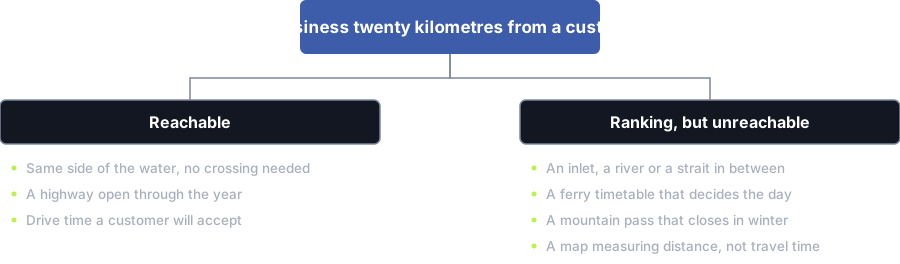
Reachable
- Same side of the water, no crossing needed
- A highway open through the year
- Drive time a customer will accept
Ranking, but unreachable
- An inlet, a river or a strait in between
- A ferry timetable that decides the day
- A mountain pass that closes in winter
- A map measuring distance, not travel time
Search behaviour
How search works in British Columbia
Search is not uniform across markets. Engine share, language, device mix and local platforms all shift what a strategy in British Columbia should prioritise.
- Regional search terms outperform provincial ones by a wide margin. People search "Lower Mainland", "the Island", "Okanagan" and their own town rather than "British Columbia", and a page built around the provincial name usually reaches nobody with buying intent.
- Local results are shaped by physical barriers in a way that catches out anyone used to flat cities. Water crossings, mountain passes and ferry routes mean nearby businesses are frequently irrelevant to a searcher and distant ones are not, so service-area content has to explain reachability rather than assume it.
- Chinese-language and Punjabi-language search carries real commercial volume across parts of the province, particularly in Metro Vancouver, and in many categories almost nothing competent is being published for those queries.
- Seasonality is extreme in tourism-dependent communities. Query volume for accommodation, activities, dining and services can multiply several times over between the off season and the peak, so an annual plan built on averages is wrong in both directions.
- Pacific Time alignment with Seattle, Portland and California shapes B2B behaviour. Many BC firms sell south rather than east, which makes their competitive set American and their content requirements different from an Ontario company's.
Strong fit
Industries with the clearest opportunity in British Columbia
Sectors worth a look in British Columbia
- Property Management marketingBuild a steady flow of owner enquiries from landlords at the point they lose patience with their current arrangement, and make the tenant experience good enough that the doors stay on the books.
- Restoration & Emergency Services marketingCapture the homeowner searching at midnight, and build the referral relationships that send work regardless of what the search results do.
- Restaurants marketingWin the short-notice local decision reliably, then move as much of the resulting trade as possible onto direct booking and direct ordering where the margin survives.
Who is here
Who does business in British Columbia
Metro Vancouver holds the province's corporate, technology, property and professional-services concentration, and competition there resembles Toronto more than it resembles the rest of BC.
Vancouver Island runs on government, education, healthcare, retirement services and tourism, with Victoria functioning as a separate business market and smaller Island communities operating on very local terms.
The Okanagan has become one of the more interesting growth markets in Canada, combining agriculture and wine, tourism, retirement migration and a growing technology and professional-services base in Kelowna.
Across the Interior and the north, the businesses that need marketing most are trades, equipment and logistics operators, healthcare providers and regional retailers serving communities with limited local competition and very little online presence to compete against.
Property, construction and the trades supporting them are large everywhere in the province, and their fortunes track housing activity and interest rates far more tightly than most operators plan for.
Where to start
Services that fit businesses in British Columbia
Local SEO
Local search is decided by different signals than the rest of SEO — proximity, profile quality, review behaviour and how clearly your service area is defined. We work all of them, for single locations and for multi-location businesses.
SEO services
SEO services make your business easier to find on Google and Bing for the searches that lead to enquiries. They suit owners and marketing leads who need qualified leads, not just traffic. Included: technical fixes, local SEO, demand mapping, content, authority building and reporting tied to enquiries.
Web design & development
Web design and development plans a site for search and conversion before design starts, then builds it fast, accessible and yours to own. It is for businesses whose site looks fine but does not bring in enquiries. Included: SEO structure, UX, design, build, migrations, Core Web Vitals, accessibility and conversion work.
Reputation & reviews
Reviews are the one marketing asset you cannot manufacture without risking the profile everything else depends on. We build the asking into how your business already works, respond properly to criticism, and tell you which reviews will never be removed.
How we work here
We serve British Columbia remotely, and we say so
We serve British Columbia businesses remotely, with no office, staff or phone number in the province. Given how many agencies list a Vancouver address they never visit, saying this plainly seems more useful than the alternative.
Pacific Time is a scheduling question rather than an obstacle. We hold calls in the BC working day, and asynchronous handover between time zones often means work moves overnight rather than waiting for the next morning.
For anything needing physical presence — photography in the Okanagan, filming on the Island, an on-site workshop — we source and quote the local supplier explicitly instead of pretending it is bundled into a retainer.
Constraints
Marketing rules in British Columbia
- British Columbia has its own private-sector privacy law. The Personal Information Protection Act governs how organisations in the province collect, use and disclose personal information, and it is overseen by the Office of the Information and Privacy Commissioner for BC rather than by the federal commissioner. Because PIPA has been recognised as substantially similar to PIPEDA, most BC organisations look to the provincial statute — though federally regulated businesses, and personal information moving across borders, remain within PIPEDA's reach. Public bodies fall under separate freedom-of-information and privacy legislation again.
- The Business Practices and Consumer Protection Act sets the province's rules on deceptive and unconscionable practices, and Consumer Protection BC licenses and oversees a number of specific sectors. Claims, pricing presentation, contract terms and cancellation rights all need to be checked against it before a campaign runs.
- CASL applies to commercial electronic messages here as everywhere in Canada, and a number of BC sectors carry their own advertising restrictions on top — real estate licensees, financial advisers, regulated health professions and travel businesses among them.
- We write to what these rules appear to require and we raise anything that looks close to a line, but we do not provide legal advice. Confirming your obligations under PIPA, the BPCPA or a sector regulator is a job for your own advisers.
Primary sources
Where to read the rules for British Columbia
The statutes and regulators behind the rules above. They are the authority, not this page, and none of this is legal advice.
- British Columbia's Personal Information Protection Act
BC PIPA
British Columbia's Personal Information Protection Act
Source: BC Laws
- Business Practices and Consumer Protection Act: deceptive and unconscionable practices
BPCPA
Business Practices and Consumer Protection Act: deceptive and unconscionable practices
Source: BC Laws
- Canada's Anti-Spam Legislation: consent, sender identification and unsubscribe rules for commercial messages
CASL
Canada's Anti-Spam Legislation: consent, sender identification and unsubscribe rules for commercial messages
Questions
Working with us from British Columbia
Does BC privacy law change how we can run marketing?
It changes which rules you are measured against. British Columbia has its own Personal Information Protection Act and its own privacy commissioner, so an organisation operating in the province is generally looking at PIPA rather than the federal statute, while federally regulated businesses and cross-border data flows still involve PIPEDA.
Practically, that means consent, purpose and retention need to be documented against the provincial requirements. We build the tracking and consent layer to support that; confirming it meets your obligations is a question for your privacy adviser.
How should we define our service area in BC?
By drive time and route, not by radius. A circle drawn on a map will include places separated by a mountain, an inlet or a ferry crossing, and exclude towns an hour up the same highway that you could easily serve.
We map the area you can reach, then build content for the communities inside it. That produces fewer coverage pages than the radius approach and far better ones.
Is it worth publishing in Chinese or Punjabi?
In parts of Metro Vancouver and in specific categories, it is one of the least competitive opportunities available. There is real query volume and very little well-made content answering it.
It only pays off if you can serve the customer in that language after they contact you. Publishing a translated page and then answering the phone in English only wastes the visibility you paid for.
Our business is seasonal. How should the budget work?
Spend ahead of demand rather than during it. Booking and research behaviour runs weeks or months in front of the visit, so content, profiles and campaigns need to be in place before the season starts.
The off season is not dead time either — it is when the technical work, content building and review generation should happen, so the peak arrives with the groundwork already done.
Do you have an office in British Columbia?
No. We have no office, address or staff anywhere in the province and we serve BC businesses remotely.
For local search work this makes no practical difference — profiles, sites and campaigns are managed in your accounts. What matters is that the location data is accurate, and that is true whoever maintains it.
Talk to us about growing in British Columbia
Start with the free Growth Scan: an indicative read of your website and the few things to fix first, with no sign-up. BOOSTD is in early access, so the market question — who is winning the searches that matter in British Columbia, and whether the opportunity justifies the investment — is worked through with our team on a strategy call. If it does not, we will say so.
Prefer to talk it through? Book a strategy call
If we don't deliver the work we agreed to deliver for reasons within our control, you don't pay for the undelivered work. Read our guarantee
References
Sources
The primary documents and published research this page relies on. Platform rules change, so check the source before acting on a detail.
Last updated · Published by Zubair Afzal (responsible editor), on owner authorisation