
Restaurants marketing
Restaurant marketing agency that fills tables on quiet nights
Restaurant marketing that wins the one-minute choice on Google Maps, fills tables on quiet nights and brings more bookings in direct.

Common problems
Common restaurant marketing mistakes
Restaurant marketing comes down to one minute. People pick where to eat on their phone, a few miles away, already hungry. Nobody compares ten options at that point.
So a short list decides it: where you show up, whether you show as open, what the photos and last few reviews look like, and how fast someone can read the menu and book.
- Your hours, menu or address are wrong somewhere that matters.
- Your details live in your Google listing, several directories, two delivery apps, a booking system and your website. Over time they drift apart. Someone turns up to a locked door on a bank holiday, or sees last year’s prices, and you hear about it in a one-star review. Keeping details in sync is dull upkeep. Skip it and you lose guests who had already chosen you.
- Your menu is a PDF nobody can read on a phone.
- The menu is the page people want most. Too often it’s a scanned file. It loads slowly, needs pinching to read, can’t be seen by Google and needs a designer to update. Put the menu on a proper web page with current prices and dietary details. That fixes the most common reason people leave your site.
- A third of the order goes to an app for a regular who already knew you.
- Delivery apps bring you new customers, and that’s worth something. Paying big commission on orders from regulars is harder to justify. They only opened the app out of habit. You don’t need to leave the apps. Make ordering direct easier and a little more rewarding. Regulars move across and the apps keep bringing new people.
- Your photos are from before the last refit.
- On Google Maps, photos sell harder than any words. Most were taken by customers, not you. A dark phone snap of a dish from three years ago sets what guests expect when they walk in. Fresh, well-lit photos of the room, the food and the front of the building cost little.
- Reviews get answered late, defensively or not at all.
- In hospitality, reviews are the product description. A run of bad ones hits trade within days. Your reply matters more than the score. Everyone who reads it later wants to know whether this place handles a problem well. An argumentative reply does more harm than the complaint. Silence looks like you don’t care.
- Your group runs eight venues off one page.
- Each restaurant competes in its own few streets, with its own hours, menu and feel. One shared page can’t rank locally for any of them. It can’t answer a guest’s questions about the venue they mean either. Give each venue its own page with address, hours, menu, photos and booking link. Then set a simple routine to keep a dozen listings accurate.
What people search
Searches like “restaurants near me open now”
Deciding right now
Close by and in a hurry. The choice is made in the results, often without opening a website.
- restaurants near me open now
- best brunch near me open now
- places to eat near me open late
- food near me open on sunday
- walk in restaurants near me
Occasion and cuisine
Planned ahead. Often the most valuable bookings you take.
- best italian restaurant [city]
- birthday dinner restaurants [neighbourhood]
- restaurants with private dining room near me
- restaurants for large groups [city]
- romantic restaurants [city] with a view
Searches that start with a need
The need comes before taste. Answer these clearly and you win bookings nothing else would.
- gluten free restaurants near me
- vegan brunch [city]
- halal restaurants near me
- kid friendly restaurants with parking
- dog friendly pub [area]
Searches for you by name
They’ve already chosen you. Answer each of these in one tap.
- [restaurant name] menu
- [restaurant name] opening hours
- [restaurant name] booking
- [restaurant name] parking
- [restaurant name] reviews
These are example searches from keyword research and public search data. Before we suggest anything, we check how often people search for them in your area.
How they choose
How customers decide who to hire
Know how they choose and you know where to show up.
- Most of the choice happens on Google Maps, before anyone opens your website. Distance, star rating, number of reviews, “open now” and photos settle it.
- Your website is a quick check. People look for the menu, price level, hours and how to book. If they can’t find those in a few seconds, they go back and pick the next place.
- Needs come before tastes. A dietary need, a pushchair, parking for a group or a table at nine gets filtered first. Say clearly what you can handle and you win bookings your food alone never would.
- Recent reviews count far more than the overall average. A 4.2 with twenty reviews from the last two months looks fresher than a 4.6 built five years ago. Diners scan the latest few for a pattern.
- Photos set what guests expect, and so they shape the review. People who get what the pictures promised enjoy the same meal more.
- The occasion often drives the search more than the food. A birthday dinner, a first date, a working lunch or somewhere to take visiting parents. The place that talks about that occasion makes the shortlist.
Choosing where to eat
How a hungry diner picks where to eat in under a minute
The map results do most of the choosing. Your site is a quick check of a few facts. Knowing which facts people check is worth more than any homepage redesign.
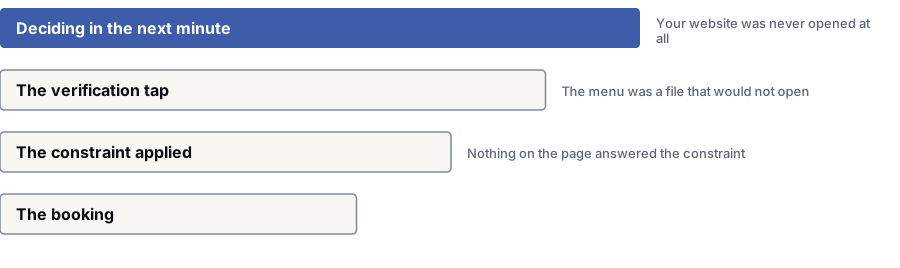
- 1Deciding in the next minute — Mostly in the map results: distance, star rating, number of reviews and whether the listing says open now.Your website was never opened at all
- 2A quick check on the site — The menu, the price level, the hours and how to book. Nothing else gets read.The menu was a file that wouldn’t open
- 3Needs filtered first — A dietary need, a pushchair, parking or a table at nine. These get filtered before any personal taste.Nothing on the page answered the need
- 4The booking — Recent reviews count far more than the average. The photos set what guests expect, and the review gets written against that.
Where to spend
Spend on local SEO first, then reviews
In the order we'd put them. Start at the top.
Your Maps listing is your shop window
Most people choose a restaurant on Google Maps without opening a website. We fix what you control: the right categories, correct hours including holidays, fresh photos, a properly linked menu and a steady flow of new reviews.
Reviews do the selling
Guests can’t taste the food before they arrive, so recent reviews sell for you. We set up a routine that asks happy guests for reviews. We write replies for the people who read them later. And we watch complaints for patterns, so a kitchen or floor problem gets spotted early.
Menu, hours and a booking in three taps
Your site has four jobs: what you serve, what it costs, whether you’re open and how to book or order. So the menu is a web page, not a PDF. Hours are correct and readable by Google. Booking takes a few taps. Direct ordering is the easy option, not hidden under the app buttons.
One page per venue for groups
Each venue needs to show up in its own neighbourhood. So each gets its own page with address, hours, menu, photos and booking link, and every Maps listing stays consistent. Without that, your venues compete with each other and none of them wins locally.
Your website
What visitors need to see
- The menu as a proper web page with current prices, easy to read on a phone
- Opening hours that are correct, readable by Google and updated for holidays
- Booking in as few taps as possible, without a detour through a third-party screen
- Direct ordering shown at least as clearly as the delivery app links
- Fresh photos of the room, the outside and the food as it’s served
- Allergen and dietary details handled with care, with a clear note to speak to staff on arrival
- The practical bits: parking, access, nearest transport and which door to use
- A page for each venue in a group, with its own hours, menu, photos and booking link
- Private dining, large groups and events on their own page, because those bookings are worth the most
- Fast enough to load on mobile data out on the street, where many of these choices happen
The rules
Rules that shape your marketing
Menus published online can carry rules of their own. Depending on your size and where you trade, you may need to show allergen information, and in some places calories or nutrition details. The rules differ by country and sometimes by state or province. We build menu pages so allergen and dietary details are easy to keep accurate and dated. Please confirm what applies to you with your food authority or legal adviser. This isn’t legal advice.
Dietary claims need care whatever the labelling rules say. Calling a dish gluten free, vegan or nut free is a promise about your kitchen as well as the recipe. If food is made in a shared kitchen, a flat claim is risky. It’s safer to list what a dish contains, explain what your kitchen can and can’t control, and ask guests with an allergy to speak to staff.
Alcohol promotions, competitions and price offers have their own rules in many places, including limits on how discounts can be advertised. If a promotion is central to a campaign, we’ll point out the areas that often carry rules. Making sure it complies is down to you and your adviser.
Sources
Read the rules yourself
Each rule above, linked to the body that publishes it. Which ones apply depends on where you work. Rules change, so check the latest version.
- How food businesses must provide information on the 14 regulated allergens, including for food sold at a distance.
- FSA allergen guidance
- Source: Food Standards Agency allergen guidance (UK)
- US restaurant chains with 20 or more locations must show calories on menus and menu boards.
- FDA menu labelling
- Source: FDA menu labeling requirements (US)
- UK non-broadcast advertising rules for alcohol, including not targeting or appealing strongly to under-18s.
- CAP Code section 18
- Source: ASA/CAP Code, section 18: Alcohol (UK)
Measuring results
The numbers we report
These numbers show if your marketing brings in customers. Website visits alone don't.
- Covers by session, with quiet sessions reported apart from busy ones
- Direct bookings and orders as a share of the total, month by month
- Commission paid to delivery apps against the revenue they bring in
- Revenue per seat per hour, as well as total revenue
- How many reviews come in, how recent they are, the rating trend and how fast you reply
- How many people start a booking but don’t finish it
- Private dining and group enquiries counted on their own, because they’re worth the most
- No-shows and cancellations, which decide whether a full book means a full room
Questions
What people ask about restaurant marketing
We are busy at weekends. Why would we spend anything on marketing?
Because the profit you can still win is in the quiet sessions. Rent, equipment and basic staffing cost the same on a Tuesday. So covers on quiet nights earn far more than the extra ones you turn away on Saturday.
It also changes what we’d do. General awareness ads mostly add people to nights that were already full. What moves a Tuesday is an offer for that session, content about midweek occasions and your own customer list.
Should we leave the delivery apps?
Almost never completely. The apps bring you new customers. Leaving them usually hands those orders to the restaurant next door.
Change the mix instead. Many app orders come from people who already know you. Make direct ordering easier. Mention it on the packaging and in the venue. Give people a small reason to use it. Those orders move across and you keep the new customers the apps bring.
How do we handle a bad review?
Reply quickly, calmly and specifically, and write for the hundred people who’ll read it later. Say what went wrong, what you’ve done about it, and offer to sort it out privately.
Don’t argue, and don’t correct the guest on details, even when you’re right. An argumentative reply loses more trade than the complaint. Future diners read it as a warning about the whole business.
Is a restaurant website worth investing in?
Yes, because it has a narrow job and most restaurant sites do it badly. People want the menu, price level, hours and a way to book. They give it a few seconds before going back to Google.
So it’s a small, cheap project that directly adds covers. A readable menu page, not a PDF. Correct hours Google can read. Booking in two taps. Direct ordering that isn’t buried.
We run five sites. One website or five?
One website with its own page for each venue, in almost every case. Each restaurant competes in its own few streets and needs its own address, hours, menu, photos and booking link.
Separate websites split your effort and reputation five ways, and they’re harder to keep up to date. One shared page for all five is the other mistake. Nothing ranks locally and guests can’t find the venue they mean.
Who should be taking the photographs?
A good photographer at least once a year, and your own team in between. A professional shoot covers the room, the outside and your signature dishes as they’re plated now. That set does most of the work on Maps and on your site.
Most venues stop after the shoot. Then menus change, the room changes and customer photos pile up. Add a few fresh photos each month so your listing looks like the restaurant people will walk into.
Show me what to fix
Start with the free checkup. It shows what to fix first on your website, with no sign-up. Want the full plan for your restaurant business? Book a call, and we'll look at your market, your competitors and the searches that bring in customers.
Prefer to talk it over? Book a free call
Your BOOSTD score improves within 90 days, or your next month is free. After 6 months, more traffic or leads, or we keep working free (up to 6 free months in any 12 months). Read our guarantee
References
Sources for restaurant marketing agency
The official documents and research this page is based on. Platform rules change, so check the source before you act on a detail.
Related
More on restaurant marketing
Last updated · Published by Zubair Afzal, responsible editor