
Hotels marketing
Hotel marketing agency that fills rooms without full commission
Hotel marketing that grows direct bookings and cuts the commission you pay booking sites, while protecting your rate and your review score.

What people search
“Hotels in [city] centre” and similar searches
Destination, dates and a filter
The shortlist is built here, usually inside a booking site or map, before any hotel website is opened.
- hotels in [city] centre
- hotel near [venue] with parking
- boutique hotel [region] with a pool
- dog friendly hotel [area]
- family rooms [city] hotel
- hotel with late check out [city]
Your hotel, by name
Already decided. Each is a booking you earned, and the one most often bought back from you.
- [hotel name] official site
- [hotel name] direct booking
- [hotel name] reviews
- [hotel name] parking
- [hotel name] cancellation policy
Trips tied to an event or a reason
Dated, predictable and your most profitable demand, because the guest has to be there.
- hotels near [stadium] for [event]
- where to stay for [festival]
- hotels near [conference centre]
- hotel near [wedding venue] with shuttle
- hotel near [hospital] for family
Doubt, price and comparison
The last few minutes before booking. Cheap to answer on your own site, and almost always left to others.
- is it cheaper to book direct or on [ota]
- do hotels charge resort fees
- best time to book a hotel room
- [hotel name] vs [hotel name]
- what does a hotel deposit cover
These are example searches from keyword research and public search data. Before we suggest anything, we check how often people search for them in your area.
Common problems
Spending more on hotel marketing and getting less?
You sell the same room two ways: once to a guest who found you and booked direct, once to a guest an online travel agent found, at a fee of fifteen to twenty-five per cent. Both fill the room. Only one leaves you the margin and the guest's email address.
For most hotels, leaving the booking sites would be a bad trade. The useful questions are which bookings should have come direct and didn't, what it costs to move them, and how much of the saving is left after that.
- You pay commission on guests who already knew your name.
- Someone likes your hotel, searches the name and clicks the first result, often a booking site's ad on your brand. The stay was already yours, so the commission was wasted. Protect your name with your own ad, make the official site clearly official and set up metasearch properly.
- The booking engine undoes everything the website achieved.
- A guest clicks book and lands in a different-looking system that asks for dates again, shows a spinner, hides the total until the last screen and works badly on a phone. Booking sites have spent years polishing that step. The engine is where direct bookings are lost, and it's the most important page on the site.
- Booking direct offers nothing the booking sites don't.
- Rate parity stops you undercutting your public rate, so most hotels offer nothing else. There usually is something: flexible cancellation, a specific room, early check-in, free parking, late checkout, breakfast, or a past-guest rate. In most agreements these sit outside parity.
- The photography is doing the selling and it is nine years old.
- Photos decide which hotel on a shortlist gets the click, yet most hotels use a shoot from before the last refurbishment that shows the lobby and skips the rooms guests get. Fresh photos of a standard room, the bathroom, the true bed size and a typical view answer doubts and set an expectation the stay can meet.
- The review score is treated as reputation, when it sets what you can charge.
- Your score is one of the filters that builds a shortlist, and below a certain score much of the market never sees you. Recency matters as much as the average, and guests read your reply more carefully than the complaint. Treat the score as an operating number with a target, an owner and a routine.
How they choose
How the shortlist gets made
Know how they choose and you know where to show up.
- The shortlist is built elsewhere. Guests filter on dates, price, location and score inside a booking site or a map, and a hotel failing one filter is never considered.
- The score works as a cut-off. Below a certain number a hotel disappears from many searches; above it, small differences matter much less than hotels think.
- Photos decide the click on a shortlist, and room and bathroom photos count more than the outside. Guests want to see the room they'll get.
- Location is judged against the reason for the trip: near the conference centre, walking distance from the venue, five minutes from the hospital, the right side of the river.
- Cancellation terms and inclusions break the tie between similar rates. Breakfast, parking and wifi still decide bookings, and a cheaper-looking rate without them usually loses.
- The last part of the decision usually happens on your own site, where guests check the reviews are real, find the full price and see if booking direct is worth it.
Where the booking is decided
How travellers build a shortlist before they ever open your website
Guests build the shortlist inside a booking site or a map, using filters you pass or fail. Only the last part of the choice happens somewhere you control, and it's the cheapest part to win.
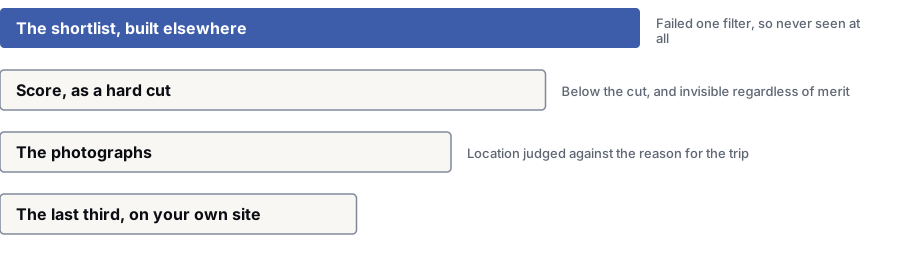
- 1The shortlist, built elsewhere — Guests filter on dates, price, location and score inside a booking site or map, before opening any hotel website.Failed one filter, so never seen at all
- 2Score, as a hard cut — Below a set score the hotel drops out of many searches. Above it, the differences between hotels shrink a lot.Below the cut, and hidden however good it is
- 3The photographs — Room and bathroom photos decide the click far more than the outside does. Guests want to see what they will get.Location judged against the reason for the trip
- 4The last step, on your own site — They check the reviews are real, find the full price and see if booking direct is better. Cheap to answer, yet usually left to others.
Where to spend
Start with organic search, then conversion fixes
In the order we'd put them. Start at the top.
Win searches you don't pay commission on
Booking sites dominate "hotels in [city]" but answer specific searches badly: the hotel near a particular venue, with a certain facility, or the reasons people visit your town. Content built around why guests travel reaches them before the shortlist forms, with no commission on the bookings.
Fix the booking engine first
Most direct bookings are lost between the book button and the confirmation. Show availability on the first screen and the full price, fees and taxes included, early. Make room types distinguishable, stop the mobile flow resetting, and remove any step that suits the hotel but not the guest.
Treat your review score as a revenue number
Your score decides who sees you, so run it as a routine. Ask happy guests for reviews, write replies for the person reading in three weeks, and spot the recurring complaint before everyone mentions it.
Measuring results
What good looks like
These numbers show if your marketing brings in customers. Website visits alone don't.
- Direct bookings as a share of room nights, month by month against the same period last year
- Profit per room night after commission, not gross revenue
- Cost per direct booking by channel, compared with the commission it replaced
- How many guests finish booking once they search availability in your engine
- Average daily rate and occupancy, reported separately for direct and booking-site stays
- Review score, how recent reviews are and how many get a reply
- Share of repeat guests, and room nights from your guest list
- Booking window by type of guest, because it decides when spend must be live
Your website
Your website checklist
- A booking engine one tap away, showing real availability and rates on the first screen
- The full price shown early, including required fees and taxes, not revealed at payment
- Fresh room photos, including the bathroom, the true bed size and the view from a typical floor
- What the direct rate includes that booking sites can't show
- Accurate accessibility details: step-free routes, door widths, bathroom fittings and lift access
- Location content built around why people visit, not just the city
- Reviews on the page with the score and dates, not a hand-picked set of quotes
- A cancellation policy stated clearly next to the rate it applies to
- Fast on a phone on mobile data, since many people book while travelling
The rules
What regulators expect
How you display room prices is regulated, and the rules have tightened in several markets. Rules on showing a total that includes required fees, resort or facility charges and taxes, and on when a price can exclude them, differ by country and often by state or province, and regulators have been active. We build rate displays to the rules of the markets you sell into and ask you to confirm details with your legal adviser. Nothing here is legal advice.
Accessibility statements are relied on and regulated. Calling rooms, bathrooms, entrances and facilities accessible is a claim guests book on, and both the physical requirements and the duty to publish accurate access details vary by jurisdiction. Website accessibility is a legal requirement in more and more markets too. We describe what you have measured, not what the room is called.
Rate parity is a contract matter, and in some markets competition law applies too. What your distribution agreements let you advertise varies by agreement and country, so before publishing any claim that booking direct is cheaper or better value, we ask you to confirm with your legal adviser what your contracts and local rules allow. Where price claims aren't allowed, the direct offer is built around extras outside parity.
Sources
The rules in full
Each rule above, linked to the body that publishes it. Which ones apply depends on where you work. Rules change, so check the latest version.
- US hotels and short-term lodging must show the total price, including mandatory fees, when quoting a price.
- 16 CFR Part 464
- Source: FTC Rule on Unfair or Deceptive Fees (US)
- Prices must include mandatory fees, taxes and charges; revealing them later in the purchase (drip pricing) is unlawful.
- CMA209
- Source: CMA price transparency guidance (UK)
- US ADA: hotel reservation services must identify and describe the accessible features of rooms offered.
- 28 CFR 36.302(e)
- Source: ADA Title III regulations (US)
Questions
Before you hire a hotel marketing agency
The travel agents bring us real business. Should we still push direct bookings?
Yes, but don't try to leave them. Booking sites bring new guests, especially in the shoulder season and in markets where you have no presence, and the hotel next door would take that demand.
Change the mix, not the volume. The bookings worth moving are the ones where the guest already knew you and the booking site showed up first. You can spot those, and winning them back costs a fraction of the commission.
Rate parity stops us being cheaper direct. What can we offer?
Everything except the rate: flexible cancellation, a specific room, early check-in where possible, late checkout, parking, breakfast, or a past-guest rate that isn't shown publicly.
Most agreements limit the price you publish, not what you include, but wording varies. Check your contracts with your legal adviser before building an offer on it.
Our occupancy is strong. Is there anything to fix?
Probably. Occupancy tells you rooms are full, not what they earned. High occupancy with two-thirds of stays through booking sites is a profit problem no occupancy report shows.
Watch profit per room night after commission. If it stays flat while occupancy rises, you're buying growth, and the fix is in distribution, not more demand.
How much does the review score affect what a hotel can charge?
More than most hotels expect, because it filters before it persuades. Guests set a minimum score, and below it you aren't shown at any rate.
Above the cut-off, recency does most of the work. A steady flow of new reviews says the hotel is good now; an older high average looks like a hotel that used to be good.
Is a new website or a new booking engine the priority?
Usually the booking engine, because that's where the money is lost. A good site handing guests to a slow, three-screen engine converts worse than a plain site with a fast one.
Measure how many people drop out between searching availability and confirming. If most losses happen inside the engine, a new website won't help; if the site isn't sending people to the engine, the problem is further up.
What should we do about the photography?
Reshoot the rooms first: the bathroom, the bed at its true size and the view from a typical floor, not the best one. Those answer what guests are unsure about.
Update the set after any refurbishment and use the same photos on your site, map profile and booking site listings. A hotel that looks like three different places across three sites loses bookings.
Ready for more enquiries?
Start with the free checkup. It shows what to fix first on your website, with no sign-up. Want the full plan for your hotel business? Book a call, and we'll look at your market, your competitors and the searches that bring in customers.
Prefer to talk it over? Book a free call
Your BOOSTD score improves within 90 days, or your next month is free. After 6 months, more traffic or leads, or we keep working free (up to 6 free months in any 12 months). Read our guarantee
References
Sources for hotel marketing agency
The official documents and research this page is based on. Platform rules change, so check the source before you act on a detail.
Related
More on hotel marketing
Last updated · Published by Zubair Afzal, responsible editor