
Event & Wedding Venues marketing
Venue marketing agency that turns enquiries into signed dates
Venue marketing for wedding and event spaces that turns enquiries into site visits and signed dates, with capacity, dates and prices shown up front.

What people search
What people type, like “wedding venue for 150 guests”
Capacity and date come first
Checked before anything else. A venue that can't answer both quickly is off the list before it is considered.
- wedding venue for 150 guests
- venues for 200 people [county]
- small wedding venue [city] 40 guests
- venue availability [month] [year] [region]
- barn wedding venue [region] capacity
Style and setting
How the shortlist gets narrowed once the practical checks pass. Almost entirely driven by photos.
- barn wedding venues [county]
- industrial event space [city]
- wedding venues with accommodation [region]
- outdoor ceremony venue [area]
- waterfront event venue [city]
Cost and what is included
Budgets are set early and searched hard. Venues that publish nothing get ruled out by people who could have afforded them.
- average wedding venue cost [region]
- dry hire venue [city]
- what does a wedding venue package include
- venue hire cost per head [city]
- wedding venue minimum spend explained
Corporate events and everything else
A different buyer with a shorter lead time. Often the answer to the midweek dates nobody wants.
- conference venue [city] 300 delegates
- christmas party venue [city]
- awards dinner venue [region]
- team away day venue near [city]
- meeting room hire with catering [town]
These are example searches from keyword research and public search data. Before we suggest anything, we check how often people search for them in your area.
Timing
When people start looking
Bookings are made far ahead: weddings usually twelve to eighteen months out, corporate events three to nine. This year's enquiries fill next year's calendar, so a quiet enquiry month becomes a revenue gap a year later.
Enquiries are seasonal in a way the events aren't. Engagements cluster around Christmas and New Year and corporate budgets are set in the autumn, so campaigns follow when people plan, not when they celebrate.
Summer Saturdays sell themselves. Fridays, Sundays, midweek and winter dates need a different audience, package and sometimes event type. Discounting the scarce dates to fill the plentiful ones is the most common pricing mistake venues make.
Once a date is taken, the whole venue is gone for that day, so whether to hold a date, and for how long, is a business decision, not an admin task.
Suppliers and planners bring a steady share of bookings that never show up in any ad report. Photographers, caterers, planners and celebrants recommend venues they enjoy working at, and that recommendation arrives already trusted.
Enquiry to signed date
How couples and planners go from first search to a signed booking
Nobody looks at anything else about a venue until capacity and date check out. A site that hides either gets dropped before anyone's looked at it properly.
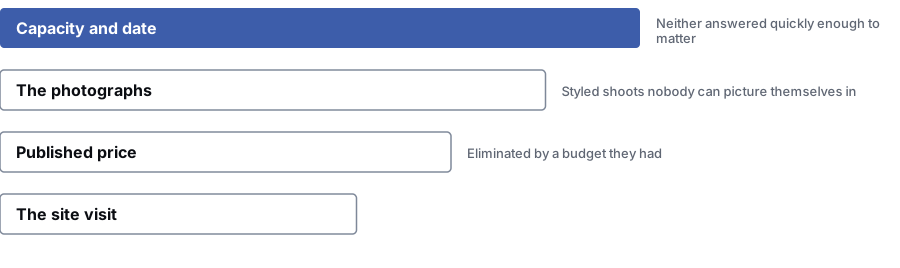
- 1Capacity and date — Checked before anything else about the venue. A site that hides either loses the enquiry before it is even considered.Neither answered quickly enough to matter
- 2The photographs — Photos of real events at the venue beat styled shoots easily. A planner is trying to picture their own day in that space.Styled shoots nobody can picture themselves in
- 3Published price — A price range with what it includes lets people rule themselves in. "Price on application" looks expensive and gets skipped.Ruled out despite having the budget
- 4The site visit — The walk from ceremony to dinner, where the bar sits, the late-afternoon light. The coordinator showing them round is a big part of the sale.
How they choose
Why they pick one business over another
Know how they choose and you know where to show up.
- Capacity and date come first. Nobody looks at the venue until both check out, and a site that hides either loses the enquiry to one that answered in ten seconds.
- Photos build the shortlist, and real events shot at the venue beat styled shoots. Planners are picturing their own day, and an empty styled room shows nothing about how 150 people fit.
- A published price decides whether they enquire at all. A range with what it includes lets people rule themselves in; "price on application" looks expensive and gets skipped.
- The site visit settles it: the walk from ceremony to dinner, where the bar sits, the late-afternoon light, whether the car park is a trek. Almost every booking is decided standing in the room.
- The coordinator matters as much as the venue. People are buying someone to run a day that can't be repeated, so the person who shows them round is a big part of the judgement.
- Recommendations from suppliers and past guests carry extra weight, because both have seen the venue working under pressure.
Common problems
What stops event venue marketing paying off
A venue might take sixty bookings a year, each worth more than a month of revenue for most businesses. There's no volume to smooth out a bad quarter, and no second chance at a date someone else has taken.
Venue marketing has to fit how those bookings get decided: a shortlist built from photos, a check on capacity and date, an enquiry, a visit, then weeks of silence. The number that matters most is how many people came and stood in the room.
- The site never answers capacity or availability.
- A visitor with a guest number and a target month has two questions, and most venue sites answer neither. Publish a capacity table by room and layout and at least the months that still have dates. The numbers change, but a slightly old month view still answers more than silence.
- "Price on application" costs you the enquiry.
- Every event is quoted differently, but a planner with a budget skips you when three other venues gave a figure. Give a "from" price, what it includes and what a typical booking of a given size costs. That filters out people who can't afford you and brings in qualified enquiries.
- The galleries are styled shoots, not the room on the day.
- Empty rooms dressed for a magazine look lovely and help no one. A planner wants to know if 150 people fit, how the room looks with tables in, where the band goes and whether the marquee joins neatly. Photos of real events, dated and with the room named, answer that.
- The enquiry gets one reply and then silence.
- A four-month decision gets one reply and a brochure, while the planner visits four other venues that kept in touch. Good follow-up answers questions as the plan develops, offers a specific visit time, and shows up when a rival venue loses their date.
- Half the calendar is corporate and the marketing is all weddings.
- Many venues earn a big share of revenue from conferences, parties, awards dinners and away days, yet market only weddings. Corporate buyers book at shorter notice, care about parking and audio-visual, and want exactly the midweek dates weddings leave empty, so give them their own content and enquiry route.
Where to spend
Why local SEO comes before the website
In the order we'd put them. Start at the top.
Show up across the whole area people will travel from
Venue searches are local, but people will drive an hour for the right room. Show up for county and region searches, set categories, attributes and photos for the setting people want, and list the practical facts a planner checks before enquiring.
A gallery, a capacity table and a date enquiry
Show real events in your rooms, state capacity by room and layout, and let people ask about a specific date without a generic form. Add a visit booking with real times, because the visit is what all this marketing aims for.
Answer planning questions before the shortlist forms
What a per-head price includes, what dry hire means, how a minimum spend works, what happens if it rains, how long the ceremony-to-dinner turnaround takes. Answer these clearly and you reach planners earlier than any listing site.
Reviews from people who saw the day run
A venue review is written once, months after the enquiry, about a one-off day. Ask at the right moment after the event, prompt for the details a future planner cares about, and reply in a way that shows how you handled what went slightly wrong.
Your website
What your website needs
- A capacity table by room and layout: ceremony, seated dinner, standing reception, dinner with dancing
- Date availability, or at least which months still have dates, updated on a stated schedule
- A starting price with what it includes, and a clear idea of what a typical booking costs
- Galleries of real events held there, dated, with the room named and suppliers credited
- A floor plan and access details: parking, step-free routes, supplier loading and where the marquee goes
- An enquiry form that asks for the date, guest numbers and type of event, and little else
- A site visit booking with actual times, because the visit is what all this exists for
- Accommodation, licensing and finish times stated clearly, not discovered during a viewing
- A separate corporate section, since that buyer wants parking, audio-visual and delegate rates, not confetti
- Fast on a phone, because much of this browsing happens on a sofa in the evening
The rules
Stay inside the ad rules
How you show venue prices is regulated, and the rules differ by country and often by state or province. Service charges, minimum spends, corkage, staffing supplements and taxes get the most attention, and several markets now require the full unavoidable total, not just a headline figure. We write pricing pages to the rules where you trade and ask you to confirm the detail with your legal adviser before publishing. This is not legal advice.
Accessibility statements are relied on and increasingly regulated. Guests book and travel on what you say about step-free routes, accessible toilets, hearing loops, lifts and parking, and the rules for the venue and its website vary by jurisdiction. We publish what has been measured, not what a room is called, and date it.
Capacity, licensing and finish times are set by your premises licence, not your marketing. Advertising a capacity, bar closing time, outdoor ceremony or live music your licence doesn't allow creates risks well beyond advertising rules, and conditions differ between local authorities. Where a figure depends on a licence condition, we state it as the licence does and ask you to confirm it with your licensing authority.
Sources
Primary sources for these rules
Each rule above, linked to the body that publishes it. Which ones apply depends on where you work. Rules change, so check the latest version.
- Prices must include mandatory fees, taxes and charges; revealing them later in the purchase (drip pricing) is unlawful.
- CMA209
- Source: CMA price transparency guidance (UK)
- Premises licences authorise licensable activities, such as alcohol sales and regulated entertainment, on conditions.
- Licensing Act 2003
- Source: Licensing Act 2003 (England and Wales)
Questions
Your event venue marketing questions, answered
We get plenty of enquiries. Why is the calendar not filling?
Because enquiries aren't the problem. The number that decides your year is how many enquiries turn into someone standing in the room, and at most venues that rate is the whole problem.
Measure it by event type. If enquiries are healthy and visits aren't, more advertising just costs more; the fix is in your reply, your follow-up and how easy it is to book a viewing.
Every event is quoted differently. Can a venue publish prices?
Yes: a starting point, not a full price list. A "from" figure for each event type, what it includes, and what a typical booking of a given size costs gives a planner enough to decide whether to enquire.
Saying nothing has a cost you never see. People with enough budget skip venues that won't give a figure, because three others did.
Should we publish availability when dates change all the time?
Yes, at a level you can keep up: a month-by-month view of which months still have dates, updated weekly with the update date shown.
A live calendar is better if your system supports it. Showing nothing doesn't work, because availability is one of the two things people check first.
How do we fill the midweek and winter dates?
Usually with a different buyer, not a discount. Corporate events, conferences, away days, parties and smaller weekday celebrations want exactly the dates weddings leave empty, and book at shorter notice.
Build any package for those dates rather than discounting from the Saturday price. A visible discount on scarce dates teaches next year's couples to wait for one.
What should we do about the supplier and planner relationships?
Treat them as a proper channel. Photographers, caterers, planners and celebrants recommend venues where the day ran smoothly and they got credit, and those recommendations arrive already trusted.
Credit suppliers in every gallery and post, keep a list of who works well at your venue, and make the day run smoothly for them. It costs nothing and keeps growing.
Find your quickest wins
Start with the free checkup. It shows what to fix first on your website, with no sign-up. Want the full plan for your event venue business? Book a call, and we'll look at your market, your competitors and the searches that bring in customers.
Prefer to talk it over? Book a free call
Your BOOSTD score improves within 90 days, or your next month is free. After 6 months, more traffic or leads, or we keep working free (up to 6 free months in any 12 months). Read our guarantee
References
Sources for venue marketing agency
The official documents and research this page is based on. Platform rules change, so check the source before you act on a detail.
Related
More on event venue marketing
- websites for event photographers
- marketing a group of restaurants
- golf club marketingRuns a function business alongside membership, on one calendar.
Guides for event venue
Other hospitality businesses
Last updated · Published by Zubair Afzal, responsible editor