
SEO
What is search intent, and how do you work it out?
Published by Zubair Afzal, responsible editor
First published Updated 7 min read
Definition
What search intent means
Search intent is the goal someone is trying to reach when they type a query, which can differ from the subject. Two people can type the same words and want completely different things. Your job is to work out which want is most common before you decide what kind of page to publish.
In 2002 Andrei Broder, then at AltaVista, published a taxonomy of web search that split queries into informational, navigational and transactional. Practitioners later added commercial investigation. Google’s published guidelines for its quality raters describe query intents in similar terms: wanting to know something, to do something, to reach a particular website and to visit somewhere in person.
Intent has always described a group of people, never a label on a set of words. Each query has a spread of intents, and Google sees that spread at a scale no outsider can. So your best evidence is the page Google returns. The wording of the query and the intent column in a tool are both weaker evidence.
Types of search intent
The four types of search intent and what each looks like
Categories only help if they change what you publish: what the searcher wants, what Google tends to show, and what a business can offer.
| Dimension | What the searcher wants | How the results page tends to look | What a business can offer |
|---|---|---|---|
| Informational | To understand something or find one fact. Often with no plan to buy anything, ever. | Explainers, definitions, question boxes, AI answers, video, and sites with no commercial link to the subject. | The clearest answer available, given early. Any commercial value comes later and indirectly, if at all. |
| Navigational | To reach a specific site, page or account they already have in mind. | One main result with its sub-links, then that brand’s other sites and profiles, then directories that mention it. | Very little, unless you are the destination. Competing for another company’s brand name is expensive and usually pointless. |
| Commercial investigation | To narrow a shortlist. They want comparisons, alternatives, reviews, price ranges and a sense of who to trust. | List articles, comparison articles, review sites, forum threads, and a mix of publishers and vendors. | A fair comparison that includes your own weak points, or a useful tool for deciding. A lot of B2B revenue is won or lost here. |
| Transactional | To act now: buy, book, call, download, sign up, or find a local business that can help today. | Product and service pages, a map for local queries, shopping and ad units, and very few explainers. | A page where they can act straight away, with price, availability, location or credentials visible without scrolling. |
Two ways to judge intent
Guessing search intent versus checking the results
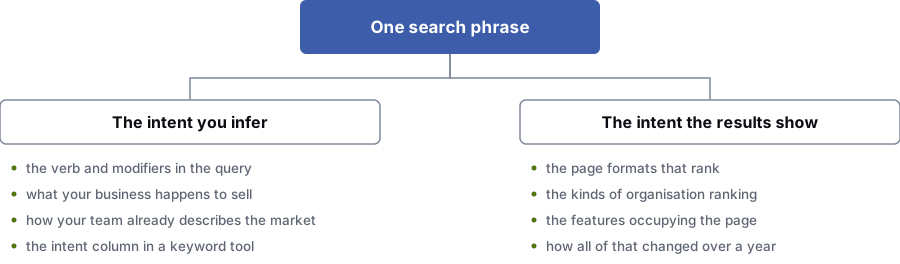
The intent you guess
- the verb and modifiers in the query
- what your business sells
- how your team already describes the market
- the intent column in a keyword tool
The intent the results show
- the page formats that rank
- the kinds of organisation ranking
- the features on the page
- how all of that changed over a year
When the wording misleads
Queries where the wording suggests the wrong intent
For these queries, guessing from the wording gives a confident wrong answer. Check the live results before anyone writes a word.
Only the results page tells you what these queries are, and it usually shows something the wording didn’t.
Questions that are buying queries
Worded as questions, yet service providers fill the results. The searcher is deciding whether to hire help.
- how much does a commercial roof replacement cost
- do i need planning permission for a loft conversion
- how long does a divorce take
- what happens if my boiler is condemned
Product queries that are research
They look transactional but behave like commercial investigation. The results are comparisons and category explainers, because almost nobody buys these in one visit.
- crm software
- commercial insurance
- accounting software for small business
- electric van
Queries whose intent has changed
The page didn’t get worse. The people searching changed, Google followed them, and nothing in your analytics flagged it.
- a category term that used to return product pages
- a how-to question now answered on the results page itself
- a comparison term a marketplace has taken over
- a local term that now shows a map before anything else
These are example searches from keyword research and public search data. Before we suggest anything, we check how often people search for them in your area.
Common mistakes
Common myths about search intent
These six beliefs are all common, and all six are wrong.
- Myth: intent is fixed for each keyword. The same phrase can have a different main intent in another country, on another device or in another year.
- Myth: intent is a setting inside the search engine that you line up with. It describes what people want. Ranking systems try to satisfy that and often only get close.
- Myth: the label in your keyword tool is the intent. Those labels are guessed from patterns in the words, the method this page says is unreliable.
- Myth: intent depends on what you want to sell. A query being valuable to you has no effect on what the people typing it want.
- Myth: matching intent guarantees results. It removes one common reason for failure. Everything else about the page still has to be good.
- Myth: once you have checked intent, you are done. Recheck your important queries at least once a year; intent drifts without warning, and the pages affected look fine.
A page can be accurate, well written and technically sound and still fail, because it answers a different question from the one searchers are asking.
This is the most common avoidable failure in content, and checking for it takes about ninety seconds. Search the query and look at what comes back. If your planned page looks like nothing on that first screen, either you have a useful new angle or you are about to waste a month. Find out which before you commission the page.
A rarer case is a weak results page, where everything ranking is thin, dated or vague because nobody has written a good answer yet. Ask: are the current results the wrong kind of page, or the right kind done badly? The wrong kind is a warning. The right kind done badly is an opportunity.
Questions
Common questions about search intent
What are the four types of search intent?
Informational, navigational, transactional and commercial investigation. The first three come from Andrei Broder’s 2002 taxonomy of web search. Practitioners added commercial investigation later for the stage between researching a category and buying in it: comparisons, reviews, alternatives and "best" queries.
Use the four types as words to describe what you see. Plenty of queries sit between two of them, and that overlap tells you something useful about the query.
How do I find the intent behind a specific query?
Search for it in a clean browser session, from the location you care about, and read the results. The formats that rank, the type of organisation behind them and the features on the page show what Google has concluded people want.
If the first screen is full of comparison articles, the query isn’t transactional, however much you want it to be. If it shows product listings and a shopping row, an explainer won’t compete, however good it is.
Can one page serve two intents?
A page can serve one intent fully and point to the other. Splitting the page evenly leaves you second best at both.
Lead with the main intent and answer it completely, then link readers with the other intent to the page that serves it.
Does intent change over time?
Yes, and it is one of the least watched causes of slow decline. The people searching a phrase change as a market matures, and the results page follows them.
The sign: impressions hold steady while clicks and average position slip, on a page nobody has edited. Search the query again. If the format that ranks has shifted, your page answers a question people no longer ask in that form.
Is search intent a ranking factor?
No, it isn’t a setting you can adjust. It describes what ranking systems are trying to satisfy, which is why matching it matters but never guarantees anything by itself.
Getting intent wrong reliably makes a page fail. Getting it right only lets the page compete on everything else.
References
Sources for search intent
The official documents and research this page is based on. Platform rules change, so check the source before you act on a detail.
Start here
Check the search intent behind your best pages
If a page you rate highly has never performed, check for an intent mismatch first: one search per query. Bring three pages and we will go through them with you.
Rather check it yourself? Try our free SEO tools