
Keyword Research & Strategy
Keyword research services that show which page should rank for what
Our keyword research services map each search need to one page, so you know what to build and your own pages stop competing with each other.

In every planIncluded in Local or Growth, from $149 a month. Every plan has every feature; they differ by size.
Compare plansWhy a map beats a list
Most people expect a spreadsheet of 5,000 phrases. What helps is a map that says which page answers which question.
A list describes what people search for. A map is a set of decisions: this page answers this question, these pages support it, and nothing else competes with it.
A list goes to a writer who picks a row. A map gets used by whoever builds the navigation, briefs the writers, or decides in eight months whether a new page should exist at all.
Why keyword lists fail
What goes wrong when keyword research stops at a spreadsheet
- Nobody knows which page a keyword belongs to.
- Without an assigned page, every writer makes their own call, and six months later three pages answer one question. A keyword with no page isn’t useful yet.
- Priority was set by search volume.
- The biggest keywords are usually the vaguest and most competitive. A phrase with a fraction of the volume but clear buying intent is often worth more, and sorting by volume hides that.
- The main keyword has no page that could win it.
- Some searches are answered on the results page, or held by marketplaces or big publishers you can’t push aside. Putting them first spends budget on a fight nobody checked.
- Existing pages were never checked.
- Research done as if the site were empty suggests pages you already have. The overlap between planned and published is the most valuable part of the analysis, and the most often skipped.
What the extra words tell you
Keywords that look related but need different pages
These examples use one industry, but the pattern works everywhere. The extra words show what the searcher wants, and that decides which page should answer.
Wants to understand the service
Belongs on a page that explains. Sending these searches to a sales page means people leave, and you learn nothing about demand.
- what does a bookkeeper do
- bookkeeper vs accountant
- do i need a bookkeeper
- bookkeeping basics for small business
Wants to buy the service
Belongs on the service page, and only one page should answer. This is where pages competing with each other cost the most money.
- bookkeeping services
- bookkeeper for small business
- monthly bookkeeping service
- hire a bookkeeper
Wants a price
Wants numbers, ranges and what moves the price. A page that avoids price will lose to one that doesn’t.
- bookkeeping cost per month
- how much do bookkeepers charge
- bookkeeping fees small business
- average bookkeeping rates
Wants a specific solution
Each one could have its own page, but only if you do that work and can write something specific about it.
- xero bookkeeper
- catch up bookkeeping behind on books
- bookkeeper for ecommerce sellers
- construction bookkeeping services
These are example searches from keyword research and public search data. Before we suggest anything, we check how often people search for them in your area.
From keyword to page
When a keyword deserves its own page
A spreadsheet can’t make this call for you. We ask these questions once per phrase. Most phrases stop at the first question, because one page can rank for many ways of asking the same thing.
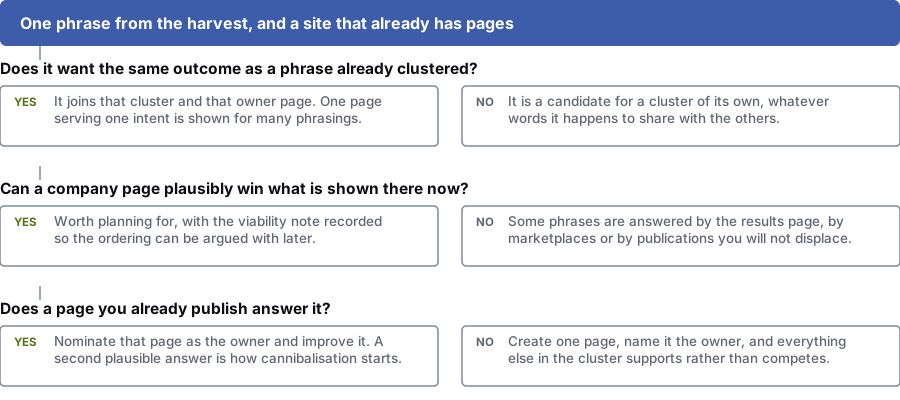
Does it want the same thing as a keyword group we already have?
Yes: It joins that group and that main page. One page for one search need can rank for many phrasings.
No: It may need a group of its own, even if it shares words with the others.
Can a business page win against what ranks there now?
Yes: Worth planning for. We note why, so the order can be questioned later.
No: Some searches are answered by the results page, by marketplaces or by publishers you won’t push aside.
Does one of your pages already answer it?
Yes: Make it the main page and improve it. A second page on the same question sets your pages competing.
No: Create one page and make it the main one. Everything else in the group supports it.
About the numbers
Where search volume figures come from
Only Google counts searches, and it doesn’t publish exact numbers. Every figure is an estimate, and its source tells you how much to trust it.
| Dimension | What it is | Its limits |
|---|---|---|
| Google Keyword Planner | Google’s ad planning data, shown in ranges and meant for budgeting ad campaigns. | Grouped and rounded, with similar phrases lumped together. The numbers also vary with how much your account spends. |
| Third-party SEO tools | Estimates built from browsing panels and other data, scaled up to a national figure. | Panels differ by tool and country. That is why two tools disagree, and why neither is necessarily wrong. |
| Search Console impressions | The only data here that comes from Google about your own site: how often your pages were shown, and for which searches. | Only covers searches you already appear for, hides rare searches, and depends on where you rank today. |
| Autocomplete and related searches | Evidence of how people phrase things and what they ask next. | No volume at all, and shaped by location and personal history in ways you can’t see. |
| Your own site search | What visitors couldn’t find in your menus, in their own words. | Only covers people already on your site, so it says nothing about demand you never reached. |
How we work
What you get from our keyword research
We will
- Deliver a page-by-page map with one main page for each search need
- Show our working, including keywords we considered and dropped, and why
- Show volume as ranges and rough ordering, never as exact counts
- Check what ranks for a keyword before we recommend chasing it
- Tell you when demand for something you sell is too small to plan around
We will not
- Hand over a 5,000-row export and call it a strategy
- Suggest a separate page for every way of phrasing the same question
- Build a traffic forecast by multiplying estimated volume by a guessed click rate
- Sort a plan by volume and call that business priority
- Ignore the pages you already have and plan as if the site were new
Our method
How our keyword research turns search data into a page plan
Gather data from several sources
Tool exports, Search Console, site search, autocomplete, sales-team questions, competitor pages, and the words customers use in reviews and support tickets. Tools alone miss how customers talk.
You get: A full set of search data with sources noted
Group by what searchers want
We group searches that want the same result, then describe the main need of each group in one sentence. Phrases with no words in common often belong together. Near-identical phrases sometimes don’t.
You get: Named groups with the main search need stated
Check what ranks now
For each important group, we look at what shows up: the format, who ranks, how much space ads and features take, and whether a business page can compete at all.
You get: A note on each priority group saying whether it is worth pursuing
Give each search need one main page
An existing page, a page to improve or a page to create. Everything else in the group becomes a supporting page or a section, and it must not compete with the main page.
You get: The map: search need, main page and supporting pages
Check your site for overlap
We find where two of your pages answer the same question, then merge them, make them different or make one the supporting page. This is often where the quickest gains are.
You get: A list of competing pages with a decision for each
Put the tasks in order
Ranked by business value, current position, competition and effort. The reasoning is visible, so you can challenge the order.
You get: A ranked plan and a working file you can keep up to date
Questions
Questions about keyword research
How accurate are search volume numbers?
They are estimates, so read them as ranges. Tools model volume from sampled browsing data and rounded advertising figures, which is why two tools can give very different numbers for one phrase.
We use them to compare phrases, never to forecast traffic. Estimated volume multiplied by an assumed click rate is arithmetic, not evidence.
What is keyword cannibalisation, in practical terms?
Two or more of your pages could each answer the same question, so neither becomes the clear answer. You usually spot it when the ranking page for a search keeps switching between two URLs.
The fix is a decision. Pick the page that answers it, rewrite the other for a different need, or merge them. Adding a canonical tag without changing the content only hides the problem.
Can one page target several keywords?
Yes, and it should. A page that serves one search need well will show up for many ways of phrasing it, including ones nobody researched.
What it can’t do is serve two different needs. A page that defines a term, compares five products and sells a service does all three worse than three separate pages.
Do we need this if we already have a keyword list?
It depends on the list. If it says which page owns each search need, what that page must do and how the pages link together, you already have a map and may not need us.
If it is a list of phrases with volume and difficulty columns, nobody has turned it into decisions yet. That step takes judgement, and it is the part we do.
How long does this take?
Usually two to four weeks, depending on site size and how many markets you cover. Gathering data is fast; grouping it, checking results and reviewing your pages for overlap takes longer.
If your site is being rebuilt, it is best to do this before the site structure is signed off.
Get the keyword map before you build the pages
If a rebuild or new content is coming, now is the cheapest time to get the structure right. Tell us what you sell and where, and we will tell you what the research needs to cover.
Prefer to talk it over? Book a free call
Your BOOSTD score improves within 90 days, or your next month is free. After 6 months, more traffic or leads, or we keep working free (up to 6 free months in any 12 months). Read our guarantee
References
Sources for keyword research
The official documents and research this page is based on. Platform rules change, so check the source before you act on a detail.
Related
More on keyword research
- turning the keyword map into pagesThe map decides which pages exist. Content work makes them perform.
- auditing the pages you already havePages competing with each other usually show up here first.
- keyword research across languages
- building the site structure the map calls for
- SEO vs PPC: where each one pays off
Where keyword research matters most
Problems keyword research can fix
More SEO services services
Last updated · Published by Zubair Afzal, responsible editor