
International SEO
International SEO for businesses selling in more than one country
International SEO starts with one choice: country domains, subfolders or subdomains. Then hreflang that validates and pages adapted to each market.
Your free checkup
ExampleScore 58 out of 100. Could reach 74
Tap a check to see what we’d fix first. Anything big waits for your approval.
Google Business ProfileNeeds work
Pick the main category people search for and list every service you offer.
Mentioned in AI answersMissing
Answer the questions customers ask, clearly, on the pages AI tools read.
Speed on phonesGood
Nothing to fix now. We keep an eye on it as you add pages.
Pages Google can findGood
All found. New pages get linked from your menu so they stay that way.
Managed SEODone by our specialist team on top of the platform, with a monthly meeting and a price agreed with you.
See Managed SEOThe first big decision
Country domains, subfolders or subdomains
Expensive to undo, and often made by whoever registered a domain first.
| Dimension | ccTLD (example.de) | Subfolder (example.com/de/) | Subdomain (de.example.com) |
|---|---|---|---|
| Country targeting | Strongest, and automatic. The domain itself says which country it serves. | Clear once set up, and backed up by content, currency, language and links. | Workable but the weakest of the three. Search engines and users often find it unclear. |
| Authority | Each domain starts from zero and has to earn its own links and history. | Every market shares the authority of one domain. New markets launch from a strong base. | Treated as related to the main domain, but not the same. Authority carries over less reliably. |
| Local trust with buyers | Highest. In several markets, buyers prefer a local domain. | Good, as long as the page shows local currency, contact details and terms. | Neutral. It rarely gains or loses trust by itself. |
| Cost and upkeep | Highest. Separate registrations, hosting, certificates, deployments and often separate teams. | Lowest. One codebase, one deployment, one set of templates. | In the middle. One brand, but often separate infrastructure in practice. |
| Best when | A market is large or legally separate, or buyers there trust local domains more. | You are growing into several markets and want each to help the others. | A platform limit forces separation, or a market runs on different technology. |
| Where it causes problems | Ten small markets, each with a weak domain nobody links to. | Regional teams who wanted independence now share one release process. | A mixed signal: neither the shared authority of a subfolder nor the clear targeting of a country domain. |
The second decision
Why international SEO needs localisation as well as translation
A translated site says the same things in another language. Fine for a manual, but not a sales page, because the words people search for are not a translation of yours.
A product can have one name in one country and a different one next door, even in the same language. A selling point that leads in one market is restricted wording in another. A payment method that is normal at home can be the biggest trust factor elsewhere. A translator with no market brief never hears about any of this.
Localisation starts from local search demand, researched in the market's language, and a brief for what the page must cover there. Often the result is a different page, with a different focus and order.
The same applies to markets that share your language. A UK page with local rules, prices and providers is a different page from its US version. If you cannot list what would differ, you may not need a separate version.
How a market launch works
From choosing a market to a local site that performs
Choose markets based on evidence
Local-language search demand, competition, the cost of serving the market, and whether you can legally and practically sell there. Sales targets are one input. Entry order matters more than most teams expect.
You get: A ranked market list with the reasons for each position
Decide the structure
Country domain, subfolder or subdomain, decided for your whole market list at once. We include the cost of moving from your current setup, which often settles it.
You get: A structure recommendation with a migration and risk assessment
Set up hreflang properly
Correct language and region codes, return tags both ways, self-referencing entries and an x-default, placed in the page code, headers or sitemaps. Then we keep checking them as pages change.
You get: hreflang specs and an ongoing validation report
Write from local demand
Keyword and question research in the market's language feeds briefs for each page. Translation happens inside that brief.
You get: Content briefs and localised sales pages for each market
Cover local search engines
Where Google is not the main search engine, the rules change. We check whether the market share justifies separate work.
You get: A search engine assessment for each market, with any extra requirements
Measure each market separately
Separate starting points, targets and reports. Averaging a new market with one you have led for ten years hides both the wins and the problems.
You get: Market-level reports with their own starting points
What hreflang can and cannot fix
Is hreflang the fix for your problem?
hreflang fixes wrong-country problems, not ranking problems. These questions show which one you have.
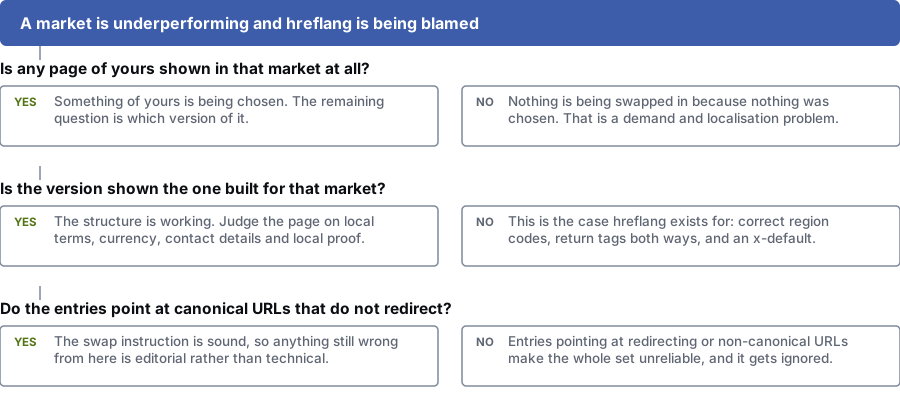
Do any of your pages show in that market?
Yes: Google is picking something of yours. The question now is which version.
No: Nothing is being swapped because nothing was picked. That is a demand and localisation problem.
Is the version shown the one built for that market?
Yes: The structure works. Judge the page on local terms, currency, contact details and local proof.
No: This is what hreflang is for: correct region codes, return tags both ways, and an x-default.
Do the entries point at canonical URLs that do not redirect?
Yes: The tags are sound, so anything still wrong is about the content.
No: Entries pointing at redirecting or non-canonical URLs make the whole set unreliable, and Google ignores it.
Common problems
Four problems behind most weak international results
- hreflang is set up but showing errors.
- Usually missing return tags, region codes used where language codes should be, entries pointing at redirecting or non-canonical URLs, or templates building tags from an out-of-date list. If many URLs have errors, Google treats the whole setup as unreliable.
- Your English sites are competing with each other.
- UK, US, Australian and Canadian versions have near-identical content. Google picks one, often the wrong one for the market. It looks technical, but the fix is mostly editorial.
- Visitors are redirected by IP address.
- It seems helpful, but crawlers visit from a few locations, so most country versions may never be crawled. A banner suggesting the local version helps visitors and keeps every version in the index.
- Each regional team built its own site.
- Five country domains, five agencies, five structures and no links between them, so each is a small, weak site. Merging them is a big project with internal politics, and usually the most valuable thing a global brand in this position can do.
What is included
What our international SEO service covers
The scope depends on whether you are entering your second market or fixing fifteen.
- Search demand research done in each local language
- A domain structure recommendation, including the cost of moving from your current setup
- hreflang specs, setup help and ongoing checks
- Search Console setup and targeting for each market
- A plan to make your English sites distinct, or merge them
- Local content briefs based on how people search and the rules they follow
- Currency, payment, contact and trust requirements for each market
- Earning local links and press coverage in the target market
- A check on non-Google search engines where their market share justifies it
- Reports for each market, with separate starting points and targets
Questions
What teams ask before expanding abroad
Should we use country domains, subfolders or subdomains?
For most businesses, subfolders on one strong domain. Every market shares its authority, there is one site to maintain, and a new market is a new folder.
Country domains make sense when buyers trust local domains more, a market is big enough for its own site, or the law requires separation, but each starts from zero. Subdomains sit awkwardly in between and are usually chosen for platform reasons.
What does hreflang do?
It tells Google that several pages are versions of each other for different languages or regions, so it can show the right one to each audience. It swaps pages. It does not boost rankings.
If a page is not ranking in a market, hreflang will not fix it. If the wrong country version is ranking, it usually will. Most setups go wrong on the return tags, which have to point both ways.
We have UK, US and Australian sites in English. Is that a problem?
Yes, it is one of the most common international problems. Three near-identical English sites with no clear market signals compete, and Google has to guess which belongs where.
The fix is partly technical: hreflang with the right region codes, an x-default and correct targeting. It is also editorial: local prices, terms, contact details, examples and rules. If there is nothing different to say, you may only need one English site.
Should we redirect visitors based on their location?
Not automatically. Crawlers visit from a few locations, so automatic redirects can leave most country versions unindexed. They also annoy travellers and anyone who wants a different version.
Suggest the local version with a dismissible banner and remember the choice. Every version stays crawlable.
Is Google the only engine we need to think about?
In most Western markets, yes, with Bing worth attention where desktop and office use is high. Local search engines have a big share in China, Russia, South Korea, the Czech Republic and Japan, among others, each with its own rules.
We flag which markets need separate work. A second search engine costs money, so it is only worth it when the share justifies it.
Do we need to translate the whole site?
Rarely all of it. Sales pages, pages that answer buying questions, and anything with legal or regulatory weight need local versions. Old archive content often does not.
Localisation matters more: their search terms, currency, examples and rules. A translated page uses your words in their language. A localised page uses their words.
Decide your domain structure before anything gets built
The domain decision is cheap to get right now and expensive to change later. Bring us your plan and we will show what each option costs across your next five markets.
Prefer to talk it over? Book a free call
Your BOOSTD score improves within 90 days, or your next month is free. After 6 months, more traffic or leads, or we keep working free (up to 6 free months in any 12 months). Read our guarantee
References
Sources for international SEO
The official documents and research this page is based on. Platform rules change, so check the source before you act on a detail.
Related
More on international SEO
- why SEO timelines differ so muchThe factors that set how fast results come.
- the technical groundworkhreflang and country targeting start as build tasks.
- SEO programmes with many stakeholdersRegional teams wanting their own way is often the hardest part of a global rollout.
- our United Kingdom market work
- search in the United Arab EmiratesA market where language and audience rarely line up neatly.
- redesign and replatform projectsThe cheapest moment to make structure decisions.
- ecommerce SEO for large cataloguesInternational stores face both problems at once.
Where international SEO matters most
Problems international SEO can fix
More SEO services services
Last updated · Published by Zubair Afzal, responsible editor