
Website Redesign
Website redesign services that keep the traffic you already have
Our website redesign services keep the pages that already bring you visitors and enquiries. We measure your traffic first, then map every old URL to its new home.
Proposed change
ExampleHomepage headline
- Loads fast on phones
- Clear call button
- Quote form works
- Easy to read
New website serviceFast, search-ready websites built in Next.js, with hosting and care included. Your checkup says plainly whether you need one.
See the new-website serviceA website redesign is also a site migration
A website redesign is a migration with a new look on top. The design is what everyone sees. What decides whether you come out ahead is what happens to every URL, search signal and page that brought in business.
Redesigns are usually led by people who care how the business looks. The risk sits with people who understand crawling and redirects, and they are often not asked until the build is finished.
We bring both in from day one, and produce the benchmark, URL list and redirect map before the first template is designed. Nobody pieces them together from memory in launch week.
Where traffic goes
How redesigns lose traffic you already paid for
The same few mistakes cause most of the damage, and each can be spotted months before launch if someone is looking.
- Somebody tidied up the URLs.
- In a planning meeting, someone decides the site would read better with different URLs. It probably would. But every changed URL needs a redirect that loses a little and must be kept forever. Changing a thousand URLs for looks is a lot of risk for no business gain.
- Pages that ranked were rewritten by someone who did not know they ranked.
- A copywriter asked to improve the old site shortens a long, detailed page that ranked for four years because it was long and detailed. Nobody had a list of the pages that mattered, so nobody warned them.
- Content was dropped when it should have been moved.
- Old guides, archived posts and older service pages get dropped because they do not fit the new templates. They often hold the links from other sites that the whole domain depends on.
- Redirects were written in launch week.
- A redirect map rushed out at the last minute gets the top fifty pages right and guesses the rest, often pointing them at the homepage. Google treats mass redirects to the homepage as soft errors, so those pages are in effect deleted.
- Nobody recorded a starting point.
- Six weeks after launch, people disagree about whether traffic is down. Without a benchmark of visits, rankings and conversions by page and template from before launch, nobody can settle it, and nothing gets fixed.
What gets lost
What makes it to the new site
Each stage of a redesign drops some pages, usually for a reason that made sense to someone at the time. The traffic that reaches the new site is whatever the earlier stages left behind.
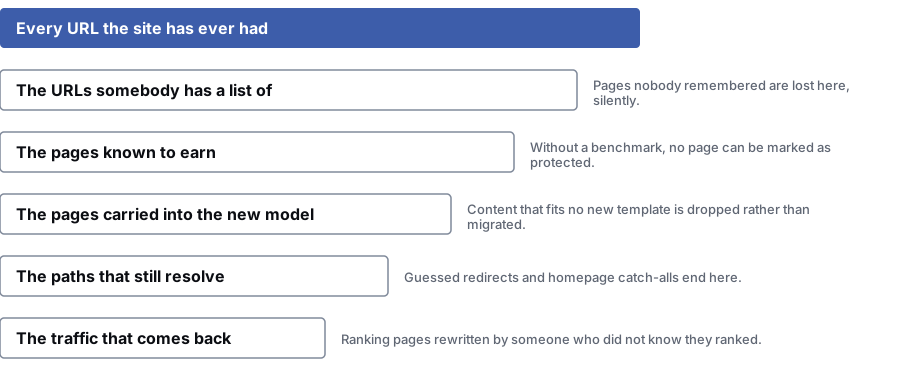
- 1Every URL the site has ever had — More than the current menu or sitemap. The full history, including old guides and archived posts.
- 2The URLs someone has listed — If a page is not on the list, nobody makes a decision about it and nobody writes a redirect for it.Pages nobody remembered are lost here without anyone noticing.
- 3The pages known to bring in business — Search visits, conversions, links from other sites and internal links, measured and dated before anything changes.Without a benchmark, no page can be marked as protected.
- 4Pages moved into the new structure — Older service pages and guides get dropped when they do not fit the new templates, and they often hold the links.Content that fits no new template gets dropped here.
- 5The URLs that still work — A redirect map written in launch week gets the top fifty right and guesses the rest. Mass redirects to the homepage act like deletions.Guessed redirects and redirects to the homepage stop here.
- 6The traffic that comes back — Indexing moves within days and rankings take four to six weeks. Compare the results with the benchmark.Ranking pages rewritten by someone who did not know they ranked.
How we run it
Our website redesign process, step by step
The order of the steps is what protects you. A design change made after the URL list is cheap. The same change made after launch is not.
Record a benchmark before anything changes
We record search visits by page, rankings for the searches that matter, conversion rate by template, Core Web Vitals data from your visitors and the links pointing at your site. It is dated and stored, so later disagreements can be settled with evidence.
You get: Dated benchmark taken before the redesign
Decide what to keep
Every URL gets one of four decisions: keep as it is, keep and improve, merge into a better page, or retire and redirect. We mark the pages that bring in business as protected, so nobody rewrites them later without a reason.
You get: A list of every URL with a decision on each
Design around the structure you have
We design templates for the pages that exist and the pages the URL list says you need. If the structure has to change, we change it on purpose and work out the redirect cost first.
You get: Sitemap, content structure and page templates
Write the redirect map early
We write it during the build and crawl-test it on a staging copy for chains and loops, against every URL the site has ever had, not only the current sitemap.
You get: Tested redirect map and crawl report
Launch in stages when it makes sense
When search matters to your business, the new site goes live in parts, checked one at a time. If something goes wrong, you lose one section for two weeks, not the whole site for three months.
You get: Launch plan with a way to roll back each stage
Monitor, then report against the benchmark
In the first weeks we watch indexing, crawl errors, redirects, speed and conversions. At 30 and 90 days we send you a written comparison with the benchmark.
You get: 30 and 90-day comparison with the benchmark
Our commitments
What we commit to on every relaunch
On every redesign we
- Record and date a benchmark before any content or structure changes
- Make a decision for every URL the site has ever had, including pages missing from the menu
- Test the redirect map on a staging copy with a full crawl before launch day
- Protect pages that already bring in business, and name them in the brief for writers and designers
- Report the first 90 days against the benchmark, including anything that got worse
What we will not do
- Change URLs to look tidier when there is no business reason
- Redirect retired pages to the homepage in bulk
- Let a copy refresh rewrite a ranking page without a reason and a record of the change
- Launch on a Friday, or on any day when the people who can fix problems are away
- Promise you will keep every ranking. Nobody can.
Questions
Questions to ask any agency before a redesign
Will a redesign hurt our search rankings?
It can. It is one of the most common ways businesses lose search traffic. The risk rarely comes from the new look. It comes from changed URLs, deleted pages, rewritten ranking pages, new internal links and template changes to headings and structured data.
Treated as a migration, most of that risk can be managed. Expect some movement for a few weeks while Google recrawls. A steady drop three months later is different, and can usually be traced to one decision.
Should we keep our existing URLs?
Yes, unless there is a business reason to change them. A URL with links and years of history has value, and "it looks neater" is not a reason to give that up.
Sometimes the structure does hold you back, such as a flat site that cannot separate services, industries and locations. Then we change it on purpose and map every old URL to a new one.
What is a staged migration and do we need one?
A staged migration launches the new site one section or template at a time, checking results between each. It is slower than switching everything over at once.
It is worth it when search brings in a good share of revenue, the site is large or the structure is changing. For a fifteen-page brochure site with little search traffic, one switchover is fine and costs less.
How do you decide which pages to delete?
From data, not from how old a page looks. For every URL we check search visits, conversions, links from other sites, internal links and whether it answers a search no other page covers.
Pages that fail every check are retired and redirected to the closest match. Pages that quietly bring in visitors are kept, even when nobody remembers writing them. Old guides with links pointing at them are the usual example.
How long after launch until we know it worked?
Indexing and crawl errors show within days, but a fair ranking and traffic comparison takes four to six weeks. Because of seasonal swings, compare with the same period last year.
Conversion rate is the fastest signal. If the new templates convert better on the same traffic, a site with steady volume will show it within two weeks.
Can you redesign the site without rebuilding the platform?
Often, yes. If the content structure works and the platform is not holding your team back, a new design on the existing templates is a much smaller and safer project.
We tell you which case you are in before we quote. Sometimes a new platform and design together is right, but doing both at once makes it harder to find the cause if something goes wrong.
Find out which pages bring in your enquiries
Before you hire anyone, find out which pages a redesign could break. We will go through them with you and tell you how much risk your project carries.
Prefer to talk it over? Book a free call
Your BOOSTD score improves within 90 days, or your next month is free. After 6 months, more traffic or leads, or we keep working free (up to 6 free months in any 12 months). Read our guarantee
References
Sources for website redesign services
The official documents and research this page is based on. Platform rules change, so check the source before you act on a detail.
Related
More on website redesign
- a fixed-price new website built for SEOWhen the old site is too slow or too limited to keep.
- site speed and Core Web Vitals workA redesign is the cheapest time to fix a slow site.
- launching a new website safelyThe same problem, looked at from the launch side.
- reasons organic traffic falls
- the pre-launch checklist we use
- website redesign checklistThe checklist to use if your own team is running the redesign.
- SEO website migration serviceFor when the domain or URL structure changes too.
Where website redesign matters most
More web design & development services
Last updated · Published by Zubair Afzal, responsible editor