
Websites
Website redesign checklist: 14 things to settle before design starts
Published by Zubair Afzal, responsible editor
First published Updated 7 min read
Most redesign problems start before a designer opens a file. They are decided then, or left undecided. The launch is only where they show up.
The technical launch checklist (redirects, indexing, keeping tracking working and the first weeks of monitoring) is your website redesign SEO checklist, and we keep an interactive one for it. This page is the earlier list.
Two checklists
Why the pre-design checklist matters more than the launch checklist
The pre-design checklist matters more because launch day is too late to change the decisions on the left. The technical launch list is well covered and still needed. The result of a redesign is settled earlier.
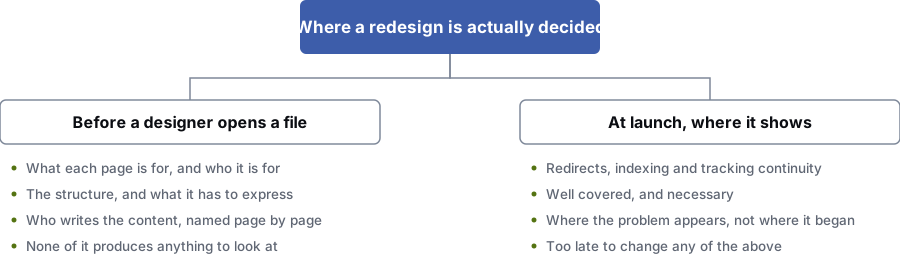
Before a designer opens a file
- What each page is for, and who it is for
- The site structure, and what it has to show
- Who writes the content, named page by page
- None of it produces anything to look at
At launch, where problems show
- Redirects, indexing and keeping tracking working
- Well covered, and still needed
- Where problems appear after starting earlier
- Too late to change anything on the left
The checklist
The website redesign checklist: 14 things to settle first
If you can answer them all, you have a brief. If you can’t answer the first three, nothing else on the list will help.
- What the business needs the site to do, in one sentence, agreed by the person who has the final say
- The three or four actions a visitor should be able to take, in order of priority
- Who the site is for, described clearly enough that it rules some people out
- A full list of your current pages, with traffic, entrances, enquiries and inbound links for each
- A keep, rewrite, merge or remove decision recorded for every page on that list
- Twelve months of performance data, exported and stored outside your analytics account
- Who writes each new page, and the date they have agreed to deliver it
- The one person who can approve a design without asking anyone else
- What happens to the blog archive, decided up front so nobody discovers it at launch
- Whether the platform is changing, and if so, who looks after it afterwards
- The connections that must keep working, listed by name: forms, CRM, booking, payments and marketing tools
- The accessibility standard the site must meet, written into the brief
- The speed standard, measured on real visits. A score from a testing tool isn’t enough.
- What you own at the end: design files, code, content, hosting accounts, domain and analytics access
In order
Five stages to plan a website redesign, in order
Each stage produces what the next one needs.
List every page you have now
List every page, with its traffic, entrances, conversions and inbound links. Most businesses find their site is much bigger than they thought, and that a few pages bring in nearly all the results.
You get: One spreadsheet listing every page with its performance data
Decide what happens to each page
Give every row one of four decisions: keep, rewrite, merge or remove. Your new site structure then comes from evidence, not a workshop diagram, and the redirect map later just copies the decisions across.
You get: A keep, rewrite, merge or remove decision for every page
Benchmark before anything changes
Export twelve months of performance data and store it outside your analytics platform. Without it, nobody can prove whether the new site beats the old one, and memory tends to side with whoever paid for the project.
You get: A twelve-month benchmark, exported and kept outside your analytics account
Write the brief, including the limits
Cover your goals, audience and the actions that matter most, the site structure from stage two, the connections that must keep working, the accessibility and speed standards, and who approves what. It makes quotes comparable and stops reviews turning into a contest of opinions.
You get: A written brief another agency could quote from without asking you anything
Agree the terms before you sign
Agree who owns the code, design files and content, who holds the domain, hosting and analytics accounts, what documents you get at handover, and what happens if the project stops halfway. Cheap to agree before signing, expensive to argue about afterwards.
You get: Ownership, handover and exit terms written into the contract
Decide these early
Four redesign decisions people put off, and why they shouldn’t
Easy to put off, and costly later.
Who writes the content
Name one person for each page, with a date. "We will sort content out as we go" doesn’t count. Content is a common reason redesigns overrun, and the one part a design agency can’t produce without your business’s knowledge.
Who gives final approval
Name one person who can approve a design without asking anyone else. Without that person, reviews turn into a contest of taste, usually won by the most senior person in the last meeting, who may not know your customers best.
What happens to the archive
Years of blog posts, old service pages, case studies and news items. Some bring in traffic and links; most don’t. Deciding page by page takes effort, but deciding by accident at launch, under time pressure, is worse.
Who looks after the site afterwards
If the platform is changing, this decides which platform suits you. A custom codebase handed to a business with no developer becomes a site nobody can change, a problem that shows up about eighteen months after a launch that looked fine.
The contract
What to put in a website redesign contract, and warning signs
Insist on these
- You own the design files, the code and the content when the project ends, stated in writing.
- Your domain, hosting, analytics and Search Console accounts are registered to your business. The supplier doesn’t hold them.
- A full page inventory and redirect map are included in the scope, with a price attached.
- A set support period after launch, with what it covers written down.
- Handover documents good enough for a different supplier to take over without starting from scratch.
Treat these as warnings
- A quote with no content plan. The content still has to be written, and the cost has been passed to you.
- A fixed price with no page count or defined scope. It turns into arguments over change requests later.
- Hosting that only the agency who built the site can provide, with no way stated to move it.
- A launch date agreed before the content deadlines. One of those two dates won’t hold.
Questions
Common questions before a website redesign
How much of this can the agency do for us?
Most of it, except deciding what your business wants the site to achieve and supplying the knowledge in your team’s heads. The page inventory, site structure and benchmarks can be handed over, though it usually costs less if you do a first pass yourself.
Preparing yourself also makes quotes comparable. Three agencies reading a vague brief three different ways send back three prices you can’t compare.
What is the most common reason a redesign runs late?
Content. Design can carry on with placeholder text for a while, then it stalls, because the content has to come from people in your business who have other jobs. Deciding who writes what, and by when, before design starts is the best way to protect the schedule.
Another common cause is a review process with no agreed standards, where each round brings new opinions and nothing gets signed off.
Do we need to keep all our old pages?
No, but every decision to remove a page should be made on purpose and written down. Pages that bring in traffic, links or enquiries should survive in some form. Pages that bring in nothing can go, and removing them often improves the site.
The damage comes when pages vanish because nobody knew they existed. A page inventory prevents exactly that.
How long should we benchmark before starting?
Long enough to cover your busy and quiet seasons, which for most businesses means the last twelve months. Export the data and keep it outside your analytics account, so a later platform change can’t wipe it.
Six months after launch, someone may say the new site is doing worse. A saved record settles the question; without one, two people remember it differently.
Should the content be written before or during design?
Before, at least in draft, for your most important pages. Designing around real content gives you layouts that fit what you need to say. Designing around placeholder text gives you layouts your content then has to be squeezed into.
Writing early also shows, while there is time to fix it, whether anyone in the business can yet explain what you do in three sentences.
References
Sources for website redesign checklist
The official documents and research this page is based on. Platform rules change, so check the source before you act on a detail.
Related
Keep reading on website redesign checklist
Start here
Want us to check your redesign brief before you send it?
Send us the brief you are about to give to agencies. We will point out what is missing, what will lead to change requests later, and what will produce quotes you can’t compare.
Want to see how your own site stacks up? Get my free SEO audit