
Websites
Six signs you need a new website, and four a cheaper fix solves
Published by Zubair Afzal, responsible editor
First published Updated 8 min read
Start here
Do you need a new website? Why a rebuild should be the last option
You need a new website only when the problem is in its foundations, and most problems aren’t. A rebuild takes months and on its own only raises your costs, yet it is the first thing suggested when marketing isn’t working, partly because the people being asked often sell rebuilds.
Sometimes a rebuild is the right call, because no amount of work on the current site will reach a problem in the foundations. From the outside the two kinds of problem look the same, and they cost very different amounts to fix.
A simple rule: problems with what the site says, how it looks, how fast it loads or how well it converts can almost always be fixed on your current site. Problems with what the site is built on, how it is structured and who can change it usually can’t.
Foundations or surface
Three questions to tell if your website needs rebuilding
Answer these three questions to see if your website needs rebuilding. Each one either settles the matter or moves you on to the next. A rebuild is only the right answer after a "no".
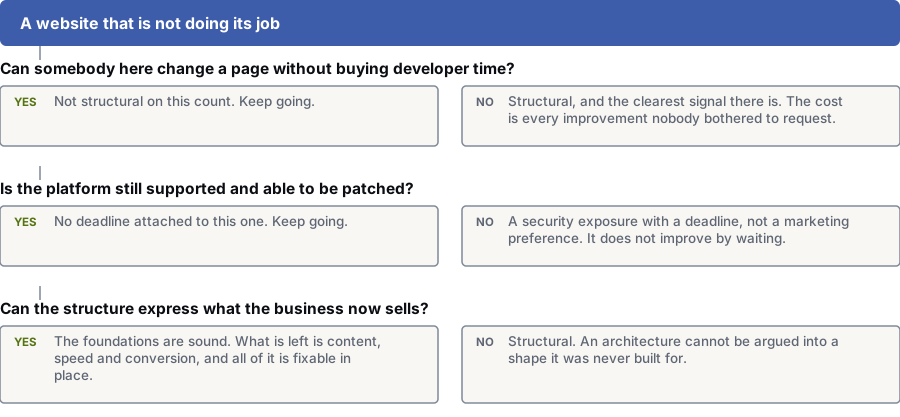
Can someone here change a page without paying a developer?
Yes: No foundation problem here. Move to the next question.
No: A foundation problem, and the clearest sign. It costs you every improvement nobody bothered to ask for.
Is the platform still supported and able to get security updates?
Yes: No deadline on this one. Move to the next question.
No: A security risk with a deadline. Waiting won’t make it better.
Can the structure fit what the business now sells?
Yes: Sound foundations. What is left is content, speed and conversion, all fixable on your current site.
No: A foundation problem. A structure can’t be pushed into a shape it was never built for.
Good reasons to rebuild
Six signs you need a new website
Each problem comes from how the site is built, so work on the current site can’t reach it.
- Nobody in the business can change a page without paying a developer.
- The clearest foundation problem there is. If changing one paragraph needs a quote and a two-week wait, the site stops being updated and soon becomes inaccurate. The bigger cost than the developer bill is every improvement nobody bothered to ask for.
- The platform is unsupported or can’t be patched.
- A content management system at end of life, a framework version that no longer gets security updates, or a custom build whose developer you can’t reach. This is a security risk with a deadline, and waiting won’t make it better.
- The structure can’t fit what the business now sells.
- The site was built for three services and you now offer eleven, or for one country and you now work in four, or your product range now has variants and categories the templates can’t show. Squeezing new pages into a structure that can’t hold them makes navigation nobody can follow.
- Accessibility problems are built into the templates.
- Colour contrast and image descriptions can be fixed on any site. Keyboard navigation order, focus handling, form labels and heading structure often can’t be when a page builder generates code you don’t control. Then fixing them costs more than replacing the site, and you are still boxed in.
- The mobile site is in effect a separate, worse site.
- A separate mobile version with less content or a different structure, or features that only work with a mouse. Most visits come from phones, so this is a main concern, usually from a site built before mobile came first.
- The site has to do something it was never built to do.
- Taking payments, holding customer accounts, connecting to an operational system, serving several languages properly, or publishing more than the current setup can handle. Nothing is broken; what you need has changed. It is the strongest reason on this list, because you can write the case down in business terms.
Rebuild, redesign or fix: which does your website need?
They differ a lot in size, and the middle option is the one most often skipped.
| Dimension | Rebuild | Redesign on the same platform | Fix on the current site |
|---|---|---|---|
| What it changes | Platform, structure, templates and how content is organised. In effect, a new site. | Visual design, templates and page layout, on your current platform and content setup. | Specific pages, copy, images, speed, forms and the steps people take to enquire or buy. |
| What it can fix | Ease of editing, unsupported technology, built-in accessibility problems, site structure and new features. | Look, navigation, messaging, layout and conversions, without touching the foundations. | Speed, clarity, messaging, forms, individual pages and most conversion problems. |
| Risk to your current search rankings | Highest. URLs, content and structure all change at once, so it is a site migration whatever you call it. | Moderate, and manageable if you keep your URLs and don’t drop content without a decision. | Low. Changes are small and each one can be undone. |
| Typical time taken | Months. Content usually holds things up more than development. | Shorter, because the platform, connections and content setup already exist. | Days to weeks per change, carried out as ongoing improvements. |
| When it is right | When the foundations are the problem: the platform, ease of editing, the structure or a new feature. | When the foundations are sound but the look, layout or message isn’t. | When the site works but specific pages or steps are underperforming. |
| How it goes wrong | You spend a large budget and end up with the same content and the same problems in a nicer design. | You find halfway through that the platform can’t support what the design needs. | You keep patching around foundations that do need replacing. |
An example: site speed
Is a slow website a sign you need a new one?
Usually not. These are Google’s published Core Web Vitals thresholds, measured from real visits, not a testing tool score. Failing them is a strong warning sign, and a weak case for a rebuild.
Because these are measured on real devices, a site can pass every lab test and still fail the measurement that counts, and a low testing-tool score is a reason to look closer, not a verdict.
Failing these thresholds is often presented as proof a site is finished. It usually isn’t: the common causes are oversized images, too many third-party tags and a slow server, all fixable without replacing anything. Rebuild only when someone diagnoses that the way the pages are built causes the slowness, and shows you the evidence.
Not reasons to rebuild
Four problems a cheaper fix solves without a new website
These problems are real, but none shows that the foundations need replacing, and each has a smaller fix.
- It looks dated. A visual refresh on your current platform fixes this. First ask whether looking dated costs you anything measurable, or mainly bothers the people who work there.
- A competitor launched a new site. That tells you nothing about your foundations. If theirs converts better, find the specific thing that works and borrow the idea.
- Organic traffic dropped. Rebuilding during an unexplained drop destroys the evidence and adds a site migration to the problem. Diagnose the drop first; the cause often has nothing to do with the site.
- The site brings in no enquiries. This is usually about traffic quality, a mismatch between ad and page, or too many steps to enquire, all testable on your current site for far less. If you still need a rebuild afterwards, you will know much more about what to build.
Questions
Common questions about getting a new website
How often should a website be replaced?
There is no set interval, and replacing a site on a schedule is how businesses pay for the same problems again. A well-built site on a maintained platform, with a clear structure, can last many years with regular updates.
Replace it when something in its foundations is holding the business back: the platform, the structure, how hard it is to change, or how it fails people who use assistive technology.
Our site is slow. Is that a reason to rebuild?
Rarely, on its own. Most slow sites have three causes: large uncompressed images, too many third-party scripts, and slow hosting. All three can be fixed without touching the design.
Speed becomes a foundation problem when the way the pages are built causes it, such as a page builder that produces bloated, deeply nested code, or a site that shows nothing until a large file has downloaded and run.
Will a new website improve our rankings?
Not by itself, and a redesign can easily hurt your rankings. Search performance depends on content, structure, links and technical health, which a new site can improve, or lose if URLs change without a proper redirect map.
If better search performance is the reason for the project, write the SEO tasks into the plan.
The site looks dated next to our competitors. Is that enough?
It can matter, but it rarely needs a rebuild. In some markets, looking credible affects whether people take you seriously, and a visual refresh on your current platform (new fonts, spacing, images and key page templates) covers most of it.
Ask whether looking dated is costing you anything you can measure, or mainly bothers the people who work there. Both are fair concerns that justify very different budgets.
How do we decide between rebuilding and fixing?
Ask whether the problem is on the surface or in the foundations. Content, layout, messaging, images, speed and conversions can almost always be fixed on your current site. Platform support, site structure, ease of editing and built-in accessibility problems usually can’t.
If it is a mix, fix what can be fixed, measure what changes, and let that evidence show whether a rebuild is needed.
References
Sources for signs you need a new website
The official documents and research this page is based on. Platform rules change, so check the source before you act on a detail.
Start here
Find out if you need a new website
We will look at your site and recommend which of the three options fits, including when the site is fine and the problem is somewhere else.
Rather check it yourself? Try our free SEO tools