
Serving Quebec remotely
SEO and digital marketing for Quebec businesses
Quebec is the one Canadian market where language is a legal question before it is a marketing one. SEO and digital marketing in Quebec starts with French-first communication, its own privacy and consumer statutes, and keyword research done in two languages rather than translated.
Prefer to talk it through? Book a strategy call
Search behaviour
How search works in Quebec
Search is not uniform across markets. Engine share, language, device mix and local platforms all shift what a strategy in Quebec should prioritise.
- Quebec search is bilingual and the two languages are not interchangeable. French queries follow their own patterns of phrasing, and Quebec French uses commercial terms that Parisian French does not, so a keyword list built from France data is nearly as wrong as one translated from English.
- Accents get dropped constantly in typed queries. Search engines handle it, but content, URLs and internal search need to tolerate the unaccented forms rather than assuming users will type them correctly.
- Language use splits by context rather than by person. The same bilingual user will search a local service in French and a technical or software term in English, so category matters more than demographics when deciding which language a page should exist in.
- A correct bilingual site uses separate URLs per language with hreflang declared between them, not a translation widget layered over one set of pages. Machine-swapped text on a single URL creates a site that neither ranks properly in French nor satisfies anyone reading it.
- The link and media landscape is separate. Quebec has its own newspapers, trade publications, broadcasters and creators, and digital PR aimed at Toronto outlets does almost nothing for visibility inside the province.
Before the French site ships
Three questions that decide whether a French site works in Quebec
A Quebec site fails quietly when it is built in English and translated afterwards. These are the three points at which that failure is usually designed in.
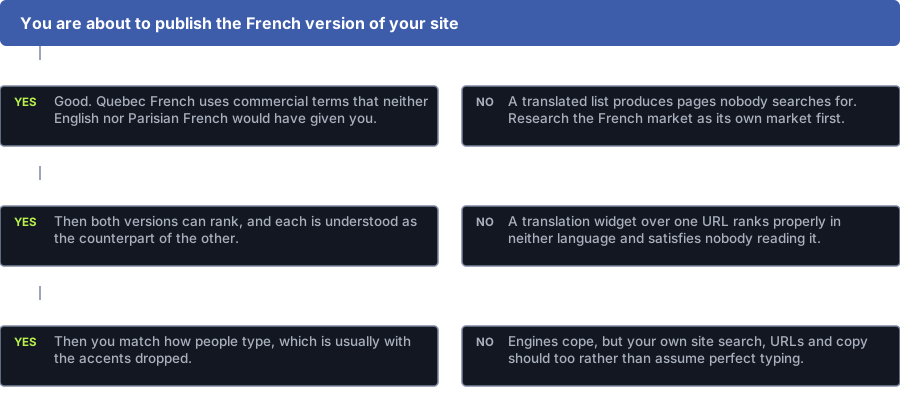
Did the French keywords come from French research?
Yes: Good. Quebec French uses commercial terms that neither English nor Parisian French would have given you.
No: A translated list produces pages nobody searches for. Research the French market as its own market first.
Does each language have its own URL with hreflang?
Yes: Then both versions can rank, and each is understood as the counterpart of the other.
No: A translation widget over one URL ranks properly in neither language and satisfies nobody reading it.
Do your pages tolerate queries typed without accents?
Yes: Then you match how people type, which is usually with the accents dropped.
No: Engines cope, but your own site search, URLs and copy should too rather than assume perfect typing.
The market
What makes Quebec different
Quebec is the only province where the language of your marketing is a matter of statute rather than preference. That single fact reorganises everything downstream — site architecture, copywriting, ad approval, customer support and the cost of entering the market at all.
The provincial economy is unusually specific. Abundant hydroelectricity has drawn energy-intensive industry, aerospace manufacturing is concentrated around Montreal at a scale few regions anywhere can match, and forestry, mining and aluminium remain substantial employers well outside the metro areas.
Quebec City is a second real market rather than an appendage to Montreal. Provincial government, insurance and a well-established software sector make it a distinct B2B environment, and it is overwhelmingly francophone in a way Montreal is not.
Competition in French-language search is materially thinner than in English. Many national advertisers run a translated afterthought or skip French entirely, which leaves gaps that a business willing to write properly in French can take without an enormous budget.
Who is here
Who does business in Quebec
Consumer retail and ecommerce are where the language rules bite hardest and where the commercial return on doing them properly is clearest. Product information, promotional terms and customer communication all have to work in French, and a store that does it well faces noticeably weaker competition than the same store would in Ontario.
Manufacturing and industrial B2B run deep through the province — aerospace suppliers, metals, wood products, food processing and packaging. These are relationship-led businesses discovering that their buyers now research suppliers online in French first.
Tourism and hospitality carry a sharp seasonal profile and a international audience, which makes Quebec one of the few Canadian markets where a three-language content decision — French, English and sometimes more — is a commercial question rather than a compliance one.
Professional and health services operate under provincial regulators and provincial rules on advertising, and their marketing is constrained accordingly. Clinics, notaries, accountants and financial advisers all work inside frameworks that differ from the rest of Canada.
Where to start
Services that fit businesses in Quebec
International SEO
Almost every international search problem traces back to one early decision: country domains, subfolders or subdomains. Get that right, add hreflang that validates, localise rather than translate, and the rest is the same work you already do — done once per market.
Content strategy
A content strategy is mostly a set of decisions about what not to make: which topics you have no realistic claim to, which existing pages should be merged or removed, and which pieces are worth more effort than anything new.
Web design & development
Web design and development plans a site for search and conversion before design starts, then builds it fast, accessible and yours to own. It is for businesses whose site looks fine but does not bring in enquiries. Included: SEO structure, UX, design, build, migrations, Core Web Vitals, accessibility and conversion work.
SEO services
SEO services make your business easier to find on Google and Bing for the searches that lead to enquiries. They suit owners and marketing leads who need qualified leads, not just traffic. Included: technical fixes, local SEO, demand mapping, content, authority building and reporting tied to enquiries.
Strong fit
Industries with the clearest opportunity in Quebec
Sectors worth a look in Quebec
- Ecommerce & DTC marketingIdentify which term in the revenue equation is limiting the business, work on that one, and hold every channel to contribution margin rather than to a revenue chart.
- Insurance Brokers marketingGrowth measured as the book: policies bound in the classes you want, retained through renewal, with cross-sell depth rather than a rising quote-request count.
- Dental Practices marketingGrow attended new patient appointments inside a realistic catchment, then keep them, because retention is worth more per pound than acquisition ever is.
How we work here
We serve Quebec remotely, and we say so
We serve Quebec businesses remotely and we have no office, address or staff in the province. We say so directly because a market this attentive to authenticity of language deserves the same honesty about presence.
French-language work is done by native French writers, not by machine translation with a review pass. Where a project needs French copy, that is a named cost with a named person behind it, and we will tell you if the budget does not support doing it properly rather than doing it badly.
Everything else — technical work, site build, analytics, campaign management, reporting — runs over video in Eastern Time, in whichever language your team prefers to work in.
Constraints
Marketing rules in Quebec
- The Charter of the French Language governs commercial communication in Quebec, and the amendments commonly referred to as Bill 96 strengthened it considerably. In broad terms the regime requires that commercial publications, websites, advertising and product information directed at Quebec consumers be available in French, and that French not be treated as secondary to another language. The rules on public signage and on the use of non-French trademarks were tightened further, and the trademark exceptions are narrower than they once were. The Office québécois de la langue française administers the regime.
- Quebec's private-sector privacy law, modernised by the reform generally known as Law 25, imposes obligations that go beyond federal PIPEDA — including consent requirements, transparency about the use of automated decision-making and profiling, appointment of a person responsible for privacy, breach reporting and data portability. It applies by reference to the personal information of people in Quebec, so it can reach businesses located elsewhere.
- Quebec's Consumer Protection Act is among the strictest in Canada. It contains its own rules on advertised prices, contract terms and promotional practices, and it restricts advertising directed at children, which is a constraint no other province imposes in the same form.
- None of this is legal advice and we do not offer any. We build to what the rules appear to require and we flag the decisions that carry legal weight, but every client marketing into Quebec should have their obligations confirmed by their own counsel before launch.
Primary sources
Where to read the rules for Quebec
The statutes and regulators behind the rules above. They are the authority, not this page, and none of this is legal advice.
- Charter of the French Language (CQLR c C-11), as amended in 2022
Bill 96
Charter of the French Language (CQLR c C-11), as amended in 2022
Source: LégisQuébec
- Quebec's private-sector privacy act (CQLR c P-39.1), as modernised by Law 25
Law 25
Quebec's private-sector privacy act (CQLR c P-39.1), as modernised by Law 25
Source: LégisQuébec
- Quebec's Consumer Protection Act, including its limits on advertising to children
CQLR c P-40.1
Quebec's Consumer Protection Act, including its limits on advertising to children
Source: LégisQuébec
Questions
Working with us from Quebec
Is an English-only website legal if we sell into Quebec?
That is a legal question and you need your own counsel to answer it for your situation. What we can tell you is that Quebec's language regime applies to commercial communication directed at Quebec consumers, and websites are within its scope.
The practical position most businesses land on is that French is required for anything a Quebec customer would rely on to buy — product information, pricing terms, forms and support — and that treating French as an optional add-on is the wrong starting assumption here.
Can we just translate our existing pages into French?
You can, and it will underperform. Translation preserves meaning and discards search demand, because Quebec French speakers do not phrase queries as translated English.
The approach that works is research in French first, then writing pages around what people search, with the English site as a reference rather than a source text. It is more work up front and it is the difference between a French site that ranks and one that only exists.
What does Law 25 mean for our analytics and advertising?
In practice it means the consent and transparency layer around tracking has to be treated seriously rather than copied from an older setup. Law 25 covers consent, informing people about profiling and automated decisions, breach reporting and appointing someone responsible for privacy.
We build tracking so it can operate under a proper consent model and we document what is collected and why. Confirming that your specific configuration meets the requirement is a job for your privacy adviser, not for us.
We are outside Quebec but want to sell here. Where do we start?
Start with the legal question, because it determines the budget. Get advice on which language obligations apply to your products and communications, since that decides whether you are adding a few pages or building a real French site.
Then size the French demand in your category before building anything. In some categories Quebec is a large, under-served opportunity; in others the volume does not justify the work, and finding that out early is worth more than a hopeful launch.
Do you have anyone based in Quebec?
No. We have no office and no staff in the province, and we serve Quebec businesses remotely.
French-language writing is commissioned from native French writers as a named part of the project. We would rather be explicit about how that is resourced than let you assume there is a francophone team in Montreal that does not exist.
Talk to us about growing in Quebec
Start with the free Growth Scan: an indicative read of your website and the few things to fix first, with no sign-up. BOOSTD is in early access, so the market question — who is winning the searches that matter in Quebec, and whether the opportunity justifies the investment — is worked through with our team on a strategy call. If it does not, we will say so.
Prefer to talk it through? Book a strategy call
If we don't deliver the work we agreed to deliver for reasons within our control, you don't pay for the undelivered work. Read our guarantee
References
Sources
The primary documents and published research this page relies on. Platform rules change, so check the source before acting on a detail.
Related
Where to go next
More to explore
Elsewhere in Canada
Last updated · Published by Zubair Afzal (responsible editor), on owner authorisation