
Retail & Ecommerce
Marketing for retailers, online and on the high street
Retail runs on margin, inventory and a marketplace that is simultaneously your largest sales channel and your most aggressive competitor. That combination sets the boundaries for everything marketing can usefully do.
Prefer to talk it through? Book a strategy call
The category
Retail & Ecommerce: what the businesses have in common
Retail marketing is judged differently from almost everything else on this site. In most categories more enquiries is straightforwardly good; in retail, more orders at the wrong cost is a slower way of losing money.
The pressure comes from three directions at once. Margins are thin and largely fixed by suppliers, acquisition costs on the main paid platforms have risen for years, and the biggest marketplaces compete with their own sellers for the same searches.
What follows is written for operators who already know that, and who want the marketing conversation to start with contribution margin rather than with a traffic chart.
Follow the money, not the visitor
What is left of an order by the time marketing can be paid for
In most categories more orders is straightforwardly good. In retail it can be a slower way of losing money, because several parties take a share before anything is available to spend on acquisition.
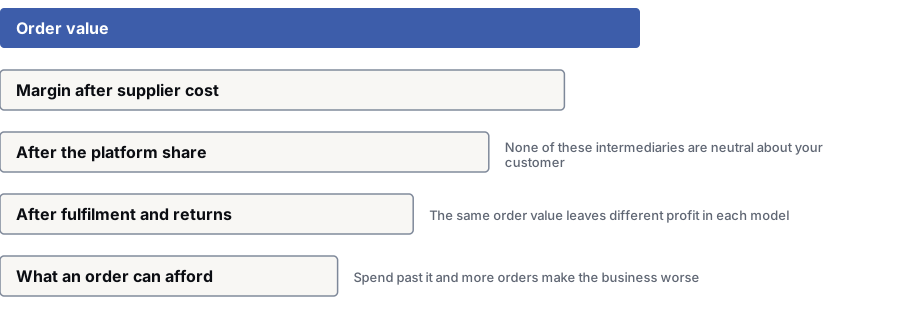
- 1Order value — The number most reporting leads with, and the least useful one on its own.
- 2Margin after supplier cost — Largely fixed by buying terms, which removes price as a durable advantage for most retailers.
- 3After the platform share — A marketplace, a shopping feed, an aggregator or a landlord takes a cut and part of the relationship.None of these intermediaries are neutral about your customer
- 4After fulfilment and returns — A store carries rent, fitting and staff. A pure-play carries warehousing, shipping and returns.The same order value leaves different profit in each model
- 5What an order can afford — Knowing this figure before a campaign is built is most of the discipline of retail marketing.Spend past it and more orders make the business worse
Where they split
Where one retail strategy stops working
These differences are the reason the pages below are written separately rather than as one page with the business type swapped out.
- The cost structures are not comparable. A store carries rent, fitting and staff against local footfall; a pure-play carries warehousing, shipping and returns against national or international reach. The same order value produces different profit, so the same acquisition cost is affordable in one and ruinous in the other.
- The search behaviour splits cleanly. Physical retail lives and dies on local intent, opening hours and stock visibility; online retail competes on product and category terms against marketplaces with far more authority than any individual brand.
- The customer relationship is owned in one model and rented in the other. A direct online brand can build a list, measure repeat purchase and market to it; a retailer whose sales run through a marketplace usually cannot contact the person who bought from them.
- Replenishable categories and considered one-off purchases behave nothing alike. One is a retention business where email and subscription decide profitability; the other is an acquisition business where every sale has to be won again from scratch.
Questions
Retail marketing questions, answered
Should we sell on Amazon or avoid it?
For most retailers the straight answer is both, with clear eyes about the trade. A marketplace gives you demand you would struggle to buy, and it takes a commission, the customer relationship and a great deal of data about what sells.
The risk is not the commission. It is building a business where the marketplace is the only place customers can find you, at which point your pricing, your visibility and your growth are decided by somebody else. Treat it as a channel worth having and not a substitute for demand you own.
We have stores and a website. Do they compete?
Frequently, and usually because nobody has decided how they should relate. Online can undercut the shops, stores can be invisible in local search while the website ranks nationally, and stock is often reported separately so neither side can see the other.
The useful starting point is deciding what each channel is for. Stores usually win on immediacy, fit, advice and returns; the website wins on range and convenience. Once that is settled, the local search work and the ecommerce work stop pulling against each other.
Why do you keep asking about margin instead of return on ad spend?
Because return on ad spend is a ratio that ignores everything between revenue and profit. Two products with the same figure can have completely different outcomes once cost of goods, shipping, payment fees and returns are taken out.
Working to contribution margin changes what we do. It usually means bidding differently across the catalogue, treating some best-sellers as unprofitable to advertise, and putting more weight on retention than a revenue-based target would ever justify.
How much does seasonality really change the plan?
In most retail categories it changes almost everything. A large share of the year's profit can land in a few weeks, acquisition costs rise sharply during those weeks, and the work that makes them successful has to be finished months earlier.
The practical implication is that the quiet periods are the working periods: catalogue structure, content, site performance and list building all have to be done before the peak, not during it.
More to explore
Guides that answer the same questions
Other sectors
Last updated · Published by Zubair Afzal (responsible editor), on owner authorisation