
Automotive Retail marketing
Dealership marketing that sells more units and keeps the service bays full
Dealership marketing runs on inventory that appears and disappears, marketplaces that stand between you and the buyer, and a service department that quietly funds the business and gets almost no marketing at all.
Prefer to talk it through? Book a strategy call
What usually goes wrong
Where automotive retail marketing tends to fail
A dealership sells a small number of expensive things and services a large number of them afterwards. Almost all of the marketing money goes to the first half.
Meanwhile the searches for your own stock are answered by marketplaces you pay per lead, and the pages describing individual vehicles are created and destroyed faster than any site was designed to handle.
- The marketplace stands between you and your own inventory.
- A buyer searching for a specific model, trim, year and price range is answered by a listings platform that aggregates every dealer in the region, including you, and charges you for the introduction. It is a legitimate channel and a poor foundation, because the customer relationship, the price comparison and the next visit all belong to the platform. The question worth answering early is what share of your enquiries you could not replace if that invoice doubled.
- Vehicle pages appear, sell and rot.
- Each unit in stock generates a page that exists for a few weeks. When the car sells, most platforms either delete the page, leave it live showing something that cannot be bought, or serve an error. Over a year a busy rooftop can accumulate thousands of dead URLs, links pointing at nothing, and a sitemap describing a forecourt that emptied months ago. What a sold vehicle page should become is a decision every dealer group has to make deliberately.
- Service gets the leftovers.
- The service department carries a recurring revenue relationship with people who already bought from you, and it is usually marketed with a seasonal offer and nothing else. Customers drift to independent garages once the warranty ends, and the drift is invisible because nobody reports on retention. Every retained customer is also the person most likely to buy the next car from you, which makes this the cheapest sales marketing available.
- Co-op rules are shaping the marketing more than the market is.
- Manufacturer funding comes with brand standards, approved creative, mandated messaging and rules about which suppliers may be used. Dealers understandably build campaigns around what is claimable rather than what works locally. The workable approach is to treat co-op as a subsidy on the activity you would run anyway, and to be honest internally about which spend exists only because it is reimbursable.
- Nobody reconciles spend against delivered units.
- Marketing counts enquiries and calls, the dealer management system knows about sold vehicles and repair orders, and the two are rarely joined. Without that reconciliation, budget is set by whichever channel reports the most leads, which usually means paying twice for the customer who was going to walk in anyway. Matching back to units delivered changes the answer more often than not.
Where the money goes
The automotive retail marketing channels that earn their place
In priority order for this business, not a menu. Anything not on this list is something we would need a specific reason to recommend.
The rooftop found for sales and for service
Each site needs to be visible for the make and models it sells and, separately, for the service and repair searches made by people who already own one. Those are different query sets reaching different departments, and most dealer profiles are set up for the first and silent about the second.
Paid built around stock and around the service diary
Campaigns that read from live inventory so you never pay for clicks on a car that sold on Tuesday, and a separate always-on programme for service bookings, which are cheaper to buy and repeat annually. Conversion signals should be a delivered unit or a booked repair order, not a form submission.
A lifecycle policy for inventory URLs
Deciding what happens when a vehicle sells: whether the page persists with an alternative, redirects to the model or the category, or is removed properly. Plus sitemap handling that keeps up with weekly turnover and structured data that matches the price and availability shown. This is the difference between a site that ages well and one that fills with dead ends.
Search, listing and vehicle pages that answer money questions
Filtering that matches how buyers shop, listing pages that make availability obvious, and vehicle pages carrying finance illustrations, part-exchange entry and accurate condition detail. Where the platform is supplied by the manufacturer, the work is establishing precisely what can be changed and building properly within it rather than pretending it is a free site.
Reviews at rooftop and department level
Buyers read reviews about the dealership, not the manufacturer, and about the process rather than the car. A systematic request after every delivery and every repair order, with sales and service tracked separately, is the most reliable way to influence a decision that happens off your website entirely.
Demand shape
When automotive retail demand arrives, and how
Demand is inventory-shaped. What you can sell this month is decided by what is on the forecourt and what is arriving, and a campaign built around a model you cannot supply produces enquiries that convert into disappointment. Marketing has to read from stock rather than from a plan written a quarter earlier.
The purchase cycle is long and the decision window is short. Months of research end in a compressed period where the buyer contacts two or three sellers, so being present only at the end means competing at the most expensive moment, and being present only early means being forgotten.
Service demand is predictable in a way sales demand is not. Mileage intervals, seasonal changeovers, safety inspections and warranty expiry all produce dated, forecastable requirements from a known list of customers, which makes it the most plannable revenue in the business.
Registration cycles, model year changeovers and manufacturer programmes create sharp peaks that are set externally. Those dates are known well in advance and they concentrate both demand and competitive spend into narrow windows.
Used and new behave like different businesses. New is constrained by allocation and manufacturer programmes; used is a trading business where each unit is unique, priced individually and competing against every similar car within driving distance.
Vehicle first, dealer second
Weeks choosing the car, then two days choosing you
The two decisions happen at completely different speeds, and dealers are largely absent for the long one. Being present only at the end means competing on price with everybody else who was.
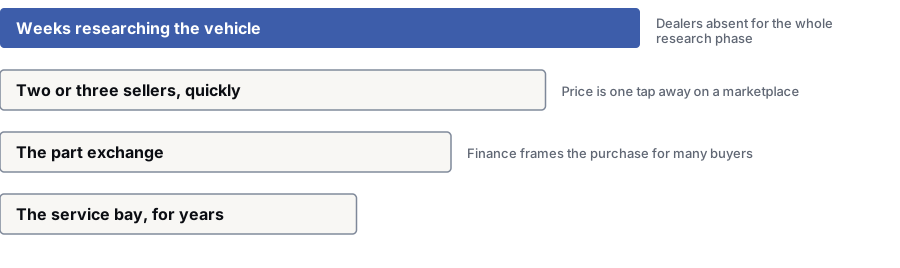
- 1Weeks researching the vehicle — Models, trims and running costs, with no dealer under consideration at all. Almost entirely ceded to publishers and marketplaces.Dealers absent for the whole research phase
- 2Two or three sellers, quickly — Months of research end in a compressed window. Arriving only at this point means competing on price with everyone else who did.Price is one tap away on a marketplace
- 3The part exchange — Buyers know what they want for their current vehicle, and a clear indicative figure given quickly frequently decides the whole deal.Finance frames the purchase for many buyers
- 4The service bay, for years — Predictable, forecastable, and searched by people who already own the car. They defect quietly to the independent garage down the road.
Search behaviour
Automotive retail searches, grouped by intent
Model research, weeks before any dealer is chosen
Long cycle, low competition from dealers, and almost entirely ceded to publishers and marketplaces.
- [model] common problems after [mileage]
- [model] vs [model] running costs
- is a [model] reliable
- best family suv for [use case]
- [model] real world fuel consumption
Stock and availability, at the decision
Short window, high value, and the searches marketplaces are built to win.
- used [model] for sale near me
- [model] [trim] in stock [city]
- [make] dealer [town]
- cheapest [model] under [amount]
- [model] available now no wait
Money: finance, trade-in and total cost
Where a large share of buyers frame the purchase, and where disclosure obligations apply.
- [model] monthly finance payment
- part exchange value for my car
- car finance with a deposit of [amount]
- balloon payment explained
- is it cheaper to lease or buy a [model]
Service, parts and aftersales
Recurring, forecastable and searched by people who already own the car. The half of the business that gets no budget.
- [make] service cost [town]
- do i have to use a main dealer for servicing
- [make] recall check
- brake replacement price [city]
- book a service [make] near me
These are examples of how customers in this market search, drawn from keyword research and public search data. They are illustrative, not a volume claim: we size the demand in your area before recommending anything.
The website
What an automotive retail website has to do
- A stated policy for what a vehicle page becomes when the car sells, applied automatically rather than manually
- Advertised prices shown with whatever the market requires alongside them, consistently across every listing
- Finance illustrations that meet disclosure obligations and still make the monthly cost easy to understand
- Part-exchange valuation available online, because it is frequently the first question a buyer has
- Service booking with real availability, pricing for common jobs, and a route for people who did not buy the car here
- Filtering and sorting that match how buyers shop: budget, monthly payment, body style, fuel, mileage
- Condition detail and photography that answer what a buyer would inspect if they were standing next to the car
- Clear separation between sales and service journeys, so an owner booking a repair is never routed to a sales enquiry
- Departmental contact routes with real response times, since an unanswered enquiry on a specific unit is a lost sale that day
Buying behaviour
How automotive retail customers decide
Strategy follows this, not the other way round. Everything on this page is downstream of how the decision gets made.
- The vehicle is chosen first and the dealer second, at very different speeds. A buyer researches models, trims and running costs for weeks, then picks a seller within a day or two, so presence during research and availability at the decision are separate jobs.
- Price is transparent to the decimal place. Comparison is one tap away on a marketplace, so a dealer does not win on price except by being cheapest, and instead wins on availability, the trade-in offer, how quickly a question gets answered and whether the process feels straightforward.
- The part exchange frequently decides the deal. Buyers know what they want for their current vehicle, and a dealer who gives a clear indicative figure quickly is negotiating from a position of trust while a dealer who insists on an appointment first is losing the enquiry.
- Reviews are read at dealership level rather than brand level, and for the process rather than the product. Complaints about being passed between people, or about finance being added late, do more damage than a manufacturer campaign can repair.
- Finance availability and monthly cost frame the whole decision for a large share of buyers. Someone shopping to a monthly figure is a different customer from someone shopping to a purchase price, and a site that only shows the second is invisible to the first.
- Service customers choose on convenience, price transparency and trust in roughly that order, and they defect quietly. The independent garage down the road wins on all three at exactly the point the warranty stops making the franchise dealer the obvious choice.
Constraints
Automotive retail advertising rules: what is allowed, and what is not
Vehicle price advertising is specifically regulated in many markets, and the requirements vary by country and frequently by state or province. Common obligations include all-in pricing that shows every mandatory fee, restrictions on advertising a price that excludes charges the buyer cannot avoid, and rules about how a discounted or was-price may be presented. A listing that is compliant in one province can be an offence in the next.
Consumer credit and finance advertising carries a second layer. Where a rate, a monthly payment, a deposit or a term is advertised, most jurisdictions require a defined set of accompanying disclosures — representative examples, total amount payable, the basis of the rate and the conditions attached. Payment-led creative is common in this sector and is a frequent focus of regulators’ attention.
Manufacturer programmes add contractual rules on top of the legal ones. Brand standards govern logo use, imagery, approved messaging and sometimes which suppliers may be engaged, and co-op reimbursement usually depends on pre-approval and on evidence of compliant execution. Those rules are contractual rather than statutory, and breaching them costs funding rather than attracting a regulator.
Used vehicle history and condition claims have to be supportable. Statements about previous ownership, accident history, mileage verification and warranty coverage are exactly the claims that generate complaints, and they should be evidenced from documentation rather than from a listing description inherited with the car.
We build campaigns to the rules of the markets each rooftop trades in and flag anything that needs review, but confirming what applies to you is a matter for your own legal advisers and regulator. None of this is legal advice.
Primary sources
The automotive retail rules above, at source
The rules this page refers to, linked to the regulator or rule-maker that publishes them. Which apply depends on where you operate, and they change, so check the current version.
- Ontario dealers must advertise an all-in vehicle price: every fee and charge except HST and licensing.
O. Reg. 333/08, s. 36
Ontario dealers must advertise an all-in vehicle price: every fee and charge except HST and licensing.
- US credit adverts that state a payment, term or down payment must also give set terms, including the APR.
Regulation Z § 1026.24
US credit adverts that state a payment, term or down payment must also give set terms, including the APR.
- UK consumer credit promotions: when a representative example is required and what it must contain.
FCA CONC 3.5
UK consumer credit promotions: when a representative example is required and what it must contain.
Source: FCA Handbook, CONC 3.5 (UK)
Questions
Automotive retail marketing questions, answered
Can we realistically reduce our dependence on marketplaces?
Reduce it, yes. Eliminate it, rarely, and it is usually not worth trying. Those platforms produce buyers and walking away to make a point costs volume you will not replace quickly.
What is achievable is building enough direct demand that the marketplace becomes one channel among several: model and trim searches you rank for yourself, a service base that returns, brand searches from people who had a good experience, and part-exchange enquiries that start on your own site. The test is what would happen to your month if the listing fee doubled.
What should happen to a vehicle page once the car is sold?
Anything other than deleting it silently. The two workable options are keeping the page live with a clear sold status and prominent similar stock, or redirecting it to the model or bodystyle listing so the visitor lands somewhere useful.
Which one depends on volume and platform. What matters is that it is a policy applied automatically, because a rooftop turning over sixty cars a month cannot manage this by hand and will not notice the accumulation until the site is mostly dead ends.
Why do you keep pushing service marketing when sales is the priority?
Because service is the cheaper half to grow and it feeds the expensive half. The customers are known, the demand is forecastable from mileage and interval, and every retained customer is substantially more likely to buy their next car from you.
It is also where the leakage is. Retention falls off sharply once the warranty ends, and most dealerships cannot say by how much because nobody reports it. Measuring service retention over three and five years usually starts the conversation on its own.
Our website comes from the manufacturer platform. How much can you change?
Usually more than the dealership believes and less than an agency would like. The first task is a straight inventory of what is configurable, what requires a platform request, and what cannot change, because that boundary is often assumed rather than tested.
Then the work is doing everything possible inside it and being open about the rest. Where a real limitation caps performance, that becomes a documented case to take to the platform or the manufacturer rather than a recommendation you cannot act on.
How should we handle co-op funding without letting it dictate everything?
Decide what you would run if there were no funding, then claim against whatever qualifies. Co-op works well as a subsidy on a sound plan and badly as the reason a plan exists.
It also helps to be clear internally about the true cost of claimable activity. Spend that only happens because it is partly reimbursed still consumes your share, your attention and your creative slots, and sometimes the unsubsidised alternative is cheaper overall.
Can you connect our advertising spend to cars we delivered?
To a workable degree, provided we can match back against the dealer management system. Enquiries and calls are matched to sold records by contact details and date, which produces a cost per delivered unit rather than a cost per lead.
It will never be perfect. Walk-ins, referrals and buyers who researched for months all blur the picture. It is still a far better basis for deciding budgets than counting form submissions, and it usually reallocates spend within the first quarter.
Find out what is winnable for your automotive retail business
Start with the free Growth Scan: an indicative read of your website and the few things to fix first, with no sign-up. BOOSTD is in early access, so the fuller picture for your automotive retail business — your area, your competitors and the searches that matter — is worked through with our team on a strategy call. If we do not think we can move it, we will tell you.
Prefer to talk it through? Book a strategy call
If we don't deliver the work we agreed to deliver for reasons within our control, you don't pay for the undelivered work. Read our guarantee
References
Sources
The primary documents and published research this page relies on. Platform rules change, so check the source before acting on a detail.
More to explore
Last updated · Published by Zubair Afzal (responsible editor), on owner authorisation