
Ecommerce & DTC marketing
Ecommerce marketing agency that grows profit, not just revenue
Ecommerce marketing that grows profit: we find which of traffic, conversion, order value or repeat rate holds your store back, and fix that first.

Measuring results
How you'll know it's working
These numbers show if your marketing brings in customers. Website visits alone don't.
- Profit per order after product cost, shipping, fees and returns. Every other number answers to this one
- Revenue split into traffic, conversion rate, order value and repeat rate, reported as four lines
- Revenue from new and returning customers, kept apart and never blended
- Repeat purchase rate, and the time between first and second order
- Cost to win a customer by channel, judged against profit, not revenue
- Share of revenue from email and your other owned channels
- Searches for your brand name and direct visits over time, a sign the brand is growing
- Marketplace share of total revenue, watched as a risk
- Return rate by product and category, because it decides which lines are worth advertising
Common problems
The ecommerce marketing traps to avoid
Ecommerce marketing comes down to four numbers multiplied together. How many people arrive, how many buy, what they spend and how often they come back.
Most plans can’t say which one they’re working on, so spend and revenue both rise while the gap between them widens. We start by finding the number that holds your store back.
- Nobody can say which of the four numbers moved.
- Traffic, conversion rate, order value and repeat rate each need different work. Blend them into one revenue chart and you can’t see which is stuck. A store with plenty of visitors and a two per cent conversion rate doesn’t need more ads. A store that converts well but gets no repeat buyers doesn’t need a redesign. Find the stuck one first.
- Your categories grew by accident.
- Categories got added as the range grew. Products sit in several. Some collections exist only because a campaign once needed a landing page. None of it matches how customers search. So the pages people look for either don’t exist or are thin product grids. Fixing categories is the biggest organic win in ecommerce, and most stores ignore it.
- Your filters publish pages you never wrote.
- Filters for size, colour, price and stock often create URLs Google can crawl. A modest catalogue turns into hundreds of thousands of near-identical pages. Google wastes its time there and visits the pages that matter less. Decide which filter pages should exist and shut off the rest.
- Ad costs keep rising and your margin can’t take it.
- Ads on the big platforms keep getting dearer. Product costs, shipping and returns haven’t got cheaper. A campaign can hit its target return and still lose money on a low-margin line. Until your bidding knows each product’s margin, the platform pushes whatever sells easily. That’s often what you make least on.
- Repeat customers are someone’s side project.
- Email usually sits with whoever has spare time. It goes out as a weekly promotion and gets judged on open rates. Yet a second order from an existing customer costs a fraction of the first. With ad costs rising, repeat rate has the most profit attached, and it gets the least attention.
- The marketplace is your biggest channel and your competitor.
- A marketplace brings sales you couldn’t buy any other way. It also outranks your own product pages, keeps the customer and sets the terms. Good channel, weak foundation. Ask early: what share of revenue could you lose overnight? And how much demand of your own would you need to survive it?
What people search
Searches such as “womens running shoes wide fit”, grouped by intent
Category and product searches
Where most sales start. Category pages match these far better than product pages.
- womens running shoes wide fit
- best [product type] for [use case]
- buy [product] online free shipping
- [material] [product] under [price]
- [brand] [product] price
Comparison and validation
Where people make up their minds, and often leave your site to check.
- [brand] vs [brand]
- [brand] reviews reddit
- is [brand] legit
- [product] size guide
- alternatives to [product]
Searches that start with a problem
Earlier, cheaper and far less crowded. Good content here wins customers a marketplace never sees.
- how to stop [problem] at home
- what to get someone who [interest]
- how to choose a [product type]
- do i need [accessory] for [product]
After the order
Dull but busy, and tied straight to whether a second order happens.
- [brand] returns policy
- where is my order [brand]
- how to track [brand] order
- [product] care instructions
These are example searches from keyword research and public search data. Before we suggest anything, we check how often people search for them in your area.
How they choose
Who decides, and what they look for
Know how they choose and you know where to show up.
- Most shoppers check somewhere else before they buy. They leave to read reviews or compare on a marketplace, then come back another way. So last-click reports undervalue the ads and content that found them first.
- Delivery cost and speed cause lots of abandoned baskets, late in the process. Someone who picked the product will still leave at the shipping step. Show the full cost early and you save more sales than any clever copy.
- Shoppers read the returns policy before buying far more than retailers think. Especially in clothing and anything where fit is uncertain. A clear, generous policy removes doubt at the moment of choice.
- Detail on the product page beats sales talk. Dimensions, materials, sizing, compatibility and what’s in the box answer the doubts that stop a purchase. Adjectives don’t.
- Reviews beat anything a brand says about itself, and the middle ratings matter most. Shoppers read the three-star reviews to find the common complaint. A wall of five-star reviews looks less trustworthy.
- Whether someone buys again depends on what happens after the first order. Accurate delivery, packaging, first use and how you handled a problem decide if there’s a second order.
Where online orders get lost
Where shoppers drop out between the first search and the checkout
Two of these four steps happen on sites you don’t control. The last one comes after the shopper has already chosen the product. That’s where most sales get lost.
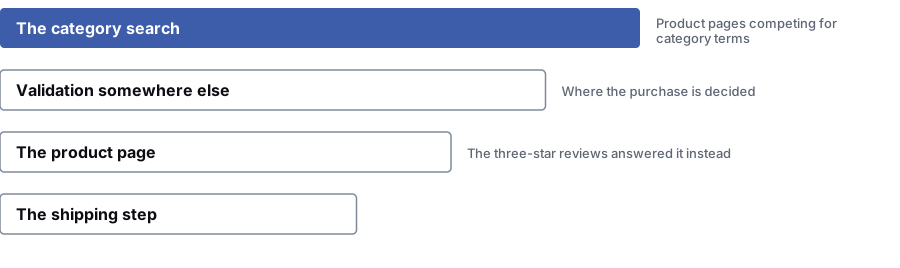
- 1The category search — Where most sales start. Category pages match these searches far better than single product pages.Product pages competing for category terms
- 2Checking somewhere else — Shoppers leave to read reviews or compare on a marketplace. Then they come back another way, or not at all.Where the purchase is decided
- 3The product page — Dimensions, materials, sizing, compatibility and what’s in the box. Detail wins because it answers the exact doubt.The three-star reviews answered it instead
- 4The shipping step — Delivery cost and speed cause lots of abandoned baskets, late, after the product has been chosen.
Where to spend
Why ecommerce SEO comes before conversion fixes
In the order we'd put them. Start at the top.
Fix the categories first, then the products
Category pages match how people search, and they pass strength down to your products. On most stores they’re bare product grids. We rebuild them around what people search for, write them so they deserve to rank and fix the links underneath.
Sell to more of the visitors you have
Conversion rate grows revenue without more spend. It rarely needs a redesign. It needs shipping costs shown early, product detail that answers the doubt, reviews shown well, search and filters that work, and a checkout that doesn’t lose people at payment.
Keep Google focused on a big catalogue
Filter pages, out-of-stock products, pagination, duplicate variants and slow templates are the usual technical problems. On a large catalogue they do serious harm. Fixing them often lifts organic sales more than new content would.
Your website
What your website needs
- Category pages that are proper pages: merchandised, written and built around how people search
- Filters with clear rules about which combinations Google may crawl and index
- Product pages that remove doubt: dimensions, materials, sizing, compatibility and what’s in the box
- Delivery cost and timing shown before checkout, not sprung at the payment step
- A returns policy in clear words, linked from the product page
- Reviews on the product page showing the full spread of ratings, not a hand-picked few
- Site search and filters that work, because a shopper who finds nothing leaves
- Product images that load fast and sharp on a mid-range phone on mobile data
- A checkout tested on real phones, with guest checkout and the payment methods your market expects
- Product structured data that matches the page, including price and stock
The rules
Stay inside the ad rules
Consumer protection law covers more ecommerce marketing than most owners expect. It covers how you justify a sale price against an earlier price, what a stated delivery time commits you to, how subscription renewals must be shown and the minimum a returns policy must say. The rules differ by country and by state or province, and regulators are active here. We write to the rules for your markets and ask you to confirm the detail with your legal adviser.
Tracking and personalisation have their own rules. Consent for analytics and advertising cookies, and what you must tell customers when you use their data for targeting, vary by country and are enforced more and more. This shapes how we set up measurement as well as the copy, so we agree it at the start.
Product claims are the third area. Any health, environmental or performance claim needs evidence. Green claims in particular get checked closely in several markets. If a claim can’t be backed up, we take it out. We don’t water it down into something vague.
Sources
See each rule in full
Each rule above, linked to the body that publishes it. Which ones apply depends on where you work. Rules change, so check the latest version.
- US guides on former-price comparisons: the earlier price must be genuine and offered in good faith.
- 16 CFR Part 233
- Source: FTC Guides Against Deceptive Pricing (US)
- Sellers need a reasonable basis for stated shipping times and must offer a delay option or refund.
- FTC Mail Order Rule
- Source: FTC Mail, Internet, or Telephone Order Merchandise Rule (US)
- Environmental claims must be truthful, clear, substantiated and must not omit material information.
- CMA Green Claims Code
- Source: CMA Green Claims Code (UK)
Questions
Ecommerce marketing questions
Our category is dominated by marketplaces. Is organic search worth it?
Yes, if you don’t fight them where they always win. On generic product searches a marketplace has more authority and range than any single brand. Two years attacking that head-on wastes budget.
A brand wins on its own name, on specific category and feature searches that need good merchandising, and on problem-led content a marketplace won’t publish. Those searches bring customers who know who you are. That’s worth far more than a marketplace order.
How do we know whether to work on traffic or conversion?
Look at which number is out of line. If your conversion rate is well below normal for your category, more traffic just makes the problem more expensive. If conversion is healthy and visitor numbers are flat, the limit is further up.
Working this out usually takes a couple of weeks, and it changes the whole plan. So we do it before recommending any channel. Often the real limit is repeat rate, which neither traffic nor conversion work would fix.
Why is faceted navigation such a problem for ecommerce SEO?
Because filters multiply pages. A few thousand products with filters for size, colour, price and brand can create hundreds of thousands of crawlable URLs. Most are near-identical.
Google then spends its visits on pages with no sales value and visits your new lines and key categories less often. Decide which filter combinations match real searches and deserve indexing. Then shut off the rest properly.
We have tried email and it just produced discount-hunters. What changes?
Usually the setup. A weekly promotion to the whole list teaches people to wait for the next offer. Much of that revenue would have come in at full price anyway.
Automated emails work differently because they’re triggered by what people do. Think post-purchase welcomes, reorder reminders timed to how long the product lasts, basket reminders and win-backs. Stopping discounts to full-price buyers is often the biggest single margin gain you can make.
Should we reduce our reliance on the marketplace we sell through?
Reduce the dependency, not necessarily the sales. Marketplace sales are still sales. Walking away to make a point rarely makes sense.
Build enough demand of your own that a change in the platform’s terms is a bad quarter, not a crisis. That means organic rankings, an email list, brand searches and repeat customers. A useful test: if your account were suspended tomorrow, what share of revenue would vanish?
How long before organic work affects revenue?
Technical and category fixes can often show within one to three months, because they lift pages you already have. That’s why we usually start there. We don’t guarantee rankings; nobody can.
New content and link building are slower. Expect three to six months before they bring meaningful revenue, and longer in competitive categories. The quick fixes pay off while the slower work builds, and we show you which is which.
Want to know what you could win?
Start with the free checkup. It shows what to fix first on your website, with no sign-up. Want the full plan for your ecommerce business? Book a call, and we'll look at your market, your competitors and the searches that bring in customers.
Prefer to talk it over? Book a free call
Your BOOSTD score improves within 90 days, or your next month is free. After 6 months, more traffic or leads, or we keep working free (up to 6 free months in any 12 months). Read our guarantee
References
Sources for ecommerce marketing agency
The official documents and research this page is based on. Platform rules change, so check the source before you act on a detail.
Related
More on ecommerce marketing
Guides for ecommerce
Other retail businesses
Industries close to ecommerce
Last updated · Published by Zubair Afzal, responsible editor