
Agricultural Equipment Dealers marketing
Farm equipment dealer marketing for sales, parts and service
Farm equipment dealer marketing for machines, parts and service, built around your territory and the crop calendar, not just the next tractor sale.

Timing
When your customers need you
The crop calendar rules everything. During drilling, spraying and harvest a farmer only thinks about a machine that has stopped, and a breakdown then is the most urgent call a dealership gets. Buying a machine belongs to the quiet months, when there is time to compare specs, arrange finance and consider a trade-in.
Farmers replace machines every few years, so in any season only a small, largely nameable group of buyers in your territory are realistic prospects. Knowing each account suits that far better than broad awareness ads.
Territory is a hard boundary. Your franchise agreement sets the area you cover, so national visibility on a manufacturer's brand terms is wasted at best. Used machinery, specialist parts and aftermarket supply can fairly reach further.
Parts and service demand never stops, and weather shapes it: a wet autumn changes what breaks, a dry summer what is needed. A pre-season inspection campaign only works if it goes out before the season.
The market moves with crop prices, input costs, interest rates and whatever tax allowance or grant scheme is open. A year when nobody buys machines is a market condition, not a marketing failure, and your budget has to make sense then too.
Regional farm shows and demo days squeeze a year of conversations into a few days, and most of the value is lost in follow-up: a pile of enquiry cards, no plan, and a sales team heading into the next season.
Two businesses, one dealership
Machine sales and parts: two businesses inside one dealership
A farmer is buying the dealership as much as the equipment. They form that view in the workshop and at the parts counter, years before anyone talks about a new machine.
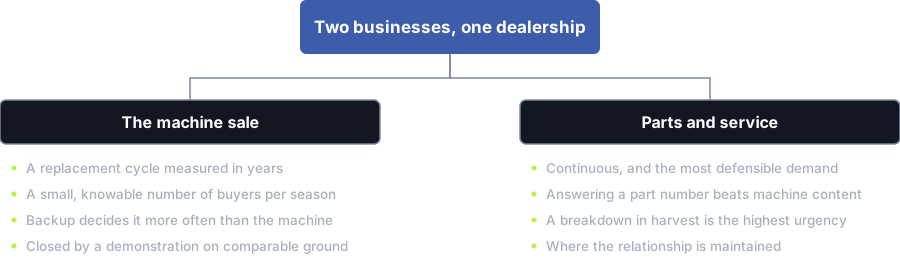
The machine sale
- Machines replaced every few years
- A small number of buyers you can name
- Backup decides it more than the machine
- Closed by a demo on similar ground
Parts and service
- Never stops, and the safest demand
- Answering a part number beats machine pages
- A harvest breakdown is the most urgent call
- Where the relationship is kept up
Common problems
Where agricultural equipment businesses lose customers
Farm equipment dealer marketing serves two businesses that share a name and a car park. One sells a few very large machines, replaced every few years, inside a territory someone else drew. The other sells filters, blades, oil and workshop hours every week of the season.
Nearly all the marketing money goes to the first, and nearly all the steady income comes from the second. That is where most of the opportunities below are.
- The website is a brochure for machines the manufacturer already advertises.
- A dealer site copying the manufacturer's product pages adds nothing a buyer can't get from the source, and competes with a brand that will always outrank it. Only a dealer can say what is in stock, what the demonstrator is doing this month, what a trade-in is worth, who services it, how fast a part arrives and what a used equivalent costs.
- Used stock lives on a portal and nowhere else.
- Listing portals reach buyers a dealer site never will, but a feed that only lives there gives away the enquiry, the contact details and the searches for that model. Publish the same machine on your own site with year, hours, specification, photos, price and branch, and it earns model searches, starts trade-in conversations and stays yours.
- Parts cannot be searched by part number or by machine.
- A customer with a broken machine knows the part number or the model. If your site can't find either, an online seller will be faster than ringing your counter. Let people search by number and machine, show fitment and live stock where possible, and offer click-and-collect to protect your most reliable revenue.
- The service department has no presence at all.
- Service often earns the best margin in the business, yet it is usually a phone number in the footer. People want to book a service or pre-season inspection, request a field call-out, check workshop lead times and find the right depot's out-of-hours breakdown number, and today that demand arrives through whichever staff member they know.
- Marketing is judged on machine leads in a year with no machine buyers.
- When crop prices fall or finance costs rise, machine purchases stop across the market, and marketing judged only on machine enquiries gets cut in exactly the year aftersales most needs support. Agree at the start that parts revenue, service bookings, account activity and used enquiries are the main measures.
- Everything is aimed at the buyer and nothing at the person who fixes it.
- Farm managers, contractors, mechanics and operators all deal with a dealership and search differently. An operator looking for a settings guide, an error code, a service interval or a compatibility answer is a relationship you can build for free, yet most dealers never write this content.
Where to spend
Spend on technical SEO first, then local SEO
In the order we'd put them. Start at the top.
Turn stock and parts data into pages Google can find
Publish each used machine as its own indexable page with model, year, hours and specification as text, structure parts data so part numbers and machines can both be searched, and build depot pages that match your real territory. It is data plumbing more than content, and for dealers it brings in more than any campaign.
Show up in every town in your territory
Franchise territories suit local search. Give each depot a profile with correct hours, list the parts counter and workshop as services, and state which postcodes you cover. It also catches the breakdown search, the most valuable local search a dealer gets.
A parts catalogue people can find and buy from
Filters, oils, blades, wearing parts and consumables are bought repeatedly, and dealers lose them to online sellers who publish part numbers and fitment. A crawlable catalogue with fitment by machine, live stock and counter collection turns calls into sales and keeps accounts active between machine purchases.
What people search
“[brand] [model] for sale hours” and similar searches
Used machines, by model
The buyer knows what they want and searches the exact model, often comparing listings across dealers and portals in one sitting.
- [brand] [model] for sale hours
- used telehandler [region]
- second hand combine [model] price
- [brand] [model] specification weight lift
- low hours [model] tractor trade in
Parts and fitment
Regular, routine and the safest demand a dealership has. Answering a part number is worth more than most machine content.
- [part number] filter cross reference
- oil filter for [brand] [model]
- cutting edge to fit [model] loader bucket
- hydraulic hose fitting [model] agricultural
- what oil does a [model] take
Breakdown and service
Made in the busy seasons, on a phone, standing in a field. Speed of answer decides it, and location is the only filter.
- tractor repair near me emergency
- [brand] service dealer [county]
- combine breakdown call out harvest
- [error code] [brand] tractor meaning
- pre season inspection sprayer [area]
Buying decision and finance
Quiet-month research, when a farmer is comparing options and doing the sums, not yet looking for a supplier.
- lease vs buy farm machinery
- [brand] vs [brand] tractor which is better
- cost per hour to run a [model]
- trade in value [brand] [model]
- is precision guidance worth it small farm
These are example searches from keyword research and public search data. Before we suggest anything, we check how often people search for them in your area.
Measuring results
What we track each month
These numbers show if your marketing brings in customers. Website visits alone don't.
- New and used machines sold, credited to the enquiry source, not the salesperson who closed it
- Days in stock for used machines, and margin kept against the first asking price
- Parts revenue per active account, and how much goes to online sellers instead
- Workshop hours booked and bay use, reported separately for pre-season and in-season
- Pre-season inspections booked from your existing service customers
- Finance and extended warranty take-up on machine sales
- Trade-in conversations started from used listings on your own site
- Accounts active in the last twelve months, the true size of your customer base
Your website
What visitors need to see
- Every used machine on its own page, with model, year, hours, specification, photos, price and branch
- Parts search that finds both a part number and a machine model, with fitment stated clearly
- Live or near-live parts stock where your system allows, and a collect-from-counter option
- A service booking route, workshop lead times and the out-of-hours breakdown number for each depot
- Depot pages showing the territory covered, opening hours and who to ask for at the parts counter
- The brands you are franchised for, plus what you can service or supply parts for but don't sell
- Finance information with the disclosures your market requires, and a route to a real quote
- Support for precision farming, guidance and telematics described, because it now shapes the purchase
- Pre-season inspection and winter service programmes, published with dates before the season starts
The rules
What regulators expect
Franchise agreements control more of your marketing than most dealers realise. They usually set brand assets, approved images, permitted claims, use of the manufacturer's name in domains and paid search, and the territory you may advertise in, and co-op advertising funds come with their own conditions. Check everything you publish against the agreement, not against what a rival dealer seems to be doing.
Performance figures belong to the manufacturer. Output, horsepower, fuel use, capacity and emissions ratings are advertising claims you must be able to back up, so quote them from published data with the conditions attached rather than rounding them into a headline. Emissions and engine standard claims are regulated and vary by market and year of build.
Describing used machinery falls under consumer and commercial protection law. Hours, year, service history, condition, warranty status and known faults must be described accurately, and a photo that doesn't show current condition counts as a description too. Trade sales aren't exempt from misdescription rules in most markets; they follow a different set.
Finance advertising is regulated, more or less tightly depending on whether the customer is a consumer or a business, and on the market. Representative examples, rate disclosure, the lender's name and "subject to status" wording are often required, and an offer advertised without them is the dealership's problem.
Claims about grants, tax allowances or subsidy schemes go out of date quickly and differ by jurisdiction. If a campaign relies on one, say which scheme, what period and where readers can check it, and take the page down when the scheme closes.
Sources
Rules and where to read them
Each rule above, linked to the body that publishes it. Which ones apply depends on where you work. Rules change, so check the latest version.
- Sets content rules for UK consumer credit promotions, including when a representative example is required.
- FCA CONC 3.5
- Source: UK: Financial Conduct Authority Handbook, CONC 3.5
- Sets disclosure rules for advertising US closed-end consumer credit, including rate and terms.
- Regulation Z § 1026.24
- Source: US: Consumer Financial Protection Bureau, 12 CFR 1026.24 (eCFR)
- Lists US emission standards for nonroad engines and equipment, including farm machinery.
- EPA nonroad emissions
- Source: US: Environmental Protection Agency, Regulations for emissions from nonroad vehicles and engines
Questions
Agricultural equipment marketing questions
Should we list used machines on our own site if they are on a portal?
Yes, and keep using the portals too. They reach buyers a dealer site won't, and a machine that sells quickly there has done its job.
A listing on your own site earns searches for that exact model, keeps the enquiry and contact details with you, and gives a trade-in conversation somewhere to start. Publishing to only one of them is what costs you money.
Farmers do not buy machinery online. What is the website for?
Research. Farmers rarely buy machines online but almost always research online, and they order parts, book services, check specs and compare trade-in values.
The real value is aftersales: parts searched by number, workshop booking, the right depot's breakdown number and the maintenance answers operators need. These happen every week and keep the account alive until the next machine.
How do we justify a budget in a year when nobody is buying machines?
Agree in advance that machine enquiries aren't the main measure. When crop prices or finance costs stop purchases across the market, no marketing can produce buyers who don't exist.
Report what holds up in a bad year: parts revenue per account, workshop use, pre-season inspections booked and active accounts. They decide how well the dealership comes out when the market turns.
Can we advertise outside our territory?
For the franchise brands, usually not; read the agreement first. Bidding on brand terms nationally, or ranking for a manufacturer's model names outside your area, tends to earn a call from the distributor and little business.
Used machinery, aftermarket parts and specialist services can normally reach further. Market locally anything the agreement grants you locally; anything you own outright can go as far as it sells.
Is a parts webshop worth building?
It depends less on whether customers buy online than on whether you are invisible when they search a part number. Many dealers lose those sales to online sellers without knowing.
A catalogue that answers part number and fitment searches, shows stock and offers counter collection usually pays for itself through the calls and counter visits it creates, before any online orders.
See how your site stacks up
Start with the free checkup. It shows what to fix first on your website, with no sign-up. Want the full plan for your agricultural equipment business? Book a call, and we'll look at your market, your competitors and the searches that bring in customers.
Prefer to talk it over? Book a free call
Your BOOSTD score improves within 90 days, or your next month is free. After 6 months, more traffic or leads, or we keep working free (up to 6 free months in any 12 months). Read our guarantee
References
Sources for farm equipment dealer marketing
The official documents and research this page is based on. Platform rules change, so check the source before you act on a detail.
Related
More on agricultural equipment marketing
Last updated · Published by Zubair Afzal, responsible editor