
Equipment Rental marketing
Equipment rental marketing that gets idle machines out on hire
Equipment rental marketing that raises utilisation. It promotes the kit that's free, at the branch that holds it, for the dates it would sit idle.

Timing
When people start looking
Utilisation varies by branch, and averages hide it. The same category can be fully booked at one depot and idle at another in the same week, and moving kit costs time and money, so demand is solved yard by yard.
Trade demand follows projects and books ahead; consumer demand is same-day and busiest at weekends. A groundworks contractor knows in March what they need in May, while a homeowner decides on Saturday morning.
Weather sets the calendar for most categories. Groundworks, access, landscaping and surfacing kit follow ground conditions and daylight, so a wet fortnight shifts demand for half the fleet while heaters and pumps move the other way.
In a downturn, every competitor in the region has idle kit at once and day rates drop. The visibility built in the good years decides whose kit goes out first.
Some demand comes on known dates. Shutdown seasons, event build-ups, harvest, school terms and council works programmes recur yearly and reward planned booking campaigns.
Two hires, one yard
Trade hire and weekend hire: two customers who book differently
Trade and consumer hire share a fleet and little else. They search differently, judge differently, and trust different sources.
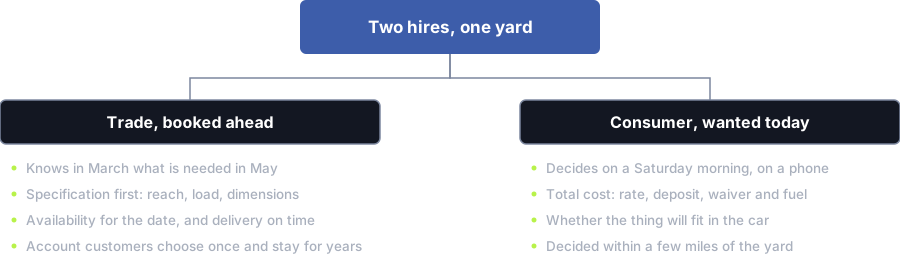
Trade, booked ahead
- Knows in March what is needed in May
- Specification first: reach, load, size
- Free on the date, and delivered on time
- Account customers choose once and stay
Consumer, wanted today
- Decides on a Saturday morning, on a phone
- Total cost: rate, deposit, waiver, fuel
- Whether it will fit in the car
- Decided within a few miles of the yard
How they choose
How buyers choose between you and a rival
Know how they choose and you know where to show up.
- Trade customers choose on availability for the date and on-time delivery. Price comes a distant third, because an hour of a crew standing idle costs more than the gap between two day rates.
- Consumers choose on the total cost of the job: the rate, the deposit, the damage waiver, the fuel, whether it fits in the car, and whether they can collect today.
- Specification decides more hires than brand. Reach, lift height, floor-loading weight, power supply, attachments and transport size all get checked, and a listing that leaves them out forces a phone call the customer may never make.
- Account customers choose once and stay for years, kept by credit terms, a named contact who answers, breakdown response times and one combined invoice. Winning an account is worth far more than a single hire.
- Distance matters because delivery costs money and time. A yard forty minutes further away has to be much better or cheaper, and beyond a certain distance it isn't considered.
- Consumers read reviews; trade customers ask other trades. The same business is judged by two reputations, and you can only see one.
Common problems
Is your equipment rental marketing wasting money?
A rental business pays for its revenue up front: the fleet is bought, the yard rent fixed and the fitters on the payroll. After that, one question matters. How many days is each machine out earning, and how many is it parked?
So equipment rental marketing has a specific brief. Not more enquiries, but a scissor lift free from Thursday at one branch, and a customer twenty minutes away who doesn't know it's there.
- The website is a catalogue that never mentions availability.
- A product page describes a machine the company owns somewhere, not whether one is free next Tuesday at the branch nearest the job. Availability changes by the hour, but a line like "usually available at this branch, book to confirm", plus a request answered within the hour, converts far better than a spec sheet and a phone number.
- Trade and retail customers share one path.
- The account holder wants agreed rates, a delivery slot and a reserved machine without a conversation. The homeowner wants a weekend price for a wallpaper steamer and the deposit. One quote form makes the trade customer phone anyway, and the homeowner gives up waiting for a Monday callback.
- Every branch page is the same page with the town changed.
- Depots differ in ways that matter: the fleet held, the delivery radius, an on-site fitter, Saturday hours, card payments at the counter. A page built from those facts helps customers and competes in local search; a page with the town name swapped does neither.
- Idle kit never reaches the marketing conversation.
- Operations knows exactly which categories are under-used this month; it's on their Monday report. Marketing plans a quarter ahead from a category list that ignores it. Link the two and advertising gets an obvious target: what's standing still, where, and for which dates.
- The advertised rate is not the invoiced rate.
- A day rate that leaves out delivery, collection, damage waiver, fuel, out-of-hours charges and a minimum hire period brings enquiries and then disputes, and consumers call it bait in reviews. Publish the realistic total for a typical hire: fewer enquiries at the top, more bookings at the bottom.
What people search
What people type, like “excavator rental near me”
Consumer hire, wanted today
Same day, led by price and decided within a few miles. Nearly all of it happens on a phone.
- excavator rental near me
- carpet cleaner hire [town]
- scaffold tower hire near me
- log splitter rental near me
- tool hire open sunday near me
Trade hire, specification first
Precise, booked ahead and tied to a project date. The searcher knows exactly what they need.
- 10 tonne excavator hire [region]
- boom lift hire 20m [city]
- telehandler hire rates per week
- concrete pump hire [county]
- site accommodation hire [region]
Cost, terms and requirements
Read before the first hire and rarely answered well. Cheap content that directly lifts bookings.
- how much does it cost to hire a mini digger
- plant hire damage waiver explained
- do i need a licence to operate a [machine]
- equipment hire deposit refund how long
- weekend hire rates explained
Branch, delivery and logistics
Practical questions asked just before booking. More often answered on a map profile than a website.
- [company] [town] opening hours
- plant hire with delivery [town]
- equipment hire near [postcode] open now
- does [company] deliver to [area]
- tool hire [town] card payment
These are example searches from keyword research and public search data. Before we suggest anything, we check how often people search for them in your area.
Where to spend
Local SEO first, then your Google profile
In the order we'd put them. Start at the top.
Local search, depot by depot
Hire is limited by delivery distance, so build visibility yard by yard. Set categories, attributes and service areas for each depot, and make sure the branch holding the kit answers "product plus town" searches. A depot nobody finds locally is a fixed cost earning nothing.
Depot profiles that show what each depot holds
For same-day hire, the map profile is where people decide: open, how far, has the thing, answers? Keep Saturday hours right, show yard photos not a logo, list the categories held, and have branch staff answer questions. Across a network that needs a named owner and a routine.
Branch pages built from each branch's own facts
Each depot needs a crawlable page built from its own details: the fleet, the delivery radius, the hours, a fitter, counter payments. Decide early how branch and category pages fit together so they don't compete; cheap to settle once, expensive to undo.
Let customers book a hire for a date
Most hire websites end in a quote request, turning a customer with a date into a next-day callback. Capture the machine, branch, start date and duration, with a stated reply time, and marketing produces bookings. Usually the quickest win on the site.
Your website
Turn more visits into enquiries
- An availability note on every product, even if it is a stated lead time, not a live count
- A branch page listing the fleet at that yard, the delivery radius and the counter hours
- Separate paths for account and one-off hire from the first click, with account rates behind a login
- The realistic total cost of a hire: delivery, collection, damage waiver, fuel, minimum period and out-of-hours
- Specifications precise enough for a site manager to check reach, weight, power and transport size
- Operating and certification requirements stated clearly, without implying training you don't provide
- A booking request that captures machine, branch, start date and duration, not a blank enquiry box
- Damage, breakdown and off-hire processes written where people can read them before hiring
- Fast on a phone with one bar of signal, because much of this happens on site
Measuring results
Numbers that matter
These numbers show if your marketing brings in customers. Website visits alone don't.
- Utilisation by category and by branch. Every other number here answers to this one
- Hire days booked at each branch against the fleet it holds
- Revenue per available machine per day, not just revenue
- New trade accounts opened, and how often a first hire leads to a second
- Share of enquiries that come with a date attached
- Cost per booked hire day by channel and by category
- Idle days for categories you advertised, compared with ones you didn't
- Delivery promises kept, because trade hire lives on repeat business
The rules
Rules that shape your marketing
How you advertise hire rates is regulated, often differently for consumers and businesses. Rules on showing the full price and disclosing deposits, damage waivers, minimum hire periods and extra charges vary by country and often by state or province, and regulators have been active on consumer pricing in several markets. We present rates to the rules where you trade and ask you to confirm details with your regulator or legal adviser. This is not legal advice.
Claims about safety, certification and operator competence need special care. Calling equipment safe, or suggesting that hiring from you meets a customer's training, inspection or certification duties, can create risks well beyond advertising rules, and those duties differ by jurisdiction and equipment type. We describe what you supply and its condition, and point customers to the requirements that apply to them.
Some regulated equipment types have their own advertising limits. Powered access, lifting gear, pressure systems, generators and anything with an emissions or noise rating can have rules on how it is described and who may hire it. We flag restricted categories in your markets; confirming them is for your compliance adviser.
Sources
Go to the source
Each rule above, linked to the body that publishes it. Which ones apply depends on where you work. Rules change, so check the latest version.
- A price made unattainable by fixed obligatory fees is misleading, unless the fees are imposed by law.
- Competition Act s. 74.01
- Source: Canada — Competition Act, s. 74.01(1.1)
- Businesses must show consumers the total price as a single figure, including unavoidable fees.
- ACL single price rule
- Source: Australia — ACCC, Price displays
Questions
Before you hire an equipment rental marketing agency
Our availability changes constantly. How can we publish it?
You don't need a live count. A note per branch like "usually available here, book to confirm", plus a request form that captures the date and gets a reply within the hour, covers most of what customers need.
Showing nothing isn't safe. Customers phone three yards, and the first to answer gets the hire, whoever had the nearest kit.
Our trade customers phone the branch. Is a website relevant to them?
Yes. They phone because the website never helped them, and they check it before calling more than you'd think: specs, delivery radius and Saturday opening, then the phone.
The website also wins accounts you don't have yet. New trade customers find suppliers by search, and if you don't show up for a spec-led search, you never get the call.
Should we advertise the categories that are already busy?
Usually not. An enquiry for a category with nothing free costs money, ties up the counter and sends the customer to a competitor.
Aim the budget at the under-used list so advertising answers to the utilisation report. It also makes the conversation with your operations manager easier, because you're working from their numbers.
Should this be done per branch or centrally?
Build the tools and process centrally and fill in the facts locally. Branch pages, profiles and campaigns are built once to a standard, then filled with what's true at that yard: fleet, radius, hours, fitter.
Leaving profiles and hours to whoever has time at each depot always fails, because it's nobody's job. Wrong Saturday hours lose more hires across a network than any campaign wins.
Is it worth publishing equipment rental prices when every hire is negotiated?
Yes. Publish prices for consumers and a guide for trade. Homeowners won't enquire without a number, and their kit is standard enough to price openly.
For trade, list rates with a note that account rates differ. A new customer can see if you're in range, without you being locked into a price that depends on duration, distance and the relationship.
See what to fix first
Start with the free checkup. It shows what to fix first on your website, with no sign-up. Want the full plan for your equipment rental business? Book a call, and we'll look at your market, your competitors and the searches that bring in customers.
Prefer to talk it over? Book a free call
Your BOOSTD score improves within 90 days, or your next month is free. After 6 months, more traffic or leads, or we keep working free (up to 6 free months in any 12 months). Read our guarantee
References
Sources for equipment rental marketing
The official documents and research this page is based on. Platform rules change, so check the source before you act on a detail.
Related
More on equipment rental marketing
Last updated · Published by Zubair Afzal, responsible editor