
Residential Real Estate marketing
Real estate agent marketing that wins you more listings
Real estate agent marketing that wins you more seller listings in the areas you work, not another feed of buyer leads.

Where to spend
Start with local SEO, then organic search
In the order we'd put them. Start at the top.
Be easy to check after someone recommends you
Most sellers type your name or your area into Google to check you’re real. They need a complete Google Business Profile, reviews in your name, fresh photos and a page that’s clearly yours. It’s quick to fix, and it helps every other channel you run.
Content for sellers and for each neighbourhood
Sellers search about home values, commission and whether now is a good time. Almost no agent site answers those properly. Add specific neighbourhood pages and this is the only channel that reaches homeowners in the months before they pick an agent.
A site for people who search your name
You won’t beat the portals on listings, so stop trying. Your site’s job is to win over someone who already knows your name. Show proof of local sales, a simple appraisal request, clear answers on fees and process, and reviews on the page.
How they choose
How the shortlist gets made
Know how they choose and you know where to show up.
- Sellers usually start with a name they already have. A neighbour’s tip, an agent whose sign they keep seeing, or someone who sold a similar house nearby. The search that follows checks that name.
- They shortlist two or three agents for an appraisal. The appraisal is the real sales meeting. Marketing has done its job when it gets you into that room with your credibility intact.
- They compare fees, but far less than agents expect. Confidence decides it: about the price, the marketing plan for their home and whether you’ll still pick up the phone after they sign.
- They read reviews for how the process went, as well as the result. Communication, straight talk about the likely price and how problems were handled matter more than a list of sales.
- Local knowledge is your strongest edge. An agent who talks accurately about the street and what buyers there want beats one showing a city-wide sales record.
- Buyers choose almost nothing. They follow the property and meet the agent after they enquire. So you can’t judge buyer marketing the same way as seller marketing.
From first thought to signed listing
How a homeowner goes from thinking of selling to signing an agent
Months, sometimes years, pass between first interest and a signed listing. That makes this a follow-up business far more than a lead-generation one.
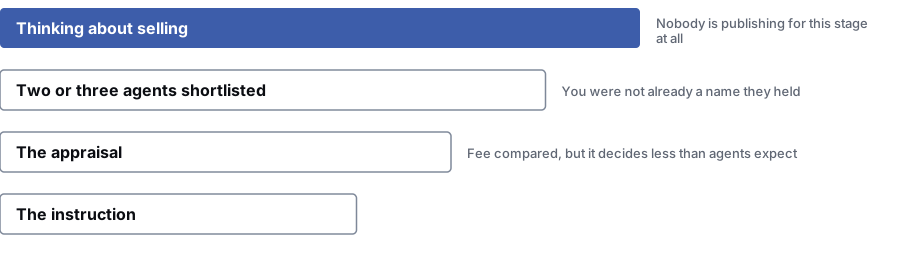
- 1Thinking about selling — Months or years before signing. Slow and private, and almost no agent website speaks to it.Nobody publishes for this stage at all
- 2Two or three agents shortlisted — Usually a name they already knew: a neighbour’s tip, a sign they kept seeing or whoever sold a similar house nearby.Your name wasn’t one they already knew
- 3The appraisal — The real sales meeting. Marketing has done its job once you’re in that room with credibility already earned.Fee compared, but it decides less than agents expect
- 4The signed listing — Confidence about price and the plan for their home, plus reviews read for how the process went.
Common problems
What's holding your residential real estate marketing back?
Real estate agent marketing has an odd imbalance. Buyers are everywhere and cost almost nothing to attract. Sellers are rare and slow to decide, and they’re the ones who sign the agreement that pays you.
Most agent marketing buys buyer leads anyway, because that’s what lead sellers sell. We start with sellers.
- Your listings generate leads for other agents.
- Once you win a property, it goes on the portals and attracts buyers, as it should. But those enquiries go to whoever bought the ad slot for that area. Often that’s a competitor. Keep the portals. Just make sure the searches that follow, for your name and your area, land on pages you control.
- Everything is built for buyers, and buyers aren’t scarce.
- Buyer marketing is easy to make and easy to measure, so it fills the plan. But buyer enquiries are plentiful, slow to convert and often already working with another agent. A seller enquiry is rare, decisive and tied straight to a fee. Until you tilt towards sellers, spending more mostly buys more of the cheap half.
- The brokerage name is on the marketing and the agent is the brand.
- Sellers hire an agent they trust. They ask friends about you, search your name and read reviews about you. A brokerage template page with a headshot gives that search nothing. Each agent needs their own page, reviews in their name and content that proves they know the six streets they cover.
- Your database is a list nobody works.
- Past clients, contacts and old appraisals sit untouched in a CRM while the budget buys strangers. These people already know you, and sellers ask people they know before they search. A steady, useful note about their own street is the cheapest listing source most agents have.
- Your area pages are city names with the nouns swapped.
- Forty near-identical neighbourhood pages is a pattern Google discounts and homeowners see through. A neighbourhood page earns its place when it holds something only a working local agent would know. The type of homes, what sells there, what’s holding sellers back right now and sales you worked on yourself.
What people search
Searches like “how much is my house worth”
Sellers, months before they list
The scarce, valuable half of the market. Slow, private and mostly ignored by agent websites.
- how much is my house worth
- should i sell or rent out my house
- real estate agent commission rates
- best time of year to sell a house
- do i need to renovate before selling
- what adds value to a house before selling
Choosing and checking an agent
They usually have a name already and want to know if they can trust it.
- best realtor in [neighbourhood]
- top listing agents [city]
- estate agent reviews [town]
- how to choose a listing agent
- [agent name] reviews
Buyers and area research
Plenty of searches, mostly captured by the portals. Worth serving, but don’t build the plan on them.
- houses for sale in [area]
- homes for sale near [school]
- condos for sale [neighbourhood]
- open houses this weekend [city]
Local knowledge questions
Where an agent can outrank a portal, because a good answer takes someone who knows the area.
- is [neighbourhood] a good place to live
- property taxes in [town]
- best neighbourhoods in [city] for families
- what is the [neighbourhood] housing market like
These are example searches from keyword research and public search data. Before we suggest anything, we check how often people search for them in your area.
Your website
Is your website losing you work?
- An agent page that’s yours: your name, your area and your reviews, not a template with a headshot
- A seller path, separate from the buyer path, that asks for an appraisal
- Neighbourhood pages with detail only a working local agent could write
- Clear, simple content on fees and what the seller gets for them
- Recent sales shown as proof, using only figures you’re allowed to publish
- Reviews shown on the page, with the count and dates visible
- A valuation request that explains what it is and what it isn’t
- Licensing and brokerage details shown the way your local rules require
- Fast on a phone, because most of these searches happen on one
Measuring results
The figures worth watching
These numbers show if your marketing brings in customers. Website visits alone don't.
- Listing appraisals booked, the one early sign that matters
- Listing agreements signed, and how many appraisals turn into signed listings
- Seller and buyer enquiries counted separately, never blended
- Cost per appraisal booked, by channel
- Share of listings from referrals, your database or your own site
- Database reach: how many of your contacts you reached this quarter
- Searches for your name over time, a sign of local recognition
- Old appraisals followed up and later won
The rules
Before you publish an ad
Real estate advertising is a licensed activity in most markets. The rules usually cover how the brokerage must be named, which licence details must appear and what you may claim about past results or market position. They differ by province, state and country, and they change. We write within the rules that apply to you and ask you to confirm the details with your licensing body or legal adviser before anything goes live. This isn’t legal advice.
Claims about sale prices, speed of sale or how you compare with other agents are the most restricted area, and the easiest to get wrong. If a figure can’t be backed up and published within your rules, we leave it out. We don’t water it down.
Sources
The rules in full
Each rule above, linked to the body that publishes it. Which ones apply depends on where you work. Rules change, so check the latest version.
- REALTORS® must present a true picture in advertising and make their professional status apparent.
- NAR Code, Article 12
- Source: US — NAR Code of Ethics and Standards of Practice 2026
- Advertising of real estate services or listings must disclose the name of the REALTOR®’s firm.
- NAR Standard 12-5
- Source: US — NAR Code of Ethics and Standards of Practice 2026
- Ontario agents may not advertise unless the brokerage is clearly and prominently identified.
- RECO Bulletin 5.1
- Source: Canada (Ontario) — RECO Bulletin 5.1, Advertising requirements
Questions
Got questions about residential real estate marketing?
We get plenty of buyer leads. Why do you want to change the focus?
Because buyer leads are plentiful and sellers aren’t. A buyer enquiry is cheap and slow, often already working with another agent, and only pays if it completes. A listing is a signed agreement with a fee attached.
Keep your buyer marketing. When it’s already working, more of it adds less than building the seller-side marketing most agents have never set up.
Can we stop the portals capturing enquiries from our own listings?
No, and any agency that says it can is overstating things. Buyers search on portals, and portals make money by sending enquiries to advertisers. Pulling out usually costs you more than it saves.
You can make the exposure pay off. A property with your sign outside leads to searches for your name, the area and the neighbourhood. If those land on a page you own, with reviews and proof of local sales, the listing does more for you than the sale alone.
How many neighbourhood pages should a real estate agent have?
As many as you can write with true local knowledge. For most agents that’s three to eight. Each page needs detail on the housing, first-hand notes on what sells and sales you can talk about yourself.
Forty pages with the name swapped is a pattern Google discounts. A homeowner reading the one about their own street will spot it at once.
My brokerage controls the website. What can I still do?
Quite a lot. Your Google Business Profile, reviews, social accounts and database are yours, whoever owns the website. Together they cover most of what a seller checks.
If the brokerage site is restrictive, your own agent site alongside it is usually worth building. Check your brokerage and licensing rules on branding first, because both often have rules about it.
The market has slowed. Should we cut marketing?
Usually not. A slowdown cuts the number of sales but not the number of agents chasing them. Competition for each listing rises just as most rivals go silent. That’s a good time to stay visible.
Change the focus. Spending on buyer volume becomes less useful. Seller content, local market updates and database work become more useful, because homeowners in a slow market take longer and read more first.
Ready for more enquiries?
Start with the free checkup. It shows what to fix first on your website, with no sign-up. Want the full plan for your residential real estate business? Book a call, and we'll look at your market, your competitors and the searches that bring in customers.
Prefer to talk it over? Book a free call
Your BOOSTD score improves within 90 days, or your next month is free. After 6 months, more traffic or leads, or we keep working free (up to 6 free months in any 12 months). Read our guarantee
References
Sources for real estate agent marketing
The official documents and research this page is based on. Platform rules change, so check the source before you act on a detail.
Related
More on residential real estate marketing
- real estate agent websites with MLS listingsDesigns with your board’s listings built in.
- area guides and editorial
- marketing for property managers
Guides for residential real estate
Other real estate businesses
Last updated · Published by Zubair Afzal, responsible editor