
Property Developers marketing
Property development marketing that sells homes before they exist
Property development marketing for off-plan sales. Build a registration list before launch, sell each release, and prove you'll deliver what you promised.

Common problems
Where property development businesses lose customers
Property development marketing sells something nobody can walk into yet. The buyer pays a deposit against a drawing, a list of finishes and a date. Every part of the campaign answers one question: will this company deliver what it described?
It's also a business of releases, not steady demand. Units go out in phases, allocation and deposit terms decide who commits first, and the first phase opens on a planning timetable that ignores your media bookings.
- The launch date moves and the campaign cannot.
- Approval takes another committee cycle, a condition needs clearing, and the launch slips a quarter while the media is booked and the registration list goes cold. Build in two parts: a long, undated phase that gathers a list and answers questions, then a short release campaign you can launch within a fortnight of a date becoming real.
- The renderings promise more than the contract does.
- Marketing images show a finish, a view and landscaping the spec may not commit to. Beyond the legal risk, buyers who expected the render complain publicly at handover, where later buyers read it. State what's included, what's an upgrade and what's indicative, and date the images.
- Buyers and investors are sent the same brochure.
- A home buyer wants light, storage, the walk to the station, the school catchment and the neighbours. An investor wants rental comparisons, service charges, tenure, management and resale in five years. One document leaves each reading the other's content, so give them two paths from the first ad.
- The registration list is collected and then left alone.
- Registrations come in for months before a release. Most campaigns send a thank-you and nothing until launch week, by which time many have bought elsewhere. Use the waiting period to answer the questions that would stop them reserving.
- Nothing addresses whether you will finish it.
- Under every off-plan purchase sits one worry: will it get delivered? Most development sites never mention it. Show completed schemes with people living in them, name the contractor and warranty provider, explain how deposits are held, and give a factual account of any scheme that ran late. That does more for reservations than another lifestyle video.
What people search
“New condos launching [city]” and similar searches
People looking for something new
Broad, early and very local. This is where a scheme gets onto a list, months before a release opens.
- new condos launching [city]
- new build homes [suburb]
- off plan apartments [city]
- new developments near [transit line]
- house and land packages [region]
- new apartments with parking [district]
Investors running the numbers
Very different questions from home buyers, and usually nothing on a developer site answers them.
- off plan investment [city] rental demand
- stamp duty on off plan purchase
- rental yield [suburb] apartments
- is buying off the plan worth it
- service charge new build apartment average
Risk and process questions
The searches that decide whether a deposit gets paid. Almost no developer answers them clearly.
- what happens if a developer goes bust
- off plan deposit protection explained
- sunset clause explained
- can a developer change the floor plan after i buy
- how long between reservation and completion off plan
Checking you specifically
Late and decisive, and mostly on pages you don't control. Worth knowing what people find.
- [development name] reviews
- [developer name] completed projects
- [development name] price list
- [developer name] delays
- [development name] service charge
These are example searches from keyword research and public search data. Before we suggest anything, we check how often people search for them in your area.
How they choose
What customers check before they choose
Know how they choose and you know where to show up.
- Buyers choose the location before the developer. They settle on an area, a commute and a budget, then compare what's being built there, so a scheme competes with two or three named neighbours.
- The floor plan sells more than any image. Buyers check whether a bed fits the second bedroom, look for storage and work out where a table goes, and a plan without dimensions or orientation loses them.
- Buyers judge delivery risk on your track record. Finished schemes they can visit, a contractor they can look up and a warranty they know count for more than any brochure reassurance.
- Price is compared by unit type against a handful of alternatives, and payment structure matters as much. Deposit size, staged payments and what happens if completion slips can decide between two schemes at the same price.
- Home buyers buy the life around the building: light, noise, the walk to a station, ground-floor shops, who manages it. Investors buy the income: likely rent, empty periods, service charge, tenure and resale.
- The display suite or show home converts far better than anything online. Most of the campaign is about getting a named person through that door on a set day.
Before the building exists
How buyers pick an area first and a new development second
Buyers settle on a location, a commute and a budget. Only then do they compare what's being built there. A scheme that isn't on the list when it forms never gets compared at all.
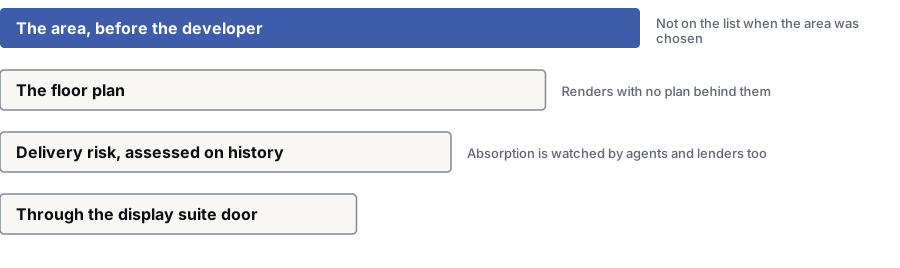
- 1The area, before the developer — Buyers pick an area, a commute and a budget, then compare what is being built there. The scheme always comes second.Not on the list when the area was chosen
- 2The floor plan — It sells more than any image. Buyers check whether a bed fits the second bedroom, look for storage and work out where a table goes.Renders with no plan behind them
- 3Delivery risk, judged on history — Finished schemes they can visit, a contractor they can look up and a warranty they know. Promises don't do this job.Agents and lenders watch sales speed too
- 4Through the display suite door — It converts far better than anything online. Most of the campaign is about getting one named person there on a set day.
Where to spend
Spend on the website first, then search content
In the order we'd put them. Start at the top.
A launch site built to run a release
A scheme site needs a release schedule, unit-by-unit availability that updates by the hour during a launch, dimensioned floor plans, separate investor and home buyer paths, and resilience when a date moves. Build it as a brochure and you'll rebuild it in launch week.
Answer the questions that stop a deposit
Deposit protection, sunset clauses, what happens if a developer fails, off-plan finance, what a service charge covers: people search these constantly, and forums and news do most of the answering. A developer who answers clearly, awkward parts included, earns trust when it counts.
Be the answer when buyers ask AI about the scheme
Buyers now ask AI assistants which developments are coming to an area, what a builder is known for and whether a scheme is on time. Those answers come from your own pages, planning documents and local press. Keep completion dates, specifications and the developer's track record stated plainly and consistently, so the summary a buyer reads is yours and current.
Your website
What a good site does
- A release schedule showing what is available now, what is coming and what has sold
- Floor plans with dimensions, orientation and a stated scale, not decorative sketches
- A specification list that separates what is included from upgrades, dated and versioned
- Separate paths for home buyers and investors from the first page, not one shared brochure
- Proof you deliver: completed schemes photographed as built, the contractor, the warranty and how deposits are held
- Images clearly labelled, with indicative renderings marked as indicative
- A registration form that asks for unit type, budget and whether they will live in it or let it
- Display suite booking with real appointment times, because that visit is what sells
- Construction updates that keep existing buyers confident between deposit and completion
- Fast on a phone, since much of this browsing happens on the move
The rules
What the rules allow
Marketing property that isn't built yet is specifically regulated in many markets. Rules often cover what you can say about the finished product, how renderings and floor plans must be qualified, which disclosure documents buyers must get before a contract, and whether a cooling-off or cancellation period applies. They differ by province, state and country and change often. We write to the rules for your scheme and ask you to confirm them with your regulator and legal adviser before publishing. This is not legal advice.
Deposits come with their own rules. Whether a deposit must be held in trust, by whom, and what your ads may say about protecting buyers' money vary a lot between markets. We describe your arrangement accurately and never call it protection beyond what your legal adviser confirms.
Investment returns are the riskiest area in this sector. Claims about rental yield, capital growth, guaranteed returns or resale value can fall under financial promotion as well as consumer protection rules, depending on audience and jurisdiction. We only publish dated, evidenced market data and avoid wording that presents buying property as a sure financial result.
Completion dates are estimates, and we present them that way, qualified as your contract does. A date that reads like a promise in an ad is the most common cause of disputes in off-plan sales.
Sources
Rules and where to read them
Each rule above, linked to the body that publishes it. Which ones apply depends on where you work. Rules change, so check the latest version.
- Ontario buyers of new condominium units get a disclosure statement and a 10-day rescission period.
- Condo Act ss. 72–73
- Source: Canada (Ontario) — Condominium Act, 1998
- Deposits paid on new Ontario condominium units must be held in trust or secured as the Act sets out.
- Condo Act s. 81
- Source: Canada (Ontario) — Condominium Act, 1998
- Covered US lot sales require a property report before signing and give a revocation period.
- ILSA, 15 U.S.C. § 1703
- Source: US — Interstate Land Sales Full Disclosure Act (Cornell LII)
Measuring results
What counts as a result
These numbers show if your marketing brings in customers. Website visits alone don't.
- Units reserved per release, and how many days the release took to sell
- Registrations before launch, split by buyer type
- How many registrations become reservations. The whole pre-launch plan answers to this number
- Display suite appointments booked and attended
- How many reservations reach exchange, with the reasons others fall through recorded
- Cost per reservation, measured against unit value, not against an enquiry
- Price achieved per unit type against the release plan
- Cancellations after exchange, which usually point to poor communication, not poor selling
Questions
Quick answers on property development marketing
We do not have approval yet. Is it too early to market?
Too early to sell, but the right time to build a list. Before approval, a scheme collects registrations, answers buyers' questions and shows the company has finished projects before.
The setup differs, though. Nothing should carry a date you can't keep, images must be qualified, and a three-month slip should mean a delay, not a rebuild. Decide that at the start.
Our selling agent handles marketing. Why would a property developer do its own?
Because the agent markets the units, and you also need to market the company: a track record, answers about delivery, and a registration list you own, whichever agency holds the contract.
Usually you need both, with boundaries agreed up front. The developer owns the scheme site, the registration data and the delivery story; the agent runs the sale. Problems start when this is left until launch week.
Should we publish prices, or ask people to enquire?
Publish at least a range. Hiding prices filters out serious buyers along with browsers, and someone with a budget moves on to a scheme that gave a figure.
A price band per unit type, with what's included and how payments work, brings fewer but better enquiries. If a release isn't priced yet, give an expected range and a date.
How do we market to investors and owner-occupiers at the same time?
Separately, from the first click. One wants a home, the other an income, and their questions barely overlap.
That means two enquiry paths, two sets of content and often two campaigns with different channels and timing. The building is the same; almost nothing else about the pitch is.
A previous scheme ran late. Do we have to mention it?
You don't have to raise it, but pretending it didn't happen is usually worse. Buyers search your name, and a delay in a news article or forum thread with no reply from you looks worse than your own account.
Keep it short and factual: what happened, why, what changed, and what buyers in that scheme received. That shows you communicate under pressure, which is what an off-plan buyer is trying to judge.
Get your free checkup
Start with the free checkup. It shows what to fix first on your website, with no sign-up. Want the full plan for your property development business? Book a call, and we'll look at your market, your competitors and the searches that bring in customers.
Prefer to talk it over? Book a free call
Your BOOSTD score improves within 90 days, or your next month is free. After 6 months, more traffic or leads, or we keep working free (up to 6 free months in any 12 months). Read our guarantee
References
Sources for property development marketing
The official documents and research this page is based on. Platform rules change, so check the source before you act on a detail.
Related
More on property development marketing
- home builder website designsCommunities, site plans and licence lines.
- commercial leasing and brokerage
- turning interest into registrations
Guides for property development
Other real estate businesses
Last updated · Published by Zubair Afzal, responsible editor