
Property Management marketing
Property management marketing that wins new doors and keeps them
Property management marketing that brings in more landlords and keeps the doors you have, because growth is doors won minus doors lost.

How they choose
Why they pick one business over another
Know how they choose and you know where to show up.
- Most owners are switching from another manager. They have a specific complaint. The firm that names that complaint in its marketing feels like the fix.
- They want to know how and when they get paid. Clear statements, payment dates and end-of-year reports come up earlier than most firms expect. It’s the part of the service an owner feels every month.
- Tenant screening sits under most other questions. The owner wants to know how likely it is that the property gets damaged or the rent goes unpaid. A step-by-step screening process calms more nerves than any claim about great service.
- Owners know most reviews come from tenants. So they read your replies more carefully than the reviews. A calm, specific reply to an angry review tells an owner more than a five-star average.
- The fee matters, but it decides fewer deals than most owners of management firms think. It only becomes the deciding factor when nothing else on the page sets the firms apart. That’s usually the case.
- Tenants don’t choose the manager. They choose the property. So a good tenant experience helps you keep owners more than it wins new ones. It shows up in shorter empty periods, lower turnover and happier owners.
Traffic versus revenue
Why tenant traffic swamps your reports while owners pay the bills
Tenant searches dominate any report you run, yet say almost nothing about new business. You win doors through a much smaller set of owner searches most firms never look at separately.
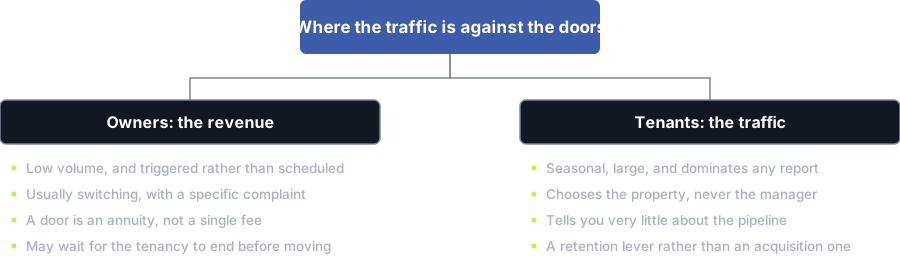
Owners: the revenue
- Small numbers, sparked by an event
- Usually switching, with a specific complaint
- Each door pays a fee for years
- May wait for the tenancy to end first
Tenants: the traffic
- Large, seasonal, and swamps any report
- Chooses the property, never the manager
- Says very little about new business
- Helps you keep owners more than win them
Timing
When the enquiries come in
Owners come to you after something happens. A bad experience, a move abroad, an inherited house or a first investment property. So the numbers are modest, steady through the year and hard to force. The goal is to be there, and look credible, when that moment comes.
Tenant demand is large and seasonal. In many markets it peaks around lease ends, the academic year and relocation periods. It swamps any traffic report and tells you very little about revenue. Measure the two audiences separately from day one.
An owner takes longer to decide than it looks. Someone thinking of switching often waits for the current tenancy to end. An enquiry may sit for months. Follow-up matters more than a fast first reply here.
Each door pays a fee every month, for years. So an owner is worth years of fees, plus letting and renewal income. Firms that set their budget against one month’s fee always underspend. Use a realistic tenure and you can usually afford much more.
Common problems
Why property management ads and SEO fall flat
Property management marketing is a different job from selling homes. Management fees recur, owners stay for years, and growth means doors added minus doors lost.
You also have two audiences. Tenants bring nearly all the traffic, the support calls and most of the reviews. Owners bring all the revenue. Follow the traffic and you end up serving the wrong one.
- Your website sells to tenants and says nothing to owners.
- A typical property management site has rental listings, an application form, a maintenance request and a tenant login. All needed. But a landlord handing over a property worth several hundred thousand needs other answers. What does the fee cover? How are tenants screened? How are arrears handled? When do I get paid? Who deals with a midnight emergency? If the site doesn’t answer, the owner never gets in touch.
- You count doors added and ignore doors lost.
- New doors get noticed and celebrated. Lost doors slip away one email at a time, and often nobody reports them. A firm that signs ten properties a month while nine leave has spent a year’s budget to stand still. Cutting churn is usually cheaper than winning more owners. Track it monthly, with reasons, so you know which to work on.
- You’re missing at the exact moment a landlord decides to switch.
- Owners switch because they’re fed up. A landlord whose calls go unanswered, or whose property sat empty for two months, starts searching. How do I change managers? What notice do I owe? Is it worth the hassle? These searches are few and full of intent. Most firms have no page that answers them.
- Your reviews are written by tenants and read by owners.
- A manager who enforces leases will collect unhappy tenant reviews. That comes with doing the job properly. But an owner reading them can’t tell a difficult firm from one doing exactly what owners pay for. Two things fix this. Ask owners for reviews on purpose, which almost nobody does. And reply to tenant reviews calmly, so the reader sees a professional firm.
- Owners compare your fee alone because nothing explains it.
- Show a landlord eight per cent and ten per cent with no context and they pick eight. The difference is usually in inspections, arrears chasing, contractor costs, empty weeks and whether anyone answers the phone. None of that appears on a pricing page. Explain the fee, including what it doesn’t cover. That wins more enquiries than a discount and attracts owners who won’t leave over half a point.
Where to spend
Why organic search comes before local SEO
In the order we'd put them. Start at the top.
Rank for the searches landlords make before switching
A landlord looking up how to change managers or what notice they owe is your best visitor. These searches are small, barely contested and almost never answered by management sites. Answer them clearly, including when switching isn’t worth it. That’s what makes the page believable.
A Maps listing that speaks to owners
Owners search locally and check your Google Business Profile before they call. Make sure it shows the management business, not just rental listings. Run a steady process for owner reviews. And reply to tenant reviews in a way that reassures the landlord reading later.
Owner and tenant reviews, handled separately
Enforcing leases brings unhappy tenant reviews. That’s part of doing the job well. Balance it by asking happy owners for reviews at the right moments, like after a fast re-let or a tricky repair handled smoothly. Reply for the landlord reading later. Don’t try to win the argument.
Separate paths for owners and tenants
Most management sites push both audiences down one path and serve neither. Give owners their own route with clear fees, your screening process, payment dates and a proposal form about their property. Judge it on owner enquiries, not the tenant traffic filling your analytics.
What people search
Searches such as “property manager for my rental”, grouped by intent
Owners looking for a manager
Small numbers, high value. Most firms build their whole site around these searches.
- property manager for my rental
- property management companies near me
- how much do property managers charge
- best property management company [city]
- residential property management fees explained
Landlords ready to switch
Driven by frustration and very specific. The highest-intent searches here, and the least served.
- how to switch property management company
- can i fire my property manager
- property manager not responding to emails
- notice period to end property management agreement
- property manager did not do inspections
Accidental and first-time landlords
People deciding whether to manage it themselves. The cheapest owners to reach.
- should i rent out my house instead of selling
- do i need a property manager
- how much rent can i charge for my house
- self managing a rental property pros and cons
Tenant searches
Most of the volume, almost none of the revenue. Serve it well, but never let it set the plan.
- apartments for rent in [area]
- houses for rent near me pet friendly
- how to pay rent online [company name]
- submit maintenance request [company name]
These are example searches from keyword research and public search data. Before we suggest anything, we check how often people search for them in your area.
Your website
What your website must have
- An owner section people can find easily, not one page buried under a tenant-first menu
- What the management fee covers and, just as important, what it doesn’t
- Your tenant screening process, step by step, not just a claim that it’s thorough
- How and when owners get paid, with statement and end-of-year report details
- How you handle arrears, damage and difficult tenancies
- Useful advice on switching managers, helpful even before they choose you
- A working tenant area (listings, applications, maintenance requests, portal login) kept apart from the owner path
- Owner reviews collected and shown next to the tenant reviews people will find anyway
- Rental listings that follow the advertising and anti-discrimination rules in your market
The rules
Keep your ads compliant
Property management is a licensed activity in many places. Handling rent, deposits and client money is often covered by trust-account or client-account rules. What you may advertise, and how the licensed business must be named, varies by province, state and country. We write within the rules that apply to you and ask you to confirm the detail with your regulator or legal adviser before anything goes live. Nothing here is legal advice.
Rental ads must follow anti-discrimination rules in most markets. These cover the wording of ads as well as how tenants are chosen. That affects listing copy, image choices and any automatic syndication to other sites. We flag any phrase that carries risk where you operate. Compliance stays with you and your legal adviser.
Claims about yield, occupancy, time to let or tenant quality get challenged more than anything else here. We don’t publish figures you can’t back up from your own records. We also avoid wording that suggests a landlord is guaranteed a financial result.
Sources
Primary sources for these rules
Each rule above, linked to the body that publishes it. Which ones apply depends on where you work. Rules change, so check the latest version.
- Prohibits rental or sale adverts that indicate a discriminatory preference or limitation.
- Fair Housing Act §3604
- Source: US — 42 U.S.C. § 3604 (Cornell LII)
- English letting and property management agents holding client money must belong to a protection scheme.
- CMP Regulations 2019
- Source: UK (England) — Client Money Protection Schemes for Property Agents Regulations 2019
Questions
What people ask about property management marketing
Most of our doors come from referrals. Is marketing worth it?
Yes. Referrals are your best source, so build a proper process around them. But you can’t turn them up on demand. If one referring agent or accountant changes firm, a big share of your pipeline can go with them.
Referrals also get checked. A landlord told to call you will look you up, read your reviews and see whether your site explains how you work. A weak search presence loses you some of the referrals you already rely on.
Our reviews are mostly angry tenants. What can we do about it?
Accept that some of it comes with the job. A manager who enforces a lease, keeps part of a deposit or chases arrears will get negative tenant reviews. A firm with none may not be doing what owners pay for.
Two things help. Ask owners for reviews when they’re happiest, like after a quick re-let or a repair they never had to think about. And reply to every negative review calmly and with facts. The landlord reading later judges your reply far more than the complaint.
How should we handle being compared on percentage fee?
Make the fee harder to compare badly. If two firms show a number and nothing else, the lower one wins. Explain inspection frequency, arrears chasing, average days to let, contractor pricing and what’s included. Then the fee stops being the only thing that counts.
It also filters your enquiries. Owners who choose on price alone tend to leave on price alone. They’re the doors most likely to go within a year.
Should we run ads for rental listings?
Usually not, beyond the listing sites you already use. There are generally plenty of tenants. Paying to fill a property that would have let anyway spends owner budget on tenant traffic.
The exception is a hard-to-let property or an unusual local vacancy problem. A short paid push there protects the owner relationship. Treat it as a service cost and budget it apart from winning new owners.
How long before property management marketing brings more owner enquiries?
Google Ads aimed at owners can bring enquiries within weeks if your market has the searches. Maps listing and review work often shows up in the same period. Both are limited by how many owners near you are looking each month, which is fewer than most firms expect.
Content for switching and first-time landlords is slower. Expect three to six months before it brings steady enquiries. But it keeps working with no cost per click, and it reaches landlords earlier than any ad.
You keep talking about churn. Is that marketing’s job?
Not directly. We don’t manage your properties, and we can’t fix a slow maintenance process. But growth in this business is net, so reporting only on new owners gives a false picture of whether the spend works.
Marketing can make sure the promises made while selling match what you deliver. It can bring churn reasons to light through owner reviews and surveys. And it can stop you paying to win doors that were always going to leave.
Find your quickest wins
Start with the free checkup. It shows what to fix first on your website, with no sign-up. Want the full plan for your property management business? Book a call, and we'll look at your market, your competitors and the searches that bring in customers.
Prefer to talk it over? Book a free call
Your BOOSTD score improves within 90 days, or your next month is free. After 6 months, more traffic or leads, or we keep working free (up to 6 free months in any 12 months). Read our guarantee
References
Sources for property management marketing
The official documents and research this page is based on. Platform rules change, so check the source before you act on a detail.
Related
More on property management marketing
Guides for property management
Other real estate businesses
Last updated · Published by Zubair Afzal, responsible editor