
Commercial Real Estate marketing
Commercial real estate marketing that gets your brokerage quoted first
Commercial real estate marketing that gets your brokerage shortlisted. Publish the submarket numbers and reach the few hundred advisers who decide who pitches.

Common problems
Common commercial real estate marketing mistakes
Commercial real estate marketing isn't like selling houses. An occupier who needs twelve thousand square feet won't browse a consumer portal. Their agent opens a listing platform, calls three brokers they already trust, and checks who's published anything useful about that submarket lately.
So the job is narrow, and hard. The people who decide whether you pitch number in the hundreds, and most already know your competitors. You move up their list by proving you know the market better than the firm they used last time.
- The website is a listings feed that makes no case for you.
- Most brokerage sites are a search box over a list of space, which helps someone who's already chosen you. The adviser deciding whether to call needs what you know about that submarket, which similar deals you've done, and who on your team handles it.
- Tenant side and landlord side are sold from the same paragraph.
- An occupier wants an advocate who'll push a landlord hard. A landlord wants an agent who'll fill space at the asking rent. One page can't make both promises convincingly, so split the offers completely — content, proof and enquiry routes — and say openly how you manage conflicts.
- You collect the market data and publish none of it.
- Every deal produces evidence: achieved rent, rent-free period, fit-out contribution, lease length, void period. Firms keep it internal, then wonder why the market quotes someone else. A quarterly report with the method stated, published as a web page rather than a gated download, earns citations, journalist calls and a reason for advisers to remember you.
- Marketing is judged on enquiry volume in a twenty-deal year.
- Form fills mean nothing when a good year is twenty deals. Track the pipeline: requirements registered with a named occupier and target date, pitches invited, instructions won by property type. Otherwise the budget gets argued over with numbers that describe nothing.
- The brokers hold the relationships and the firm markets only itself.
- In commercial property the broker is the product. Advisers recommend a person, not a logo, and a broker who leaves takes the requirements with them. If brokers have no visible profile, no bylined commentary and no way to be found by name, you're building an asset that won't answer the phone.
How they choose
What makes them pick you
Know how they choose and you know where to show up.
- The shortlist comes second-hand. An occupier asks their project manager, lawyer or agent for two names, then checks whether those names hold up. It's not a hunt for options.
- Track record gets judged by property type and submarket, not city. Letting lots of office space proves nothing for an industrial requirement across the ring road, and buyers know it.
- Producing evidence fast is a live test. A broker who can show achieved rents, incentives and comparable deals within a day is showing exactly the skill the client is paying for.
- Team stability matters because the job outlasts many people's time in a role. A mandate can run a year or more, and clients ask outright whether the person in the room will still be there at the end.
- Landlords want reach and standing with occupiers. Occupiers want tough negotiating and independence. The same firm gets judged on opposite qualities, depending which side of the table the client sits.
- Fees come up late and rarely decide it. The fee is small next to the rent being committed. What decides it is confidence the advice will hold up when repeated to a board.
A pipeline dated years ahead
How an occupier with a lease event picks a broker to run the search
Lease expiries, break clauses and rent reviews are already set. Ask whose lease event lands next year and who they'll call first, not just who's searching this month.
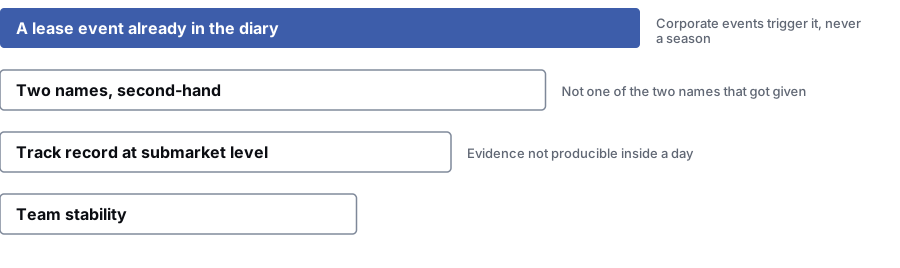
- 1A lease event already in the diary — Expiries, breaks and rent reviews are set years ahead. Ask whose event lands next year, not who is searching now.Business events trigger it, never a season
- 2Two names, second-hand — An occupier asks their project manager, lawyer or current agent for names. The search that follows is a check.Not one of the two names given
- 3Track record at submarket level — Judged by property type and submarket, not city. Lots of office lettings prove nothing for an industrial requirement.Couldn't produce the evidence within a day
- 4Team stability — A mandate can run a year or more. Clients ask whether the person in the room will still be there at the end.
Where to spend
Start with content and PR, then B2B search
In the order we'd put them. Start at the top.
Publish the numbers your market argues over
A quarterly submarket report built from your own deal evidence, method stated and figures dated, is the best-returning asset a brokerage can have. Journalists cite it, advisers quote it, and it gets forwarded inside occupier firms. The fourth edition shows a trend the first couldn't.
Search built for a few hundred buyers
The searches that matter get double-digit monthly volume and carry five-figure fees. Write pages combining a property type, a submarket and a specific process question, not broad terms. A page forty people read can be the best page on your site.
Use the words your market uses
Square feet or square metres, to let or for lease, industrial or logistics, unit or suite. Terms differ by country, property type and whether the searcher is an occupier or an adviser. Get them wrong and your pages read fine but never get found.
A research library with listings attached
The site should work as a reference: reports as web pages with figures and dates, broker profiles by discipline and property type, submarket pages with evidence, and listings that say whether space is still available. Separate occupier and landlord enquiry routes stop the two sides undercutting each other.
What people search
Searches like “office space for lease downtown”
Occupiers and their advisers looking for space
Specific, dated and few in number. Each one is tied to a real requirement with a budget behind it.
- office space for lease downtown
- warehouse for lease near [motorway junction]
- industrial units to let [city]
- retail space for rent [high street]
- flexible office space [district] 30 people
- cold storage facility for lease [region]
Market evidence and numbers
Read by advisers, analysts and journalists. Research here earns citations more than clicks.
- [city] office vacancy rate
- industrial rents per square foot [region]
- average lease incentives [city] office market
- [submarket] net absorption this quarter
- prime yields [city] logistics
Choosing an adviser
A checking search. They usually arrive with a name and want to see if it survives ten minutes of checking.
- tenant representation broker [city]
- commercial real estate broker [asset class] [city]
- how does a tenant rep broker get paid
- landlord leasing agent [submarket]
- commercial property agent for industrial [region]
Process and lease terms
Asked by the person at the occupier who has to explain the deal internally. Cheap to answer, rarely answered well.
- what is a triple net lease
- how long does a commercial lease take to negotiate
- what is a tenant improvement allowance
- break clause commercial lease explained
- schedule of condition commercial lease
These are example searches from keyword research and public search data. Before we suggest anything, we check how often people search for them in your area.
Your website
What visitors need to see
- Listings that state size, use class, specification and whether the space is still available
- Submarket pages with rent evidence and current incentives, not descriptions of the neighbourhood
- Broker profiles by discipline and property type, naming the deals they are allowed to name
- A research library where every report is a readable page, not a gated download
- Tenant representation and landlord agency kept separate, with their own enquiry routes and proof
- A date and a stated method on every published figure
- Floor plans, spec sheets and site plans attached to the unit they describe
- Licensing and company details shown the way your jurisdiction requires
- Pages that load quickly on a corporate network, since much of this is read at a desk behind a firewall
Measuring results
What we track each month
These numbers show if your marketing brings in customers. Website visits alone don't.
- Tours booked, and tours per live requirement
- Requirements registered with a named occupier, a size band and a target date
- Pitches you are invited to, and how many become mandates, by property type
- Landlord instructions won, counted apart from occupier mandates
- Time from first contact to signed heads of terms
- Mentions of your research in the trade press and by other advisers
- Searches for individual broker names, as a measure of personal profile
- Deals where the client can name a report, article or broker of yours they had read
The rules
Claims to avoid
Commercial brokerage is a licensed activity in most markets. The rules usually cover how the licensed business must be named in ads, what you may say about a property, and how you disclose acting for both sides, and they vary by province, state and country. We write within the rules that apply to you and ask you to confirm details with your licensing body before publication. This is not legal advice.
Publishing market data carries its own risks. Yields, valuations, income figures and forecasts aimed at investors can fall under financial promotion or securities rules, depending on jurisdiction and audience. We only publish figures you can back up and may release, dated, and qualified as your legal adviser directs.
Claims about market position, like "leading" or "largest", get challenged more than anything else in this sector. If a ranking, market share or deal volume figure can't be backed by a source you can cite, we leave it out rather than water it down.
Sources
The official wording
Each rule above, linked to the body that publishes it. Which ones apply depends on where you work. Rules change, so check the latest version.
- Advertising of real estate services or listings must disclose the name of the REALTOR®’s firm.
- NAR Standard 12-5
- Source: US — NAR Code of Ethics and Standards of Practice 2026
- A financial promotion may only be communicated by, or with the approval of, an authorised person.
- FSMA 2000, s. 21
- Source: UK — Financial Services and Markets Act 2000, s. 21
Questions
Your commercial real estate marketing questions, answered
Our deals come from relationships. What does marketing add?
It reaches the relationships you don't have yet, and protects the ones you do. Every referral gets checked fast: your site, your recent commentary, the recommended broker's profile.
It also helps with timing. A relationship surfaces a requirement only when someone remembers to call. Published research and a visible profile put your name in front of an adviser drawing up a shortlist, often months earlier.
If we publish our market data, are we not helping competitors?
No, because they already have most of it. Achieved rents, incentives and vacancy changes spread through the broker network within weeks.
Publishing changes who gets credit for the analysis. The firm whose report everyone quotes is seen as the firm that knows the market, and gets invited to pitch. Anything confidential to a client stays out.
Can one website serve tenant representation and landlord agency?
One site, yes. One message, no. The two sides need separate sections with their own case, proof and enquiry routes, because the promises are opposed.
Say openly how you handle conflicts. A sophisticated occupier will ask, and silence looks worse than an explanation.
How do we measure marketing when we close twenty deals a year?
Not on conversions; the numbers are too small. Track the pipeline: requirements registered, tours booked, pitches invited, instructions won, and how long each stage takes.
Also track early signs: research citations, searches for broker names, and whether new clients can name something of yours they read. These move within a quarter and predict later deals.
The listing platforms carry our availabilities. Do we need our own?
Yes, both. The platforms match a live requirement to space, and pulling out loses deals for nothing.
Your own listings serve people who arrived through your research or a broker, asking whether this firm should run the process. That's why the spec, the evidence and the named broker matter more on your page than the photo.
Want more customers from Google?
Start with the free checkup. It shows what to fix first on your website, with no sign-up. Want the full plan for your commercial real estate business? Book a call, and we'll look at your market, your competitors and the searches that bring in customers.
Prefer to talk it over? Book a free call
Your BOOSTD score improves within 90 days, or your next month is free. After 6 months, more traffic or leads, or we keep working free (up to 6 free months in any 12 months). Read our guarantee
References
Sources for commercial real estate marketing
The official documents and research this page is based on. Platform rules change, so check the source before you act on a detail.
Related
More on commercial real estate marketing
Guides for commercial real estate
Other real estate businesses
Last updated · Published by Zubair Afzal, responsible editor