
SEO
What topical authority is, and how to build it
Published by Zubair Afzal, responsible editor
First published Updated 9 min read
Nobody outside Google can point to a topical authority setting. What people can point to is a pattern, and that pattern is worth acting on even though Google hasn’t published how it works.
Treat topical authority as a confirmed ranking factor and you get a plan built on a claim nobody can back up, publishing pages to fill a map. Treat it as a model that makes testable predictions about coverage, links between pages and expertise, and you get a plan you can defend whatever the real mechanism turns out to be.
Google’s published guidance never uses the phrase, but it asks three questions. Does the site have a primary purpose or focus? Is the content written by people who know the subject well? Would a reader feel they had to search again after reading? A site that answers all three well would behave exactly the way practitioners describe topical authority.
What the model predicts
What topical authority predicts, and how you could test it
Topical authority makes three predictions you can test. First, a set of pages that answers every reasonable question on a subject will compete better on it than the same effort spread across unrelated subjects. Second, pages that link to each other in the order a reader needs them will do better than the same pages published on their own. Third, a site with proven knowledge of a subject will find it easier to get new pages on that subject ranking than a site starting from scratch.
You can arrange the first two yourself, and they make the site better for the reader, so the effort pays off even if the search benefit is smaller than people claim. At worst, you end up with a better library.
The third is the one people want most and control least. Whether Google treats a site as knowledgeable depends partly on who links to you, what is said about you elsewhere, and whether your writers are named and know the field. A plan built only on publishing does nothing for that half.
Common mistakes
Four common topical authority mistakes
Most disappointing results with this model come from one of these four mistakes, all avoidable before you commission a page.
- The map came from a keyword export, so nobody can say who each page is for.
- A generated map includes pages that exist only because a phrase exists, which you then have to maintain forever. Write the questions before the map. If you can’t name who asks a question and what they do next, it doesn’t get a page.
- Nobody drew a boundary around the subject, so the plan keeps growing.
- Without a boundary, every nearby subject looks like part of the cluster, and a plan for one subject becomes a plan for the whole industry. Write the boundary as one sentence: what your site aims to be the best place on the internet to read about, and what it will leave out.
- Pages were published on the same subject but never linked to each other.
- Twenty articles that don’t link to each other are just twenty separate pages. Linking is the cheap part, and it gets skipped because it happens after publishing. Each page should link to the pages a reader needs before and after it, with anchor text that describes the destination rather than repeating the target phrase.
- The team published more to make up for having little to say.
- Content pieced together from the first page of results can only summarise what already ranks, which is why a competitor with fewer, better-informed pages often wins. If nobody in your business can add something a researcher couldn’t find elsewhere, change the subject.
The hidden cost
Each page costs money to make and more money to keep
The biggest cost of the topical map trend is pages nobody needed: you pay for them once, then keep them correct for as long as they exist.
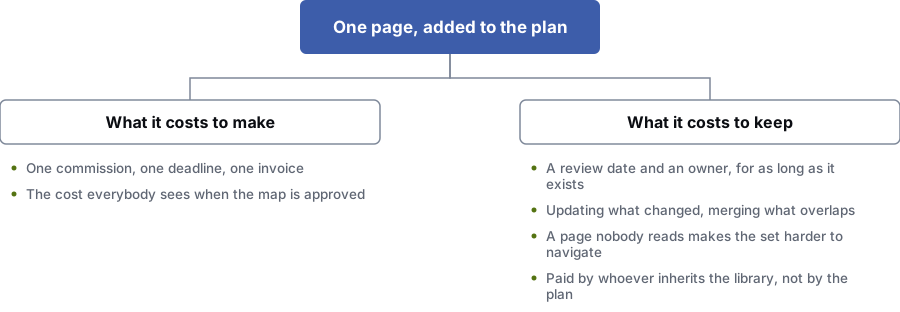
What it costs to make
- One commission, one deadline, one invoice
- The cost everyone sees when the map is approved
What it costs to keep
- A review date and an owner, for as long as it exists
- Updating what changed and merging what overlaps
- Each unread page makes the set harder to use
- Paid by whoever inherits the library later
How to build it
How to build topical authority in five steps
This method works by cutting. Most of its value comes from the pages it removes from your plan.
Write the boundary as one sentence
What should your site be the best place to read about, and what falls outside that? The sentence has to leave things out, or it leads to a plan that never ends and a site with no clear subject.
You get: One sentence, agreed by whoever signs off the budget
List the questions people ask
Write down every question a buyer, a beginner and a sceptic would ask inside that boundary, in their words, from sales calls, support tickets and the colleagues who answer them every day. Then use a keyword export to catch phrasings you missed, not to build the list.
You get: A list of questions, with the source of each one noted
Merge the list until each page has one clear job
Merge every question the same page would answer. Remove any question you can’t answer better than the pages ranking now, or that nobody in your business knows first-hand. What is left is your plan, much shorter than the list you started with.
You get: A page plan, plus a list of removed questions with reasons
Decide the reading order, then link in that order
Arrange the pages the way a reader would meet them: what they need first, what comes next, and which pages only some readers need. Add internal links in that order, with anchor text that says where the reader is going. It takes about an afternoon.
You get: A reading order and an internal linking plan
Publish, then maintain the set instead of adding to it
Once the set is complete, resist adding more. The next useful job is keeping it correct: update what has changed, merge pages that overlap, and remove anything nobody reads. Most content programmes never get there because the map always has one more page on it.
You get: A review date for each page and a named owner for the set
What builds authority
Four things that build topical authority, and how much you control
These four are usually treated as one programme, but differ in who decides the outcome and how long they take.
| Dimension | How much you control | Realistic timescale | What it can’t do alone |
|---|---|---|---|
| Coverage of the subject | Almost all of it. You decide the scope and what gets produced. | One or two quarters for a tightly defined subject. | Make you stand out. Anyone can write the same set of pages, and more and more sites do. |
| Links between your pages | All of it, and it is the cheapest item on this list. | An afternoon once the pages exist, then a regular habit. | Rescue pages nobody needed. Linking filler to filler just gives you linked filler. |
| Proven expertise | Some of it. You control who writes and whether they are named. You can’t fake knowledge. | Immediate if the expertise exists in your business. Otherwise you can’t buy it at any price. | Replace coverage. One brilliant page on a subject doesn’t cover the subject. |
| Being mentioned by others | Very little. You control what you publish and whether it is worth citing. Others decide whether to cite it. | Unpredictable and rarely fast. Usually the slowest of the four by far. | Be bought safely. There is a market for bought links, and it carries risks you can’t control. |
How we work
How we use topical authority when planning content
What we do
- Describe topical authority as a model that makes predictions. We write down which parts are documented and which are inference.
- Draw the subject boundary before anyone discusses page counts, and write it as a sentence that leaves things out.
- Build the plan from the questions people ask, and record what we removed and why.
- Plan the internal links as part of the content plan, before anything is published.
- Tell you when a subject needs knowledge your business doesn’t have, and suggest a different subject.
- Report progress as query breadth and position on the subject. You can check both in your own Search Console.
What we don’t do
- Sell a map generated from keywords as a strategy, or charge for pages nobody can justify.
- Claim that Google has a topical authority score, or that a third-party authority metric measures one.
- Recommend publishing in bulk to compete on a subject your business knows nothing about.
- Quote a number of pages a subject needs, because no reliable number exists.
- Treat mentions from other sites as something a content plan can deliver on a schedule.
Questions
Topical authority questions
Is topical authority a real ranking factor?
Google hasn’t documented any system called topical authority, so calling it a confirmed ranking factor claims more than is known. It is a model practitioners use to explain a pattern: sites that cover one subject thoroughly often compete better on it than sites that cover it once.
The closest published statement is Google’s guidance on helpful content, which asks whether a site has a primary purpose or focus and whether the content comes from people who know the subject well.
How many pages does a subject need?
There is no set number, and any figure you are quoted was made up. You have covered a subject when a reader with any reasonable question about it finds a page that answers it fully.
To size it, list every question a buyer, a beginner and a sceptic would ask, and merge the ones that belong on the same page. What is left is your number: usually smaller than a keyword export suggests, and larger than the three pages you were planning.
Should we buy a topical map?
Only if it gives a reason for every page and names the question each page answers. Maps built from keyword exports contain many pages that exist only because a phrase exists.
Test a map before you pay: pick five pages at random and ask who would search for each, what they want and what they would do next. If the supplier can’t answer for all five, the map is just a list with nicer graphics.
Does publishing more make a site more authoritative?
No, not by itself. Forty unconnected pieces on forty subjects leave a site with no clear subject. Eight connected pieces that fully answer one question can put it in the running for that question.
Volume also has a cost: a library where many pages have never been read is harder to maintain and find your way around than a smaller one that is complete and up to date.
Can we build authority in a subject we aren’t expert in?
You can build coverage, but you can’t easily build expertise: having something to say that a reader couldn’t get by summarising other pages.
This is the biggest limit of the model. Depth pieced together from the first page of results only summarises what already ranks. What sets a site apart comes from sources competitors can’t reach: your data, how your business runs, your customers, or colleagues who know the answer first-hand.
How would we know it is working?
Watch your queries in Search Console. The first sign is breadth: the number of distinct queries on the subject where you get impressions, and how many you never targeted.
After that, watch your position on the harder terms in the subject, and whether new pages start ranking faster than older ones did. Both show in Search Console; you don’t need to buy a metric.
References
Sources for topical authority
The official documents and research this page is based on. Platform rules change, so check the source before you act on a detail.
- Google Search Central: creating helpful, reliable, people-first content
- Google Search Central: a guide to Google Search ranking systems
- Google Search Central Blog: what creators should know about the August 2022 helpful content update
- Google Search Central: spam policies for Google Web Search
- Google: Search Quality Rater Guidelines
Related
Keep reading on topical authority
- what to do if you can’t rank for competitive termsFor a well-built site that has stopped gaining ground.
- finding the questions inside a subject
- tidying up the content you have already published
- deciding what not to publish
- how to get backlinks
- earning mentions through digital PR
- our SEO services
- realistic SEO timescales
- experience, expertise and trust (E-E-A-T) explained
Start here
Define your subject before you commission the pages
Which subject will you cover, and what will you leave out? We work that out with you in a conversation. Have it before you buy a map from anyone.
Rather check it yourself? Try our free SEO tools