
SEO
How to get backlinks safely, and which tactics are link schemes
Published by Zubair Afzal, responsible editor
First published Updated 10 min read
What a backlink is
A backlink is earned, and someone else decides to give it
A backlink is another site choosing to link to yours, and that choice belongs to them. "Link building" makes the outcome sound like a construction job with a schedule; it is closer to being cited in someone else’s work. You can make yourself worth citing and easy to find. Then you wait.
That wait is why a market for links exists. Suppliers sell certainty by paying a publisher to add a link it wouldn’t otherwise have written. Google’s spam policies call that deal a link scheme. The risk falls on your domain; the supplier carries none of it.
Nobody can promise how many links any method will produce, and we don’t.
What Google prohibits
Link building tactics Google’s spam policies call link schemes
Each of these is named in Google’s spam policies as a link scheme. Suppliers still sell them routinely, and most won’t describe the tactic in writing.
Read the policy at the source too. Below is a plain-English version of the tactics it names, and why each is there.
- Buying or selling links that pass ranking credit, whether for money, goods, services or free products. The link then reflects a payment, not an editorial choice.
- Excessive link swaps: two sites linking to each other at scale purely so both benefit. The odd mutual mention between closely related businesses is normal; a systematic swap programme isn’t.
- Automated link creation: programs and services that generate links across many sites. The accounts and pages involved are often not yours to clean up later.
- Requiring a link in a contract or terms of service. Some links are a condition of using your product, getting a discount or closing a deal. Those aren’t citations, and the policy names this case directly.
- Advertorials and paid articles that pass ranking credit. Paid placement is a normal advertising deal; it becomes a scheme when the link isn’t marked to stop it passing credit.
- Guest posting at scale mainly for links, especially with keyword-rich anchor text. Writing for a publication whose readers matter to you is fine. The policy targets articles produced in bulk just to carry anchor text.
- Low-quality directory and bookmark sites, whose listings exist only to hold links. Would anyone visit that directory to find a supplier?
- Keyword-rich links spread through widgets, badges or embeds, such as a calculator that carries an optimised link everywhere it goes. The site owner who embeds it didn’t choose the anchor text.
- Site-wide links in footers and templates on other people’s sites. This includes the developer credit an agency repeats on every page of every site it builds, when that credit is keyword-rich and passes ranking credit.
- Forum comments and signatures placed for ranking. Taking part in a community is normal. Posting just to leave optimised links in the post or signature is named in the policy.
- Publishing on another site’s domain to borrow its ranking strength. Site reputation abuse, added to the policy in 2024, covers third-party pages hosted on an established site to exploit its standing. A November 2024 update says oversight by the site owner doesn’t change that.
Earned links and bought links
The difference between earned and bought backlinks
Waiting for links is slow and uncertain, so an industry sells certainty. This is what you get when you buy it.
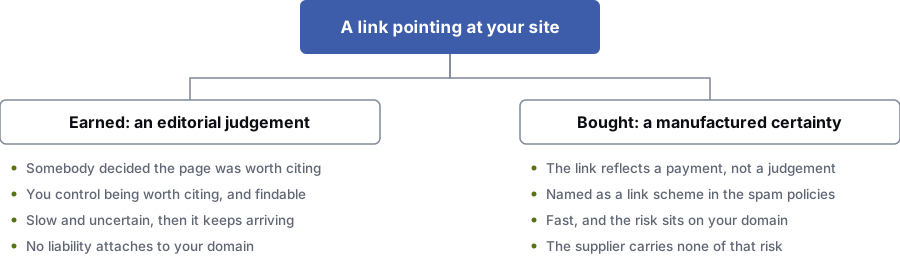
Earned: an editorial choice
- Another site decided the page was worth citing
- You control being worth citing and easy to find
- Slow and uncertain, then it keeps coming
- No risk attaches to your domain
Bought: certainty for a price
- The link reflects a payment
- Named as a link scheme in the spam policies
- Fast, and the risk sits on your domain
- The supplier carries none of that risk
How to earn backlinks
How to earn backlinks in six steps
This is slow, and there is no shortcut. Outreach comes fourth: it can only spread the word about something that already deserves attention.
Find something only you can say
Go through what your business already records: job durations, failure and repeat-visit rates, price changes, seasonal patterns, approval outcomes and the questions customers ask most. You want a fact nobody else has that a writer covering your field would need. Almost every business has several and thinks they are all boring.
You get: A shortlist of facts nobody else can publish
Check that it is new
Search for the fact before you build anything. If three publications already quote the same number, a fourth adds nothing. If nothing comes back, or the results are ten years old or clearly guessed, you have found a gap. Twenty minutes here prevents most wasted campaigns.
You get: Evidence that the fact isn’t already published
Publish it so others can quote and check it
State the number clearly and early: where it came from, how many cases it covers, over what period, and what it doesn’t show. Careful writers can’t use a figure with no method, and their links are the ones worth having. Give the page a permanent address.
You get: One page with the figure, the method and the limits
Send it to the people who would use it
Find the writers, trade publications, associations, forums and community pages that cover the subject. Tell them in three sentences the fact, the method and why it is new, leaving your company out of it. Most will ignore you; the ones who reply do so because you gave them something they couldn’t get elsewhere.
You get: A short list of named contacts and a three-sentence note
Be available when a journalist wants a comment
Choose a spokesperson who can answer on the record within the hour, on agreed subjects, with contact details outside any contact form. This earns more coverage per hour than almost anything else, and usually fails for practical reasons: the request arrives, the expert is in a meeting, and the deadline passes.
You get: A named spokesperson, easy to reach, with agreed topics
Keep it up to date so the links build up
Update the figure every year and say what changed. A number that stays current becomes the go-to source, so links build up on one page instead of spreading across one-off campaigns. This is what makes the effort pay, and the step most teams drop after the first push.
You get: A dated annual update that explains what changed
What to create
Four types of content that earn backlinks
These differ in cost and in how long they stay useful. Most businesses can start one this quarter without hiring anyone.
A number nobody else has
Counted from your own records and published with the method and sample size. It is the cheapest to make and lasts longest, because a writer who needs the figure has nowhere else to go.
A tool that works
A calculator, a checker, a template or a well-kept reference table. Tools get linked because they save the reader effort, and keep earning links for years. The cost is significant, and a tool that half works is worse than none.
A clear guide to a confusing subject
Fields with confusing rules, changing regulations or disputed terms reward whoever writes the clearest explanation and keeps it correct. The links come from other writers who need somewhere to point readers instead of explaining it themselves.
An expert who answers quickly
A named expert who can reply to a journalist within the hour on subjects agreed in advance. It earns the most per hour, and is an operations problem more than a creative one, which is why so few businesses manage it.
Comparing the options
Five ways to get backlinks compared
Two are slow and safe, one is fast and safe within limits, and two leave you with a risk that could land at any time. Suppliers sell all five with the same confidence.
| Dimension | Who decides the link appears | Time to first result | What you carry afterwards |
|---|---|---|---|
| Publishing original data | The writer who needs the figure. You give them the reason. They make the decision. | Weeks to months. Links keep coming for years if you maintain the page. | A page you have to keep updated. No risk beyond the effort. |
| Building a useful tool | Anyone who finds the tool useful enough to link to it. | Slow to start, then steady. Getting people to use it matters more than outreach. | Ongoing maintenance. A broken tool costs you more than never launching it. |
| Expert comment for journalists | The journalist, on the day. You control only how available and how good you are. | Days, once the practical side is set up properly. | Nothing, as long as the expert knows the subject and the comment stands up. |
| Sponsorship and memberships | You do, and that is exactly why the link must be marked as paid. | Immediate. The value is the audience. Ranking credit isn’t part of the deal. | An ongoing cost. Safe when the link is marked as paid, a scheme when it isn’t. |
| Bought placements | Whoever was paid. The publisher wouldn’t have written it otherwise. | Fast. That speed is the whole appeal, and why it keeps selling. | A risk on your domain, of unknown size, on a timetable you don’t control. |
Related
More on link building and digital PR
If someone is selling you links
If you want to earn links yourself
Questions
Backlink questions to ask before you spend anything
Is buying links against the rules?
Yes, if the link passes ranking credit. Google’s spam policies call that a link scheme. That includes paying money, trading goods or services, and sending free products in return for a link.
Paying for a placement is allowed if the link is marked rel="sponsored" or rel="nofollow" so it passes no ranking credit. If a supplier objects to marking the link, they are selling you ranking credit, which is the part the policy bans.
Are guest posts allowed?
Yes, when you write for a publication whose readers you want to reach. The policy calls two things schemes: posts produced at scale mainly to place links, especially with keyword-rich anchor text, and paid advertorial content that passes ranking credit.
A simple test: would you still write the post if the link were removed? If not, you are buying a link with an article attached.
How many backlinks do we need?
There is no set number, and any figure you are quoted is a sales tactic. A few mentions from sites about your subject can matter more than hundreds of directory entries.
Ask instead: who links to the pages that outrank you, and would any of those sites have a reason to mention you? You can answer that. You can’t answer "how many links".
Should we disavow the links a previous agency built?
Usually not. Search engines generally ignore links they don’t trust, and rarely penalise the site those links point to. The disavow tool is meant for a narrower case, where a manual action has been applied or is likely.
Check Search Console for a manual action first. If there is none, your money is almost always better spent earning new mentions. A disavow file that is too broad can also remove links that were helping you.
Our industry is boring. What would anyone reference?
The things you find unremarkable. Your business holds records nobody outside can get: how long a job takes, how often something fails in year three, what a price did over five years, which months demand drops away.
They seem ordinary because you see them every week, but nobody else has them, which is what makes something worth citing. They usually just need counting carefully and writing up with the method explained.
Does a nofollow link have any value?
Yes, though not as ranking credit. It can send visitors, be read by people deciding whether to trust you, and add to what is said about your business across the web.
If a supplier charges for authority and delivers nofollow or sponsored links, the price and the product don’t match. Raise that before you renew.
References
Sources for how to get backlinks
The official documents and research this page is based on. Platform rules change, so check the source before you act on a detail.
- Google Search Central: spam policies for Google Web Search
- Google Search Central: qualify your outbound links to Google
- Google Search Central Blog: evolving "nofollow", new ways to identify the nature of links
- Google Search Central Blog: the March 2024 core update and new spam policies
- Google Search Central Blog: updating our site reputation abuse policy (November 2024)
- Search Console Help: Manual actions report
- Search Console Help: Disavow links to your site
Related
Keep reading on how to get backlinks
Start here
Find out what your business has that is worth citing
It starts with an hour going through what your business already records. If something is worth publishing, we show you what it is. If nothing is, we tell you before you spend money on a campaign.
Rather check it yourself? Try our free SEO tools