
SEO
Digital PR vs link building: what is the difference?
Published by Zubair Afzal, responsible editor
First published Updated 8 min read
The key differences
Digital PR vs link building side by side
Each row shows where the two behave differently. Everything follows from the first row.
| Dimension | Digital PR | Link building as usually sold |
|---|---|---|
| Who decides the link appears | An editor or writer who owes you nothing and hasn’t seen the story yet. | Whoever received the payment. That is why the result can be promised. |
| What you are buying | Effort, judgement and contacts. You get a story worth running and the relationships to put it in front of the right people. | A placement. The article, the site and often the anchor text are all agreed in advance. |
| How it is priced | By campaign or by month, because nobody can predict the output in advance. | Per link, sometimes tiered by a metric. That makes it easy to compare on a spreadsheet. |
| How it fails | Openly and straight away. The story doesn’t land, the month produces nothing, and the fee is spent anyway. | Out of sight and later. The links always arrive. The consequences come on a timetable you don’t control. |
| What you get besides links | Audience, recognition, sales conversations and a record of independent mentions of your business. | Very little. Hardly anyone reads the pages, which is partly why they were cheap. |
| Where the risk sits | On the budget. You may spend a quarter and have little to show for it. | On your domain. The supplier moves on, and the links stay with you. |
| What good reporting looks like | Named publications, uneven months, and coverage and links reported on separate lines. | A steady monthly count from sites that all look alike, and reluctance to say where links came from. |
| When it is the right choice | When you have something new to say and can live with uneven months. | We don’t recommend it. If you want a paid placement, buy it as advertising and mark the link as sponsored. |
A ninety-second test
How to tell if a proposal is digital PR or link building
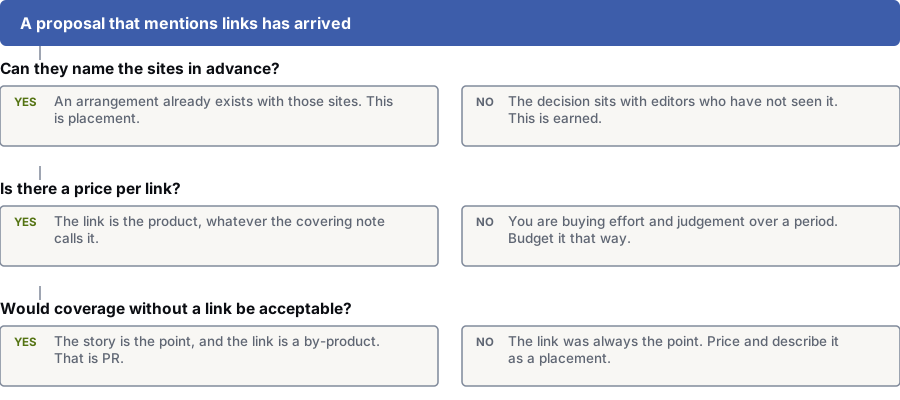
Can they name the sites in advance?
Yes: A deal with those sites already exists. This is a paid placement.
No: Editors who haven’t seen the story will decide. This is earned coverage.
Is there a price per link?
Yes: The link is the product, whatever the covering note calls it.
No: You are paying for effort and judgement over time. Budget for it that way.
Would coverage without a link be acceptable?
Yes: The story matters most and the link is a bonus. That is PR.
No: The link was always the goal. Price it and describe it as a placement.
The grey area
Link building terms that blur the difference
Some link building terms exist to make a bought link sound like an earned one. Each is technically accurate, which is why it works: a link insert is an insertion, a niche edit is an edit. Neither mentions the payment, the one fact that decides what the deal is.
Syndicated press releases put identical text on many sites at once, with links you placed yourself and no editor chose. Wire distribution suits announcements that need to go out widely at the same moment, but it doesn’t earn editorial citations, and reports shouldn’t count it as if it did.
The hybrid proposal is the most expensive form of the confusion: a monthly PR fee with a minimum number of links attached. Guaranteed links aren’t earned links. In months when earned coverage doesn’t land, the supplier meets the guarantee by buying placements, so you pay campaign prices for placement risk, and the reports won’t show which is which.
Buying mistakes
Four common mistakes when buying digital PR or link building
Experienced buyers make each of these, and all four happen before any work starts.
- Both goals were lumped into one line of the proposal.
- Authority and audience are different purchases with different measures of success. Bundle them and the search team sees coverage with no links as a failure while the brand team sees links from sites nobody reads as one. Split them into two lines, each with its own definition of success.
- Suppliers were compared on cost per link.
- Once your spreadsheet has a cost-per-link column, the supplier who buys placements wins, because earned coverage can’t promise that number. If you want earned coverage, compare suppliers on the story, the team and their track record.
- Nobody asked what happens in a month that produces nothing.
- Earned coverage has empty months. Talk about it before it happens, or the first empty month becomes a broken promise and the supplier fills the gap by buying something. Agree in advance what a good enough quarter looks like.
- The links were counted but never checked.
- A monthly link count tells you almost nothing. Open five of the pages. Would anyone read them? Does the site have an audience? Does the sentence with your link make sense? Ten minutes of reading tells you more than a year of dashboards.
How we work
How we scope and report digital PR and link building
What we do
- State on the first page of a proposal which of the two you are buying, and price it to match.
- Report coverage and links on separate lines, including coverage that had no link.
- Price earned coverage by campaign and period. We never price it per link, because we can’t promise the output.
- Agree in advance what a good enough quarter looks like, including the chance of a month with nothing in it.
- Mark any paid link as sponsored, and call a placement a placement.
- Hand over the contact list and the content, so you can take the programme elsewhere.
What we don’t do
- Guarantee coverage, publications, link counts or rankings from either approach.
- Sell a monthly fee with a minimum link count attached, because both halves can’t be true.
- Buy link inserts, niche edits or advertorials that pass ranking credit on your behalf.
- Count syndicated press release links as earned coverage in a report.
- Pitch a story we would be unhappy to see published without a link.
Glossary
Link building terms in proposals, explained
What these proposal terms mean. None is dishonest in itself; several are popular because they sound neutral.
- Link insert or niche edit: paying to have a link added to an existing article on another site. It is a bought link that passes ranking credit.
- Contextual link: a link inside the body text, away from the footer or sidebar. It describes where the link sits, not how it was obtained.
- Guest post opportunity, sold with a fee to the host site: paying a site to publish an article with your links in it. The article doesn’t change what the payment is for.
- Placement: usually an accurate word. It means a site published because of a deal, not because of the content.
- Authority target given as a third-party score: the supplier is choosing sites by a vendor metric. That describes their shopping list, not the editorial quality of any site on it.
- Wire or syndicated release: identical text sent to many sites at once, with links you placed yourself. Useful for announcements; it doesn’t show that any editor was interested.
- Journalist request platform: answering reporters who have asked for sources. The links are earned, competition is stiff, and success depends on replying fast with something specific.
- Brand mention: your name in an article without a link. Worth having and reporting accurately, but it doesn’t support an authority argument.
Questions
Digital PR and link building questions from buyers
Is digital PR just link building with a bigger invoice?
No. The difference is who decides. In digital PR, an editor who owes you nothing decides whether to publish, so nobody can promise the result. In link building as usually sold, whoever was paid decides.
The pricing, the risk, the reporting and what happens in a bad month all follow from that, which is why the two should never share a line in a proposal.
If PR can’t promise links, how do we budget for it?
Budget for the effort, over a period long enough for good and bad months to even out, with an agreed point where you stop: for example, a campaign fee for one quarter, with agreed activity and a frank review at the end.
Don’t accept a PR fee with a guaranteed number of links. The supplier can only meet that guarantee by buying placements when earned coverage doesn’t land, so you pay PR prices and carry the risk of bought links.
What is a link insert or a niche edit?
A link insert, also called a niche edit, is paying to have your link added to an article that already exists on another site. It is popular because it is cheap and fast, and the link looks natural in the text.
It is still a bought link that passes ranking credit, exactly what the spam policies describe. The age of the article doesn’t change that.
Does coverage without a link have any value?
Yes, so don’t count it as a near miss. Coverage puts you in front of an audience, adds to what is said about your business, and is read by people deciding whether to trust you.
The problem is expectations. If the whole case for the spend was authority and you got mentions with no links, the spend didn’t do what it was sold to do. Price the two goals separately at the start.
Our competitors buy placements openly. Why shouldn’t we?
Because you would take on a risk you can’t measure, on a timetable you don’t control: a financing decision disguised as a marketing one. Describe it that way to whoever signs it off.
Competitors who buy placements may well be seeing results today. The question is whether you want a position that depends on this tactic continuing to work, and a supplier you keep paying to hold it together.
References
Sources for digital PR vs link building
The official documents and research this page is based on. Platform rules change, so check the source before you act on a detail.
Related
Keep reading on digital PR vs link building
Start here
Send us a proposal and we will tell you which one it is
It takes about fifteen minutes, and you don’t have to work with us afterwards. If the offer is sound, we will confirm it. If it is a placement programme with a PR cover note, we will show you the lines that give it away.
Rather check it yourself? Try our free SEO tools