
Build organic authority
Build organic authority: rank for the terms that bring buyers
Organic authority comes from covering one subject in depth and being referenced by others, not from publishing more pages. It takes longer than anyone likes.
Content brief
Example- Search
- how much does a new roof cost
- Answer first
- A price range in the first two sentences
- Evidence
- Two cited sources, dated
- Links to
- Roof replacement service page
Why you’ve hit a ceiling
Three reasons a well-built site can’t break through
These aren’t technical faults. Sites in this position are usually well built, which is why the ceiling is so confusing.
- The site covers many subjects and owns none.
- Content was written to fill a calendar, not to answer a question. The result is wide and shallow: enough to be found for unusual phrasings, never enough to be treated as a source. The sign is a content list where no two pieces in a row belong together, linked mostly through the menu.
- Nobody outside the business has ever pointed to it.
- Every link was placed by the business itself: directories, partner pages, a supplier list, an old press release, some guest posts bought in a bundle. Nobody has read something and decided it was worth linking to. Search engines can see that gap, and it limits what on-site work can do on a competitive term.
- It’s hard to tell who the business is.
- Three versions of the company name, a trading name that differs from the registered one, an old address on half the web, profiles under a founder who left in 2019. None of this is fatal alone, but it makes every other signal harder to credit to one business. It’s the cheapest of the three to fix.
Building depth
Pick one subject and cover it fully before starting another
This is narrow on purpose. The hard part is what you choose not to publish, not the writing.
Choose the subject the business must own
Don’t pick the biggest search term. Pick the one subject where your future sales are, where you have deep expertise and where people are searching. Write it as a sentence and get your leadership to agree. It’s the step people most often skip.
You get: One written, signed-off subject
Map every question, as well as the keywords
List everything a buyer needs to work out before deciding: definitions, comparisons, objections, costs, mistakes and unusual cases. Keyword tools show how people phrase things, not the gaps between phrases, which is where the pages people link to tend to sit.
You get: A full map of questions, with the gaps marked
Fix what you have before adding more
Sites like this often have three thin pieces on the subject, published years apart and competing with each other. Merge them, redirect the others, and make the result better than anything ranking now. This often moves things before you write a new page.
You get: Existing pages merged and improved
Link the pages so they read as one body of work
Write internal links as sentences, in the order a reader would follow, from supporting pages towards the ones that bring in sales. Unlinked pages on one subject are just a collection. This step costs almost nothing, and most content plans leave it out.
You get: Internal links written by hand
Publish the one thing only you could publish
Data you hold, a survey you ran, a method you use or a view nobody else in your field will state publicly. It gives others a reason to point to you, and is the only reliable way to earn coverage without asking strangers for favours.
You get: One original piece for each subject
Keep it current and don’t spread out
Review the pages on a schedule and update them properly, noting the date and what changed. Don’t start a second subject until the first is clearly working. Giving in to pressure to spread out is how you end up stuck again, one level higher.
You get: An update schedule and a clear rule for when to move on
What we work on
Four parts of organic authority, with realistic timelines
Depth on a subject
A connected set of pages that covers one subject fully, with thin existing pages merged so they don’t compete. Expect early movement on specific searches within a few months. The main terms move much later, and only if you stick with the subject.
Earned coverage
Mentions from people with no reason to give them, won by publishing something worth pointing to, not by asking. Single results are unpredictable. What counts is how they add up, and you judge that over years, not quarters.
Consistent business details
One name, one description, one address and one set of profiles, matching everywhere your business appears. It’s the quickest of the four to finish and the least visible in effect, which is why it’s so often still on the to-do list.
A timeline nobody enjoys
Expect six to eighteen months before clear movement on competitive buying searches, and longer against well-established leaders. Cover those terms with paid ads meanwhile, and don’t expect organic work to report wins every month.
Where progress shows first
Where signs of growing authority show up first
The terms your board asks about are the last to move. The early sign sits one level down, on specific searches around the same subject. It shows up months before anything in the plan.
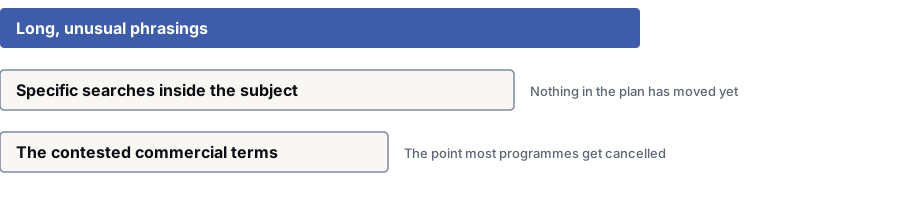
- 1Long, unusual phrasings — These already work, which is why the ceiling is confusing. People can find the site, but it can’t get near anything that pays.
- 2Specific searches inside the subject — The first clear sign that search engines are noticing your depth. Movement here comes within a few months of publishing a connected set.Nothing in the plan has moved yet
- 3Competitive buying searches — Six to eighteen months before movement is clear, and longer against leaders with ten years of coverage behind them.The point where most plans get cancelled
Questions
Questions about building organic authority
Is domain authority something we should be trying to raise?
The scores sold under that name are estimates from companies that don’t run a search engine. They’re handy for roughly comparing two sites and useless as a target, because chasing an estimate means chasing whatever that company measures.
The idea behind them is sound: search engines trust some sites more than others on certain subjects. But that trust is tied to the subject, not the whole site, which is why a site can be trusted on one topic and invisible on another.
Our competitors obviously buy links. Why should we not?
Because you’re comparing where they are today with where you are, and ignoring the risk under their rankings. Bought links break the rules of the search engines you rely on. If the penalty comes, you don’t choose when.
Explaining your marketing during due diligence, or rebuilding your whole source of customers in a quarter, costs far more than the visibility you rented.
How long does this take?
For competitive buying searches, expect six to eighteen months before you see clear movement. It takes longer in markets where the leaders have ten years of coverage behind them. Anyone giving you a tighter number is guessing.
You can see the direction sooner. The long, specific searches around your subject move well before the main term, and that is a reliable early sign.
We publish constantly and nothing happens. What are we doing wrong?
You’re probably going wide when you need to go deep. Forty articles on forty unrelated topics leave a site with no clear subject, and none of them backs the others up.
Pick a question your buyers have and cover it completely across a set of connected pages. Link them properly and keep them current. That means less writing and more deciding.
Can we shorten this with paid media in the meantime?
Yes, and it’s often worth it. Paid search can cover the buying searches while your organic depth builds, and gives you demand data that helps decide what to write.
Be clear which budget does which job. Paid spend rents a presence that stops when payments stop; authority is what still works in three years. Mixing them up is how organic plans get cancelled six months before they would have paid off.
Where to get help
Services that solve this
SEO & Organic Growth
Phone not ringing while competitors show up above you? Our SEO services fix your site, write the pages buyers search for and show you every call and form it brings in.Content SEO
Our SEO content services start with the pages you already have. We decide which to update, rewrite, merge or remove, and fix the links between them.Digital PR
A digital PR agency that earns coverage in the publications your buyers read, with new data and timely expert comment. We never pay for placements.Original Research & Data Studies
Original research and data studies designed method first, so journalists and AI tools can check and cite them. We publish what the data says, limits included.Entity & Knowledge Optimisation
Entity optimisation helps Google and AI tools recognise your business as one clear company, not three weak versions described three different ways.Keyword Research & Strategy
Our keyword research services map each search need to one page, so you know what to build and your own pages stop competing with each other.
Find out what’s holding your rankings back
Send us the five searches you can’t reach and the content you’ve published. We’ll tell you whether depth, coverage or consistency is holding you back, what a realistic timeline looks like, and which links pointing at you could cause trouble.
Prefer to talk it over? Book a free call
Your BOOSTD score improves within 90 days, or your next month is free. After 6 months, more traffic or leads, or we keep working free (up to 6 free months in any 12 months). Read our guarantee
References
Sources for build organic authority
The official documents and research this page is based on. Platform rules change, so check the source before you act on a detail.
Related
More ways to fix this
- the wider SEO plan this belongs inAuthority isn’t something you buy on its own. It’s the slow half of your SEO.
- publishing data nobody else holds
- how links get earned, and what we won’t buy
- making the facts about your organisation agree
- authority that fell away, as opposed to never arriving
- the timeline question answered at length
- topical authority as a working model, not a score
Last updated · Published by Zubair Afzal, responsible editor