
AI search · 10 min read
AEO, GEO and SEO: what each term means and how much of the work is new
Much of what gets sold as AEO and GEO is SEO fundamentals under a new label. This page defines all three terms precisely, marks which tactics are the same work, and names the small set of things that really do change when a model writes the answer instead of listing links.
Want to know where your own site stands? Run a free Growth Scan
AEO and GEO are not new disciplines so much as a new unit of measurement: the passage rather than the page, and a probability rather than a position.
That sentence does most of the work on this page. Almost every practical difference between optimising for a list of links and optimising for a generated answer follows from the change in what is being selected and how you can observe it.
The rest of this page defines each term precisely, marks clearly which parts of the work are new, and says plainly where the three overlap so completely that charging separately for them is hard to justify.
Definitions
The three terms, defined precisely
These definitions are stricter than common usage. They are worth holding to, because the loose versions are exactly what allows one service to be sold three times.
- SEO — search engine optimisation. Work that improves how a website performs in a ranked list of results on a search engine. The unit is the page. The measurement is position. The output is a click.
- AEO — answer engine optimisation. Work that makes a passage of your content the source used to produce a direct answer: featured snippets, People Also Ask, voice responses, AI Overviews. The unit is the passage, and there is usually still a link.
- GEO — generative engine optimisation. Work that improves how you are represented inside text a language model generates, including where no page is quoted and the model reflects a consensus. The unit is the claim about you, measured by repeated sampling.
- The three are nested rather than parallel. AEO needs SEO to have worked, because a page that cannot be retrieved cannot be extracted from. GEO benefits from both but is also affected by sources you do not own and cannot edit.
- The commonly used umbrella term for all three is AI search optimisation, which is fine as a label as long as the invoice underneath it itemises work that is distinct.
The shape of it
The three are nested, not parallel
This is why the overlap question has the answer it has. Each stage depends on the one before it, so the same foundation work is a prerequisite for all three rather than a rival to them.
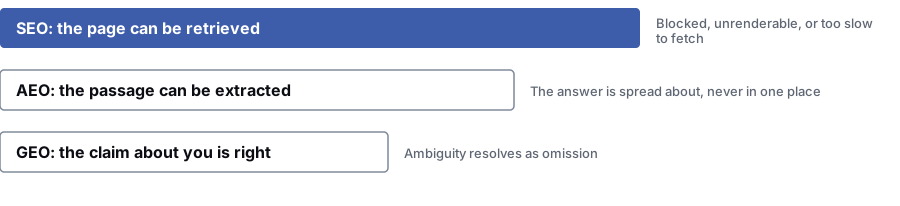
- 1SEO: the page can be retrieved — Crawlable, indexable, fast HTML. The unit is the page, the measurement is position, and the output is a click.Blocked, unrenderable, or too slow to fetch
- 2AEO: the passage can be extracted — A paragraph that still makes sense lifted out of its context. The unit is the passage, and there is usually still a link.The answer is spread about, never in one place
- 3GEO: the claim about you is right — What the web collectively says, including sources you do not own and cannot edit. The unit is the claim about you.Ambiguity resolves as omission
Same work, adapted work, or new work
The overlap question, task by task. Most rows say "same work", and that is the finding rather than a shortcut.
| Dimension | Where it sits | Honest assessment |
|---|---|---|
| Crawlable, indexable, fast HTML | SEO, unchanged | Same work. If a retrieval system cannot fetch and parse the page, nothing downstream matters. |
| Topical depth and coverage | SEO, unchanged | Same work. Comprehensiveness helped before and helps now, for the same reasons. |
| Structured data | SEO, unchanged | Same work. Useful for machine comprehension, but it was already meant to be accurate and visible-content-aligned. |
| Author and organisation credibility | SEO, unchanged | Same work. Real named authors and verifiable expertise mattered before the acronyms existed. |
| Self-contained answer passages | AEO, adapted | Meaningfully different. Writing so a single extracted paragraph still makes sense without its context is a discipline most site copy does not have. |
| Definitions and direct-answer openings | AEO, adapted | Meaningfully different in emphasis. Leading with the answer was always good writing; now it is also a retrieval requirement. |
| Consistent entity description across the web | GEO, mostly new | Different. A model has to resolve you to one organisation. Conflicting descriptions on directories, profiles and old pages actively degrade that. |
| Third-party mentions and independent coverage | GEO, mostly new in purpose | Different in intent. Links were the point before; being described accurately in the text is the point now, even where no link exists. |
| Model crawler access decisions | GEO, new | New. Search crawling and model crawling are separate permissions with separate consequences, and this did not exist as a decision before. |
| Measurement | AEO and GEO, new | New. No position to track. You sample prompts repeatedly and record frequency and description, which is a materially weaker signal than rank data and should be presented as such. |
The part worth paying for
The four things that are different
First, the unit of selection. A ranking system picks a page; an answer system picks a passage. That changes how you write more than it changes what you build. A page can be excellent overall and useless for extraction because its actual answer never appears in one place.
Second, the weight of sources you do not own. When a model composes an answer about a category, it is drawing on whatever the web collectively says. A comparison article, a forum thread or an industry directory that describes you inaccurately is a problem you cannot fix by publishing another page on your own site.
Third, entity resolution. Before a model can say anything useful about you it has to work out which organisation you are. Businesses with a common name, a recent rebrand, an inconsistent legal name, or three different descriptions across their own profiles make that harder, and ambiguity resolves as omission.
Fourth, measurement honesty. There is no position. What exists is a distribution: run the same prompt ten times and you may get several different sets of sources. Any report that presents this as a precise score is dressing up sampling noise, and it is worth asking directly how many samples the number is based on.
Everything else on the list is SEO. That is not a criticism of the field, and it is not a reason to skip the work. It is a reason to be sceptical of a proposal that charges separately for AEO, GEO and SEO without itemising which of these four things it is doing.
Straight talk
What can and cannot honestly be claimed here
Defensible claims
- Making a page easier to retrieve, parse and extract from improves its chances of being used in an answer.
- Consistent, accurate descriptions of your organisation across the web make it easier for a model to represent you correctly.
- Repeated prompt sampling over time can show a directional change in how often you appear.
- Some of this work is simply good SEO, and doing it well benefits both surfaces at once.
Claims nobody can support
- Any guarantee of inclusion or citation in an AI-generated answer.
- Precise knowledge of how a commercial model weights or retrieves sources internally.
- An exact "AI visibility score" presented without the sampling method behind it.
- That AEO or GEO replaces SEO. The retrieval layer they depend on is the thing SEO builds.
Questions
Questions people ask about these three terms
Is AEO just SEO with a new name?
Mostly, but not entirely. The retrieval side is the same: the page has to be crawlable, indexable, relevant and credible, and none of that changed. What is different is the granularity — an answer engine extracts a passage, so the writing has to put a complete, standalone answer somewhere a machine can lift it without the surrounding context.
If someone is selling you AEO and cannot name a specific thing it does that their SEO service does not, they are selling you the same service twice.
What is the actual difference between AEO and GEO?
AEO is about being the source used to produce a direct answer — featured snippets, People Also Ask, voice results, AI Overviews. The answer usually comes from a retrieved page, and there is normally a link.
GEO is about how you are represented inside text a model generates, including when no single page is being quoted. That makes GEO more concerned with off-site consensus: what independent sources say about you, whether your description is consistent across the web, and whether a model can resolve you to a specific organisation at all.
How much of this work is new?
Roughly speaking: the foundations are unchanged, the writing changes moderately, the off-site work changes more, and the measurement changes completely.
Crawlability, site structure, topical depth, accuracy and credible authorship were already the job. Writing self-contained answers, keeping your entity description consistent everywhere it appears, deciding which model crawlers to allow, and measuring by repeated prompt sampling instead of rank tracking are the parts that did not exist five years ago.
Why do I rank first and still not get cited?
Because ranking selects a page and citation selects a passage. If your best answer is spread across four paragraphs, qualified twice and preceded by three hundred words of preamble, there is no clean extract to take, and a lower-ranked page that states the answer plainly gets used instead.
It can also happen because the generated answer is synthesising a consensus rather than quoting a source. In that case what matters is whether independent pages describe you the way you would describe yourself.
How do you measure visibility when there is no ranking position?
By sampling. You define a set of prompts a real buyer would use, run them repeatedly over time across the assistants that matter to you, and record how often you appear, how you are described, and which sources are cited alongside you.
It gives you a frequency and a description rather than a position. That is less precise than rank tracking, and anyone presenting an AI visibility score as an exact measurement is overstating what the data supports.
Should I block AI crawlers?
It depends on whether your content is the product. Publishers whose revenue comes from people reading their pages have a real argument for restricting model crawlers. Most service businesses do not — being described accurately by an assistant is closer to advertising than to theft.
Whichever you choose, make it a decision rather than an accident. Check what your robots file and your CDN rules allow, because a lot of sites are blocking crawlers nobody intended to block.
Want to know which of these you need?
If you are holding a proposal with all three acronyms in it, we will read it and tell you which line items are distinct work and which are the same thing counted twice. Useful whether or not you ever work with us.
References
Sources
The primary documents and published research this page relies on. Platform rules change, so check the source before acting on a detail.
Related
Where to go next
- AI search services
- answer engine optimisation as a service
- generative engine optimisation as a service
- a fuller definition of AEO
- the GEO explainer
- entity workThe part that decides whether a model can resolve who you are.
- technical foundationsEverything here depends on the page being retrievable in the first place.
Last updated