
AI search
What is generative engine optimization, and how is it unlike AEO?
Published by Zubair Afzal, responsible editor
First published Updated 6 min readWe check this page every three months. Next check: .
Definition
What GEO means for your business
Generative engine optimization (GEO) means improving how your business is described when an AI tool builds an answer from several sources at once. The term comes from a 2023 research paper of the same name by Aggarwal and colleagues (cited below). A generative engine, such as ChatGPT, Perplexity, Copilot or a generated answer inside a search product, gathers possible sources, writes a response from them and cites some of them. GEO is about getting into that set, being described accurately, and giving the system enough consistent evidence to name you at all.
The key word is "writes". Nothing you publish controls a sentence in the answer, because each sentence draws on several sources. That is the main difference from answer engine optimization, where a passage you wrote is lifted more or less as it is.
So much of GEO happens away from your own site. If four independent sources describe your business, specialism and market the same way, a system has a solid basis for describing you. If they disagree (different service descriptions, an old address, a former company name, positioning updated in only one place), the safest thing the system can do is talk about someone else.
AEO asks whether the machine will quote you. GEO asks whether the machine mentions you when it writes the answer in its own words, and whether it gets you right.
Mechanism
How AI tools build a generated answer
Roughly five stages. Knowing where you can influence each one separates GEO from guesswork.
Interpretation
The system rarely searches the exact words typed. It rewrites the question into several related searches, narrower, broader and nearby, and works from those. So showing up across the group of questions around a topic matters far more than one phrase.
You get: Coverage across a group of related questions
Retrieval
The system pulls possible sources from an index, some products also fetch pages live, and it draws on what the model learned in training, which you can’t edit and may be years out of date. Your pages must be easy to retrieve: crawlable, fast, rendered on the server where it matters, and open to the crawlers these products use.
You get: Pages that can be fetched and read
Selection
The system keeps sources that are specific, current, consistent and backed up by the others it found. A page that contradicts three others is more likely to be dropped than trusted, even if it is the one that’s right.
You get: Consistency with everything else said about you
Synthesis
The system writes the answer from what it kept. Claims get shortened, and careful wording often becomes confident wording. This is where wrong descriptions of a business come from: the system is averaging four sources that never quite agreed.
You get: An accurate, shared description for the system to work from
Attribution
Some sources are named and some aren’t, by rules that differ by product and change without notice. A source can shape an answer and go unnamed, or be listed without adding much. Treat citations as a partial signal, never a measurement.
You get: A sampled record of citations over time
The difference
How GEO differs from AEO
The two terms are often used as if they meant the same thing. They call for different tasks, in different places, judged by different evidence.
| Dimension | Answer engine optimization | Generative engine optimization |
|---|---|---|
| What counts as a win | Your passage is used as the answer | Your source is one of those the answer was built from, and you’re described accurately |
| Sources in play | Usually one, sometimes two | Usually several, often from different websites |
| What the system needs from you | A clean, correct statement in one place that can be lifted | Consistent evidence, backed up by others, about who you are and what you do |
| Where the influence sits | Mostly on your own pages, in how the answer is written and laid out | Largely on other sites, in the sources a system finds about you |
| What breaks it | Burying the answer in long prose, or getting it wrong | Conflicting descriptions of your business across the web |
| How you observe it | Sampling answers for your questions and checking whose text is used | Asking the assistants again and again, and recording whether you appear and how you are described |
PR and GEO
Why good press coverage can still be weak for GEO
The same article can be judged in two ways, and the two don’t always agree.
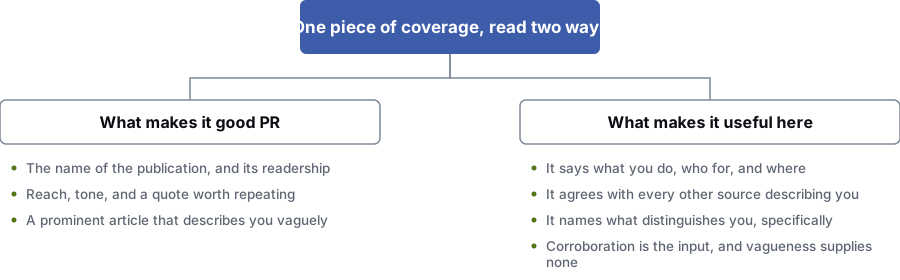
What makes it good PR
- The name of the publication and its readers
- Reach, tone and a quote worth repeating
- A high-profile article that describes you vaguely
What makes it useful for GEO
- It says what you do, who for and where
- It agrees with every other source describing you
- It names what sets you apart, in specific terms
- A vague article gives the system nothing to confirm
Boundaries
What generative engine optimization isn’t
The term is new, so a lot gets sold under it. Five claims to turn down:
- It can’t change what a model was trained on. Training data is fixed when the model is trained, and no supplier can edit it afterwards.
- It isn’t the same as AEO. Being quoted and being part of a written answer are different problems.
- It isn’t writing instructions to a model inside your pages. Hidden text aimed at an assistant isn’t how retrieval works, and it counts as manipulation where it is detected.
- You can’t buy it. There is no paid inclusion in an organic generated answer; anything sold as one is advertising or fiction.
- It doesn’t replace being findable. Every one of these systems works from an index or a live fetch, so a site that can’t be crawled is out before any of this starts.
Questions
Common questions about generative engine optimization
What is the difference between GEO and AEO?
Answer engine optimization is about being the single source an answer is quoted from. Generative engine optimization is about being one of several sources an answer is built from, and being described accurately in it.
That decides where the effort goes. Being quoted is won mostly on your own pages, with a clean answer that can be lifted. Being part of a written answer is won largely on other sites, through what they consistently say about you.
Can you get a brand into ChatGPT answers?
Nobody can promise that. What you can improve is the evidence these systems draw on. Is your business described the same way everywhere? Do independent sources back that up? Can the systems retrieve the pages that explain what you do?
Improving these raises your chances. It doesn’t produce a placement, and there is no way to buy one.
Does blocking AI crawlers hurt visibility?
It can. Many assistants fetch live pages when answering, and those products can’t quote or cite a page they can’t fetch.
You’re trading control over your content against the chance to be used as a source, and the right answer differs by business. Make the choice on purpose, rather than inheriting it from a template robots file.
Is GEO just digital PR under a new name?
No, though they overlap, because backing from independent sources is one of the main inputs. Treating them as the same gets you coverage that reads well and clarifies nothing.
GEO asks whether the sources describing you agree on the facts a model needs: what you do, who for, where, and what sets you apart. A high-profile article that describes your business vaguely is good PR and poor GEO.
How is generative visibility measured?
By sampling, reported as a sample. Ask the questions that matter to your business repeatedly across the relevant assistants, and record whether you appear, how you are described, which sources are cited with you and whether the description is accurate.
That gives a trend, not a precise metric, and it shifts with the wording of the prompt. It still beats hearing from a customer that an AI tool described your business wrongly.
References
Sources for generative engine optimization
The official documents and research this page is based on. Platform rules change, so check the source before you act on a detail.
Related
Terms related to generative engine optimization
Start here
Find out how AI assistants describe you today
Start by asking the tools your customers use what your business does, and read the answers. We’ll run that with you and show you where each description came from.
Rather check it yourself? Try our free SEO tools