
Improve local visibility
Why are local customers not finding us? Check five places
Local customers look for you in five places, from the Google map to directories, review sites and AI answers. Doing well in one tells you nothing about the other four.

What people miss
Four ways a local business misjudges how visible it is
A common mistake is checking one place and drawing conclusions about all five. Here are the mistakes that follow.
- You’re checking visibility from inside the business.
- Search from your own premises, on your own wifi, signed in to the account that manages your profile, and you see results almost nobody else sees. The only useful test is what a stranger sees from where your customers are. It usually looks much worse.
- You’re counting positions and not reading the screen.
- A report can say you rank fourth for "service plus city" while a map, a marketplace and a review site sit above you and you’re far down the page. What matters is what fills the screen a customer sees, and whether any of it is yours.
- You assume one fix works everywhere.
- Work on your profile doesn’t move the ordinary search results. Work on your site doesn’t move the map. Reviews affect both and are controlled by neither. Businesses improve one place for a year, see no change in another, and decide local search doesn’t work, when they fixed a different problem from the one they were watching.
- You’re ignoring the places you don’t control.
- A marketplace profile you never wrote, a review page you’ve never claimed, a directory listing with a phone number from two offices ago. These affect how visible you are and are often the first thing a buyer sees. Leaving them alone is a decision, usually made by accident.
The check
What to record before you pay for any local SEO work
Pick your three most valuable local searches and ask someone in the target area to run each on their own phone. Record everything below for each. It takes an hour and covers most of what a paid local audit would tell you.
- A screenshot of the whole first screen, before scrolling, from a real phone in the target area
- What fills it: a map, a marketplace, a review site, an AI answer, ordinary results or ads
- Whether your business appears anywhere on it, and where
- Which competitors appear, and whether they’re local businesses or national platforms
- The same three searches repeated from two more places, further away each time
- Every third-party profile of your business that appears, claimed or not, with its phone number and address
- Which review sites have a page for you, how many reviews each has, and when the last one came in
- Whether your own website has a page for that search, or only a homepage
The five places
The five places local customers find you, compared
Each row is a separate contest with its own decision-maker. Read across before you decide where the budget goes.
| Dimension | Who decides it | How you know you’re missing | What changes it | How long it takes |
|---|---|---|---|---|
| The map results | Your Google profile, your distance from the searcher and how well known you are | Competitors in the three-business map box, and no sign of you from outside your street | Verification, the right category, removing duplicates, a steady flow of reviews | Days to weeks after a fix, months to become better known |
| Local search results | Your website, judged against local results | You rank for your brand name and nothing with a place name in it | A page that properly covers the service and the area, linked to the rest of the site | Months, and longer where national platforms compete |
| Marketplaces and directories | A platform that’s also selling your competitors | A site you never signed up for fills the space when people search your service | A complete, well-reviewed profile on the platform, and a decision about paying for placement | Weeks, and you’re renting space, not owning it |
| Review sites | Your customers, plus how the site orders reviews | Callers mention a site you don’t check, or your page there is unclaimed | A routine for asking, replies in your own voice, and time | Quarters, because both numbers and recency count |
| AI answers | AI tools drawing on sources you mostly don’t control | Asking an AI tool for a local recommendation brings up competitors and not you | The same facts everywhere, and a presence in the local sources those tools use | Unpredictable, and nobody can promise it |
Read the search, not the ranking
Which kinds of local search each place answers
How people word a search largely decides which contest you’re in. These are examples, not volume figures. Swap in your own service and area.
Run each type of search for your business and note what comes up first. Which place does the answering matters more than your position.
Searches the map usually answers
Distance matters and your Google profile decides these. If the profile isn’t in order, nothing else you do reaches these searches.
- veterinary clinic near me
- accountant open now near me
- garage doors repair nearby
- physio clinic within walking distance
Searches a marketplace or directory usually owns
Broad, comparison searches that are worth a lot. Decide whether to compete inside the platform, since beating it outright is rarely realistic.
- best electricians in melbourne
- compare mortgage brokers near me
- top rated landscapers ontario
- find a builder in manchester
Searches your own pages can win
Specific enough that platforms have no page for them. This is where a well-written page for your service and area pays for itself.
- commercial gutter replacement scarborough
- invisalign for adults in north london
- emergency water extraction for basements calgary
- dutch speaking immigration lawyer sydney
Searches that end on a review site
The searcher has already found you and is checking you out. Ranking doesn’t matter here. What people have written about you decides everything.
- reviews for dental clinics in vancouver
- is this roofing company any good
- complaints about local moving companies
These are example searches from keyword research and public search data. Before we suggest anything, we check how often people search for them in your area.
Without a shopfront
Getting found locally without a shopfront
Distance is still measured from your registered location. Listing service areas takes away the distance advantage without replacing it. Evidence built up over time makes up for it. A rented mailbox passed off as a branch puts the whole profile at risk.
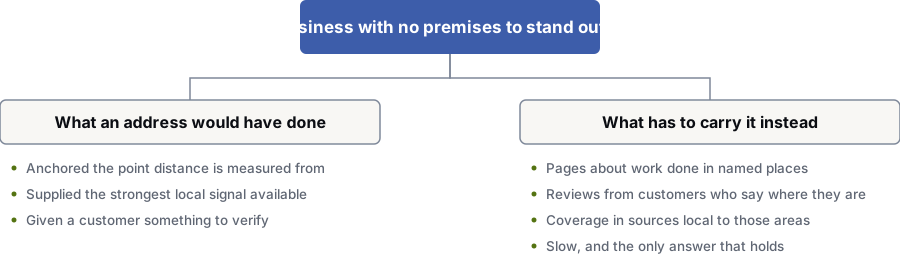
What an address would have done
- Set the point distance is measured from
- Given the strongest local signal there is
- Given customers something they could check
What has to do that job instead
- Pages about work done in named places
- Reviews from customers who say where they are
- Coverage in local media for those areas
- Slow, and the only approach that lasts
The order
Improve local visibility in the order that builds on itself
Doing all five at once gives you five half-finished projects and no idea what worked. In this order, each step makes the next one cheaper.
Sort out your Google profile first
Check ownership, verification, duplicates, main category, service areas, hours and services. It’s the cheapest place to fix, and it feeds signals several of the others use. Nothing else is worth paying for while it’s wrong.
You get: A verified, correctly set-up profile that you control
Make your details match everywhere
Your name, address, phone number and hours should be identical across the listings that matter in your market, including marketplace profiles you never set up. Mismatches make you harder to verify everywhere at once.
You get: Matching listings, with a record of every source
Build the pages specific searches need
Write one proper page for each service and area worth the effort, with things only a business working there could say. Templates with the place name swapped compete with your own pages before anyone else’s.
You get: Pages written for named searches
Make asking for reviews a routine
Pick a set moment in your work to ask for a review, make one person responsible for replies, and offer no rewards of any kind. Reviews help in the map, on review sites and when a buyer decides. It’s slow work with the widest effect.
You get: A review routine that runs without anyone having to remember it
Decide where you’re renting space, and accept it
For searches a platform owns outright, choose on purpose: keep a strong profile there, pay for placement, or spend the money on a search you can win. Make it a decision with a reason, not a yearly invoice nobody checks.
You get: A written decision for each platform you appear on
Where to get help
Services for each place local customers look
Profile and map
Website and search
Questions
Questions about improving local visibility
We rank well in the ordinary results but never in the map. Why?
They’re two different contests. The ordinary results depend mostly on your website. The map depends mostly on your Google profile, your distance from the searcher and how well known you are. A strong site can sit above a map that shows three competitors.
The gap usually means the website work is done and the profile work isn’t, which is fairly cheap to fix.
A directory outranks us for our own service. Can we beat it?
Sometimes, but often not. Big marketplaces and directories build up authority across thousands of businesses. A local independent will rarely outrank one for a broad "service plus city" search, however good its site is.
So decide which searches you can win. For the ones you can’t, a complete, well-reviewed profile inside the platform is your visibility, and it’s worth managing on purpose.
Do citations and directory listings still matter?
Consistency matters; quantity mostly doesn’t. When your name, address and phone number match across the main sources in your market, you’re easier to verify. That’s worth doing once, properly.
Hundreds of low-quality listings won’t improve local visibility. They just leave a clean-up job after a move or rebrand. Fix the sources people and platforms use, then stop. Our guide to local citations and NAP consistency covers which sources matter.
We have no premises customers can visit. What can we realistically achieve?
Less than a shopfront in the same town, but far more than nothing. As a service-area business, your address is hidden and you list the areas you serve. That removes some of the distance advantage and puts more weight on everything else.
What makes up for it, slowly, is specific evidence: pages about work done in named areas, reviews from customers who say where they are, and local media coverage. A rented mailbox passed off as a branch puts the whole profile at risk.
How do we check what our local visibility looks like?
Not from your own office, and not while signed in: both make you far more likely to see yourself. Ask people in the areas you want to win to search your main services on their own phones and screenshot the whole first screen.
Note what fills that screen as well as where you appear. A map, a marketplace, a review site or an AI answer each points to a different place that needs work.
How is this different from not ranking in Google Maps?
The map pack is one of the five places. If it’s the only one you’re missing, our Google Maps page is the better one to work through.
This page is for when local customers aren’t finding you and you don’t yet know where the gap is. Check all five first, then focus on the weakest.
Where should we start if we are weak on all five?
Start with your Google profile: it’s the cheapest to fix and helps several of the others. Then your website, which the local search results and the proof behind your service areas both depend on.
Reviews and press coverage come third, because they build up slowly. Marketplaces come last, because that’s a choice about where to compete.
Where to get help
Services that solve this
Local SEO
Our local SEO services get you onto Google Maps and into "near me" searches. We fix your Business Profile, area pages and reviews, for one location or forty.Google Business Profile Management
Our Google Business Profile optimization service fixes your listing, fills it in properly and watches it for suspensions and edits by strangers.SEO & Organic Growth
Phone not ringing while competitors show up above you? Our SEO services fix your site, write the pages buyers search for and show you every call and form it brings in.Reputation & Review Management
Online review management that gets you more real reviews without breaking platform rules. We build the asking into your routine and reply properly to criticism.Content SEO
Our SEO content services start with the pages you already have. We decide which to update, rewrite, merge or remove, and fix the links between them.Multi-Location & Franchise SEO
Multi-location SEO services for chains and franchises. Head office sets the structure, each branch supplies local facts, and every location page and profile gets found.
Get all five places checked at once
Send us three searches that bring in business and the areas you want to win. We’ll check all five places from outside your building and tell you where you’re missing, which are worth competing in and where you’d only be renting space.
Prefer to talk it over? Book a free call
Your BOOSTD score improves within 90 days, or your next month is free. After 6 months, more traffic or leads, or we keep working free (up to 6 free months in any 12 months). Read our guarantee
References
Sources for why are local customers not finding us
The official documents and research this page is based on. Platform rules change, so check the source before you act on a detail.
Last updated · Published by Zubair Afzal, responsible editor