
Which review problem you have
Want to improve your online reviews? Start with the real problem
To improve online reviews, find the real problem first: too few, too old, a low average or bad reviews left unanswered. Each needs a different, legitimate fix.

Why it happens
Three reasons your online reviews aren’t helping
Most people start with "we need more reviews", but often the number isn’t the problem. Open your profile in a private browser window, next to the two competitors shown beside you. Which of these do you see?
- Not enough recent reviews.
- Too few to read, forty reviews with nothing new in two years, or a burst of thirty in a fortnight, then silence. Readers care more about recent reviews than the total, and a business with no new reviews looks closed. The fix is a steady routine of asking; a one-off push just creates the next gap.
- The average is dragging.
- You’re on 4.1 next to a competitor on 4.8, and that gap decides who gets the call. Usually a few bad experiences went unanswered in a total too small to absorb them. The fix is a steady flow of new reviews plus visible replies. Asking for removals won’t do it.
- The bad reviews are unanswered and the good ones are empty.
- The only detailed reviews are the two angry ones, nobody replied, and the good ones are bare star ratings. Readers take the detailed story seriously, so your profile reads worse than your average. You can fix this one this week, for free.
Next step
Where to fix each review problem
Too few or too old? Fix how you ask. A low average or unanswered bad reviews? Fix how you reply.
Too few, too old, or a burst
A low average or unanswered bad reviews
Reviews are fine, but you’re hard to find
The rules
What we will and won’t do with your reviews
Every shortcut here breaks the rules of the platforms you rely on. Some are even sold as software features.
What we do
- Ask every customer, in a way the platform allows, when they’re most likely to say yes
- Build the ask into a step you already do, so it runs all year
- Give every customer an easy private way to raise a problem, never used to decide who gets asked
- Reply to every review in your voice, with no template
- Report review numbers, recency, average and reply rate for each location
- Report fake or rule-breaking reviews through the platform’s own process, and accept its decision
What we never do
- Buy reviews, or work with anyone who sells them
- Offer a discount, prize draw, gift, credit or any other reward for a review
- Filter requests so only happy customers get asked to post publicly
- Write a review, or draft one for a customer to paste
- Try to hide a fair bad review that needs an answer
- Promise a set rating, number of reviews or removal
How we fix it
How to get more reviews, all year round
Businesses with steady reviews don’t ask harder. They ask at a fixed moment that’s already part of their day.
Pick the moment
Choose when the customer feels relief or says thanks: the engineer packing up, the handover call, the day the claim settles. That feeling fades fast, so ask then.
You get: One set moment for each service
Decide who asks and how
The person the customer dealt with should ask, in the channel they already use. A text from the technician beats an email from an unknown address. No new system needed.
You get: A person and a channel for each moment
Use a short, direct link
Use a direct review link that opens the review box straight away. Test it on a phone. Every extra tap loses people.
You get: A tested short link for each location
Give complaints their own door
Every customer gets both an invitation to review and an easy way to raise a problem privately. Never use the complaint route to decide who gets asked: that’s the line between good service and gating.
You get: A complaints route offered to every customer
Reply to everything
Reply within a few days, specifically enough that readers can tell someone wrote it. For bad reviews, acknowledge the problem, calmly correct any errors and take the detail private. Never identify a customer.
You get: A reply standard and one person responsible
Track recency as well as totals
Track reviews per month, days since the last one, average by location and reply rate. If bursts and silences come back, your routine has slipped.
You get: A monthly review report for each location
Replying well
What a good reply to a bad review includes
You’re writing to the next hundred people deciding whether to call you, not the reviewer. They read your reply more closely than the review.
- An acknowledgement that something went wrong for this customer, without agreeing to anything untrue
- A calm correction of anything wrong that matters, said once
- Enough detail that readers can tell you wrote it for this case
- What you’ve changed as a result, if anything
- A direct contact so the conversation can continue in private
- Nothing about the customer’s identity, situation or anything they told you in confidence
- No defensiveness, no sarcasm, and nothing written in the heat of the moment
Why it matters
Good online reviews win you two things
First, they help you get found. Google says prominence is part of how it ranks local results, and review count and score are part of prominence.
Second, they help you win the customer. People compare you with the two businesses next to you, and reviews are usually the last thing they read: how recent, how detailed, and how you handled complaints.
A steady routine of asking customers at the right moment helps both. A one-off burst flatters one number for a while and does nothing for the person deciding.
Use your reviews on your website too. A detailed review works hardest next to the service it describes.
Two jobs
What Google looks at, and what customers look at
The same reviews do two jobs, and each job looks at something different. That’s why a burst can nudge one and miss the other.
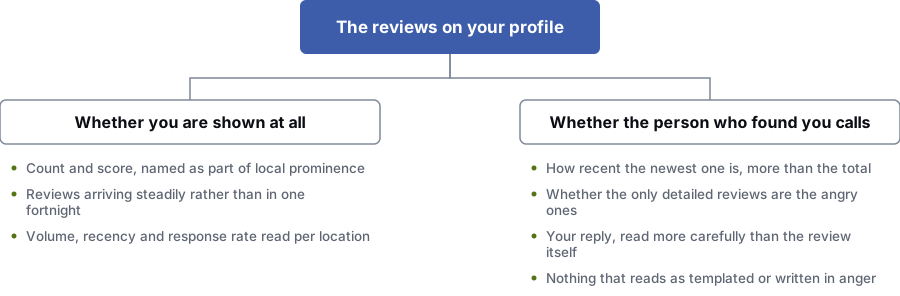
Whether you’re shown at all
- Count and score, part of local prominence
- Reviews arriving steadily, not in one burst
- Numbers, recency and reply rate per location
Whether the person calls
- How recent the newest review is
- Whether the only detailed reviews are angry
- Your reply, read more closely than the review
- Nothing that reads as copied or angry
Questions
Common questions about improving online reviews
Can you get a bad review removed?
Only if it breaks the platform’s rules: spam, a review of a different business, personal attacks, conflicts of interest and anything else their policy bans. We report it through the platform’s own process, and the platform decides.
A fair review from an unhappy customer won’t be removed, and it shouldn’t be. Reply calmly and specifically, then build up enough recent reviews that one bad week doesn’t define you.
Why can we not offer a small discount for a review?
Because it breaks the rules of the platforms you rely on. Google’s Maps content policy bans offering payment, discounts or free goods for a review. Other major platforms say the same. Profiles with rewarded reviews can lose them all at once.
In the United States it’s a legal issue too. The FTC’s rule on consumer reviews and testimonials bans fake reviews, and offering a reward on the condition that the review is positive.
Rewarded reviews also look fake: short, generic and posted together. Careful readers ignore them.
What is review gating and why is it a problem?
Gating means asking customers a private question first, then only inviting the happy ones to post a public review. Lots of review software sells it. Google’s Maps content policy bans it: businesses can’t discourage negative reviews or ask only for positive ones.
What’s allowed: ask everyone for a public review and, separately, give every customer an easy private way to raise a problem. You’re not choosing who gets asked; you’re giving complaints somewhere to go.
How many reviews do we need?
Enough that people stop counting and start reading, and recent enough that you look open. In most local categories that means roughly matching the competitors next to you, with new reviews arriving steadily.
How recent your reviews are usually matters more than how many. A profile whose newest review is two years old looks neglected.
Should we reply to every review, even the five-star ones?
Yes, and keep it short. A brief, specific reply shows someone is paying attention, and people choosing a business read the replies as closely as the reviews.
Vary them. Ten identical "Thanks for your feedback!" replies look worse than none, because they show nobody is reading.
Where to get help
Services that solve this
Reputation & Review Management
Online review management that gets you more real reviews without breaking platform rules. We build the asking into your routine and reply properly to criticism.Local SEO
Our local SEO services get you onto Google Maps and into "near me" searches. We fix your Business Profile, area pages and reviews, for one location or forty.Leads, Reviews, Tracking & Reports
Every call and form tracked to its source, a reply to each lead in your name, every review answered, and a monthly report you can read. It is in every BOOSTD plan.
Find out which review problem is costing you customers
We’ll compare your profile with the competitors next to you, tell you if the issue is numbers, recency, average or replies, and set up a routine your team can run.
Prefer to talk it over? Book a free call
Your BOOSTD score improves within 90 days, or your next month is free. After 6 months, more traffic or leads, or we keep working free (up to 6 free months in any 12 months). Read our guarantee
References
Sources for improve online reviews
The official documents and research this page is based on. Platform rules change, so check the source before you act on a detail.
- Google Maps User Generated Content Policy Help: Prohibited and restricted content
- Google Business Profile Help: Report inappropriate reviews on your Business Profile
- Google Business Profile Help: Tips to get more reviews
- Google Business Profile Help: Tips to improve your local ranking on Google
- FTC: Trade Regulation Rule on the Use of Consumer Reviews and Testimonials (16 CFR Part 465)
- FTC: The Consumer Reviews and Testimonials Rule, questions and answers
Last updated · Published by Zubair Afzal, responsible editor