
Local search
How to do SEO for multiple locations, one branch at a time
Published by Zubair Afzal, responsible editor
First published Updated 9 min read
Where to start
Why do branches with the same setup get different results?
Because Google judges each location on its own. Picture five branches, one website, one brand, one budget: three show up well and two barely appear.
Google Business Profile Help names three things behind a local result: relevance (how well the profile matches the search), distance (how far you are from the searcher) and prominence (how well known you are, including links and reviews). Google measures all three at each location, not at the brand.
Your shared website is the smaller part. The bigger part builds up at each address: its own categories, reviews, photos and history, plus a position nobody can change. So SEO for multiple locations works branch by branch:
1. One verified profile per branch, set up to a shared standard.
2. One location page per branch that says things only true there.
3. A review routine owned by each site, with every branch page linked from your service pages.
The five causes below take an afternoon per branch to check, from easiest to hardest to fix.
The causes
Five reasons one branch lags behind
Work down the list in order: it’s sorted by how fast each cause can be fixed.
- The branch profile is set up differently.
- Nobody compares profiles side by side. A branch set up years later may have a different primary category, fewer services, missing attributes or a differently written address, so it competes for different searches.
- The location has two profiles splitting everything.
- A move, rebrand or new manager often leaves a second listing behind, splitting reviews, photos and mentions. Search Maps for the address, old name and old phone number first; every other check is unreliable while a duplicate exists.
- The location page says nothing only true of that branch.
- Copy one page, swap the place name, and the pages compete with each other while telling customers nothing. Write four paragraphs per branch that would be false on any other branch page.
- Some branches get reviews and others don’t.
- Reviews stay on the profile that earned them, so a group average hides big gaps. At strong branches, someone asks as part of the job. At weak ones, asking was a one-off push that stopped when the person who started it left.
- The branch is further from where people search.
- Google measures distance from the searcher, so a branch on the wrong side of its area will lose some searches it can never win. It’s the one cause effort can’t fix; spot it early.
Types of search
Which searches depend on the branch, and which on the brand?
Most groups report both together, which hides the problem. Split them to see what’s missing.
Decided almost entirely at the branch
Distance and profile strength matter most. Central content and brand authority do little here.
- service near me
- service in town name
- open now nearby
- best service close to me
Decided by the brand, then sent to a branch
They’ve already chosen you. The risk is sending them to the wrong location or a central phone queue.
- brand name town name
- brand name opening hours
- brand name near me
- brand name phone number
Decided by the website for all locations
One good page serves every branch. Copying it per location weakens every copy.
- how much does the service cost
- what to expect at your first appointment
- service explained
- do i need this service
These are example searches from keyword research and public search data. Before we suggest anything, we check how often people search for them in your area.
Group ratings
Why your group rating doesn’t help each branch
Google counts review count and rating per profile. Your group can look strong while two branches compete on numbers nobody’s checked.
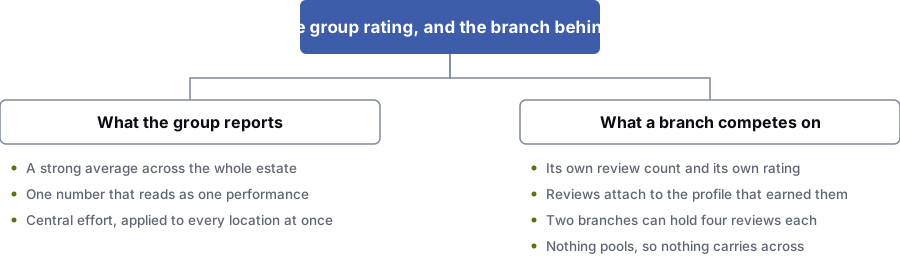
What the group reports
- A strong average across all locations
- One number that looks like one result
- Central effort applied to every location
What each branch competes on
- Its own review count and rating
- Reviews stay on the profile that earned them
- Two branches can have four reviews each
- Nothing pools, so nothing carries across
Step by step
How to find out why a branch is lagging
Allow one afternoon per branch. Go in order, because a duplicate profile makes every later check unreliable.
Look for duplicate listings first
Search Maps for the branch address, current name, any old name, old phone number and any brand you bought, and note every listing. Until each location has one profile, nothing else you measure means anything.
You get: A list of every listing per branch, with duplicates marked for merging
Compare the profiles side by side
Put every branch in one table: primary category, extra categories, services, attributes, hours, photo count and review count. Lagging branches usually stand out within a minute.
You get: A one-page comparison table for all your locations
Test distance from the local area
Ask someone in the branch’s area to search your main service on their own phone, then repeat from two points further away. You’ll see where the branch stops appearing, and whether it’s underperforming or just further away than competitors.
You get: Screenshots from three points, showing where the branch stops appearing
Read two location pages side by side
Open your strongest and weakest branch pages together and count sentences that would be false on the other. Near zero means they’re the same page. A high count with the branch still lagging means the page isn’t the problem.
You get: A count of unique sentences for each pair of pages, with those sentences listed
Check who asks for reviews, and when
A review policy isn’t enough. At branches that collect reviews, a set role asks at a set point in the job; at branches that don’t, asking stopped. Fix this before paying for anything else, because reviews keep building long after any project ends.
You get: A set role and moment for asking at each branch, written into the daily routine
Fixes
What a lagging branch usually needs
Sorted by cost and speed: the first three are cheap admin; the last few are slow but build over time.
- One verified profile, owned by the business, not by a former agency or ex-manager.
- The same setup as your strongest branch: primary category, extra categories, services and attributes matched on purpose.
- A complete profile with photos of that building, that team and jobs done there. No shared stock images.
- A location page with four paragraphs that would be false on any other branch page, and structured data that matches it.
- Internal links from the services that branch offers and from nearby location pages. Not just a store locator.
- A review routine owned by a set role at that site, starting at a set point in the job, every week.
- Local mentions earned nearby: a supplier listing, membership, sponsorship or partnership. It’s the only part of prominence a branch can build on purpose.
- A clear call on which searches distance rules out, and a plan for where distance matters less.
Want help with SEO for multiple locations?
Questions
SEO for multiple locations: common questions
Why does one branch outrank another with the same setup?
Because almost nothing that decides a local result is shared. Google names relevance, distance and prominence, and it measures all three per location: that profile’s categories, that address’s distance, and that branch’s reviews and mentions.
Your shared website helps, but it’s the smaller part, so two branches with the same support from head office often get different results.
How long should a new branch take to become visible?
Longer than anyone wants, and nobody can give you a reliable number. A new profile starts with no reviews, photos, mentions or history, and each builds up over months.
What you can commit to is the order: verify the profile and set its category, build the location page, and ask for reviews from week one. Expect steady progress, not equal results by a set quarter.
Our location pages aren’t ranking. Are they competing with each other?
Yes, if they’re the same page with the place name swapped. When several pages answer one search equally well, none is a clear answer.
Read two pages side by side and count sentences that would be false on the other. Close to zero means they’re duplicates: merge or rewrite them.
Can a branch on the edge of town be fixed?
Not for searches where distance decides the result. Google measures distance from the searcher, and no content or reviews can shorten it.
Compete where the branch is closest, usually the nearby area rather than the whole city, and build visibility where distance matters less: normal search results, directory sites and local referral partners.
Should each branch have its own website?
Usually not. Separate sites split your group’s authority, multiply the upkeep and spread inconsistent details, which hurts every location.
One exception: a franchise network where franchisees run their own marketing anyway. Even then, one shared platform with local editing works better than separate sites nobody can check.
Do reviews transfer between branches?
No. Reviews stay on the profile of the location that got them. Google names review count and rating as part of prominence for that profile.
So a group average misleads: your network can have a strong overall rating while two branches compete on four reviews each.
References
Sources for how to do SEO for multiple locations
The official documents and research this page is based on. Platform rules change, so check the source before you act on a detail.
- Google Business Profile Help: Tips to improve your local ranking on Google
- Google Business Profile Help: Guidelines for representing your business on Google
- Google Business Profile Help: Manage your business category
- Google Search Central: Local business (LocalBusiness) structured data
- Google Search Central: Creating helpful, reliable, people-first content
- Google Business Profile Help: Manage your service areas for service-area and hybrid businesses
Related
Keep reading on how to do SEO for multiple locations
- marketing for multi-location and enterprise organisationsThe wider marketing picture when locations are part of a bigger brand.
- why a multi-location business grows unevenlyWhat head office should control, and what to leave to branches.
- what each Google Business Profile field does
- when a branch is missing from Google Maps
- local SEO vs national SEO
- marketing for franchise networks
Start here
Two branches doing differently for no clear reason?
Send us both locations and the searches that matter at each. Our specialists will tell you which of the five causes is behind it, even if it’s one you can’t fix.
Rather check it yourself? Try our free SEO tools