
Franchise marketing problems
Franchise marketing problems: why a franchisee is not a branch
Most franchise marketing problems come from one fact: head office can instruct a branch, but can only persuade a franchisee. Build marketing franchisees choose to use.
Every location, one view
Example- 72Downtown branchOn track
- 48North branchProfile gaps
- 66Airport branchOn track
Numbers are Growth Scores out of 100
The big difference
What changes when someone else owns the location
Many franchise marketing plans are branch plans with "franchisee" swapped in. These are the rows where that swap breaks.
| Dimension | Company-owned branch | Franchised location |
|---|---|---|
| What makes them comply | Employment. The instruction just gets carried out | A business agreement, and only as far as it says |
| Who pays for marketing | The company, from its own budget, answering to itself | A levy from independent businesses, who have every right to ask what it bought |
| Going off-brand | A performance chat, sorted internally within days | A contract issue: slow, expensive and bad for the relationship |
| Marketing on their own | Doesn’t happen, as there’s no separate budget for it | Happens whenever head office doesn’t give them what they need |
| Territory clashes | A manager moves budget between branches | Two owners with their own targets, both entitled to trade |
| The second audience | None. Growth comes from opening more branches | People thinking of buying a franchise, marketed to alongside customers from related budgets |
| What happens when they leave | Accounts and profiles stay with the company automatically | Profiles, reviews and customer data may leave with them unless ownership was settled early |
Where networks struggle
Three franchise marketing problems branches never have
None of these happen when the company owns every location. All three start with the relationship before they become technical, which is why fixes that work elsewhere don’t work here.
- Nobody trusts where the money goes.
- Everyone pays into the ad fund, a national campaign runs, and no franchisee can see what their own area got. That feels like a tax with no accountability, and pushback follows whether or not the campaign worked. The same distrust shows up in ad auctions, where neighbouring franchisees bid against each other on the same terms and the brand pays more to reach its own customers. Both are predictable, and usually tackled only after they start.
- A franchisee has built something of their own.
- Their own website, social accounts and sometimes their own version of the name. Head office sees defiance, but usually the central offer didn’t do something they needed, so they bought it elsewhere. Enforcement deals with the symptom, and the same gap will push the next franchisee to do the same.
- Recruitment marketing is eating the customer budget.
- Selling a franchise is a big, visible win the board loves; marketing to end customers is spread out and slow. When both come from one team and one report, attention drifts to recruitment until franchisees aren’t busy enough, and the network has to rebuild demand it stopped paying for.
Before you send a legal letter
A franchisee built their own website? Ask these three questions first
You can probably enforce a rule twice before the relationship changes for good. So know what you’re using it on. These three questions tell you whether this is worth one of those two.
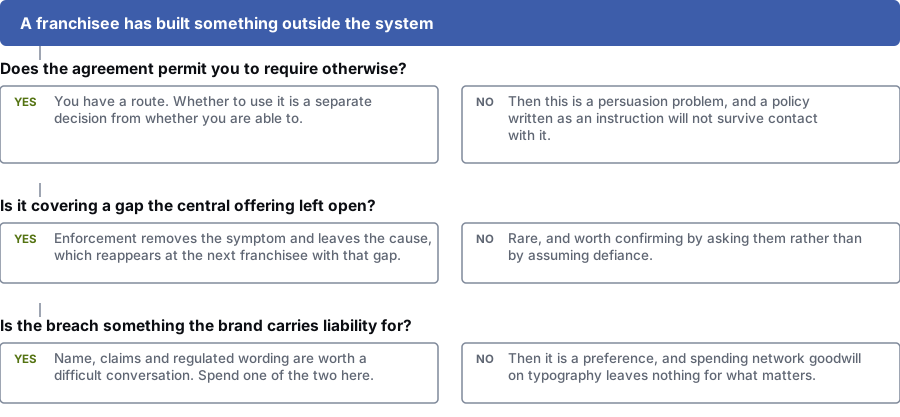
Does the agreement let you require otherwise?
Yes: You have an option. Whether to use it is a separate question from whether you can.
No: Then you have to persuade them. A policy written as an order won’t work.
Is it filling a gap the central offer left?
Yes: Enforcing fixes the symptom and leaves the cause, which will push the next franchisee the same way.
No: That’s rare. Confirm it by asking them before you assume they’re being defiant.
Is the brand legally liable for what they’ve done?
Yes: Name, claims and regulated wording are worth a hard conversation. Use one of your two here.
No: Then it’s a preference. Spending goodwill on fonts leaves nothing for what matters.
The steps
How to build a marketing programme franchisees want to use
The order matters. Each step makes the next one something franchisees choose, the only kind of buy-in that lasts across a network.
Read the agreement before you write any policy
Find out what you can require, what the levy can pay for, who owns the customer relationship, and what happens to profiles and data when a franchisee leaves. Ask your legal advisers, not your marketing team. It sets the limits for everything else.
You get: A written summary from your lawyer of what the agreement allows
Cut the standards down to what matters most
Keep the name, logo, claims, regulated and legal wording, and anything the brand is liable for, on one page. Label everything else as a preference. A short list of must-follow rules gets followed; a long manual gets skimmed once.
You get: A one-page list of must-follow rules
Find out what franchisees buy elsewhere
Ask the franchisees who went outside the system what they were missing. The answers are usually specific and ordinary: local landing pages, seasonal creative, a booking system that works, reports they can read. That list, from the network rather than head office, tells you what the central offer needs.
You get: A list of gaps, from franchisees who went elsewhere
Offer something better than going it alone
Supply ready-made local content, a managed Google profile, campaign templates and measurement that works from day one. Then make continued access depend on the short list of rules, so following them is the price of something franchisees want. It’s the only enforcement that doesn’t cost the relationship.
You get: A central offer good enough to adopt on its own merits
Write down the territory and bidding rules
Decide who may bid on brand terms, how territory lines apply to ads as well as service, and what happens where two territories overlap in one city. Publish the rules before the first dispute.
You get: Published rules for ads and territories
Report the fund to the people who pay into it
Show what was spent, on what, and what each territory got, next to the national picture. Separate brand activity that helps everyone from local activity that helps specific franchisees. Most disputes come down to that split.
You get: A regular ad fund statement for each territory
What the job involves
Four things a franchisor’s marketing team has to run
Run the ad fund like a product
The franchisees paying in are your customers, and they can ask what they got. That means accounts for each territory, a clear split between brand and local activity, and reports a sceptical franchisee could check. Being able to see results matters as much as the results.
Content good enough to beat going it alone
Supply local pages, creative, profile management, booking systems and measurement from the centre, better than anything a franchisee could buy locally. That makes following the rules a choice, not an order. It’s also the biggest single cost of a franchise marketing team that works.
Rules that head off the arguments
Decide and publish the rules on ad territories, brand-term bidding, who replies to reviews, who controls profiles and what happens when a franchisee leaves, before anyone disputes them. The same rule written after the first dispute reads like a punishment aimed at one franchisee.
Keep the two audiences apart
Customer marketing and franchise recruitment can share a team, but they must not share a budget or a report. Keeping them apart stops the bigger, more visible recruitment wins from eating the customer demand the network needs to be worth buying into.
A franchisor can probably enforce a rule twice before the relationship changes for good. Save it for the things the brand is liable for.
A typical network has a few standards worth a hard conversation, such as the name, the claims and the regulated wording, and a much longer list that aren’t. Treating them all the same spends the network’s goodwill on fonts.
That doesn’t mean letting everything slide. Make the approved route clearly the better one, so the hard conversations are rare enough to carry weight.
Questions
Common questions about franchise marketing problems
How do we get franchisees to follow the brand standards?
Make the approved option better than going it alone; enforcement rarely works. Give franchisees ready-made local content, a managed Google profile, working measurement and creative they’d otherwise pay for, and they have a reason to stay in the system.
Separate the must-follow rules (name, logo, claims, regulated wording and anything the brand is liable for) from preferences. A short list of rules that matter gets followed. A long document about fonts doesn’t, and mixing the two makes the important rules impossible to enforce.
A franchisee has built their own website. What now?
First find out what your agreement says, with your own legal advice, because that decides every option you have. Then ask the franchisee why they did it. Most likely the central offer didn’t do something they needed.
The lasting fix is to give them what they were missing, on terms that make the separate site pointless. You may need to enforce where the brand is exposed, but a network that settles these only by escalation gets compliance and loses the relationship.
How should the ad fund be reported?
Report it to the franchisees who pay in, in terms they can check: what was spent, on what, what it produced, and what each territory received as well as the national total. Franchisees push back on funds they can’t see into, almost whatever the results.
Be clear about the split between brand activity that helps everyone and local activity that helps specific territories; that’s where most disputes start. What the fund can legally be spent on is set by your agreement and is a question for your legal advisers.
Two franchisees are bidding against each other. How do we stop it?
Write the rules before the conflict, not after it. Decide who may bid on the brand name, how territory boundaries apply to ads as well as service, and what happens where audiences overlap in a shared city.
The cleanest setup is usually for head office to buy brand terms for the whole network, with local campaigns on non-brand terms in set areas. That removes the most common flashpoint and cuts costs for everyone.
Who should own the Google Business Profiles?
The brand should, with franchisees given access to post, reply to reviews and fix hours. Central ownership allows bulk fixes, keeps naming consistent and stops profiles disappearing when a franchisee leaves.
Franchisees must still be able to edit locally. A profile only head office can touch goes stale, and wrong hours cost more local business than most brand slip-ups. Settle this when a franchisee joins.
Why do some franchise locations underperform others?
Compare your strongest and weakest locations on the same inputs, not just revenue: each Google profile, how many reviews and how recent, whether a local page says something local, who is bidding on what in the area, and how fast enquiries get answered. You can usually spot the differences in an afternoon.
If the inputs are similar and results still differ, the cause is probably local: territory size and demand, competition, or how the franchisee runs the business. If the inputs differ, the network has a marketing problem head office can fix.
Should franchise recruitment and customer marketing share a team?
They can share a team, but not a budget or a report. They’re different audiences with different funnels, sales cycles and measures of success, and recruitment gets more attention from leadership.
Left mixed, recruitment slowly eats the customer budget, because selling a franchise is a bigger single win. That works until franchisees aren’t busy enough, and then recruiting gets much harder anyway.
Where to get help
Services that solve this
Multi-Location & Franchise SEO
Multi-location SEO services for chains and franchises. Head office sets the structure, each branch supplies local facts, and every location page and profile gets found.Local SEO
Our local SEO services get you onto Google Maps and into "near me" searches. We fix your Business Profile, area pages and reviews, for one location or forty.Google Business Profile Management
Our Google Business Profile optimization service fixes your listing, fills it in properly and watches it for suspensions and edits by strangers.Marketing Analytics & Attribution
Marketing analytics and attribution you can trust, with a written account of where the data is blind and tests for what attribution can’t answer.Reputation & Review Management
Online review management that gets you more real reviews without breaking platform rules. We build the asking into your routine and reply properly to criticism.
Find out why franchisees are going outside the system
Tell us how big your network is, what the fund pays for and the three things franchisees complain about most. We’ll tell you where the central offer falls short, which rules are missing, and what the fund reports need to show.
Prefer to talk it over? Book a free call
Your BOOSTD score improves within 90 days, or your next month is free. After 6 months, more traffic or leads, or we keep working free (up to 6 free months in any 12 months). Read our guarantee
References
Sources for franchise marketing problems
The official documents and research this page is based on. Platform rules change, so check the source before you act on a detail.
Related
More ways to fix this
- franchise marketing run for a whole network, as an ongoing serviceOur franchise marketing service, and how networks of different sizes differ. That page covers the service. This one helps you find the cause.
- profiles owned centrally with local editing rights
- branch performance diagnosis for company-owned locationsWhen head office owns the branches, the causes are different.
Last updated · Published by Zubair Afzal, responsible editor