
Franchise Systems marketing
Franchise marketing agency for franchisors and advertising funds
Franchise marketing for franchisors: recruit new owners, bring customers to every outlet, and run an ad fund you can explain to the owners who pay in.

Common problems
Why your franchise marketing isn't bringing in work
A franchisee isn't a branch manager. They put in their own money and carry their own risk. They signed an agreement that lists exactly what you can require of them. Outside that list, they can say no.
Almost every recurring franchise marketing problem comes back to that one fact. The ad fund, brand standards, territory disputes and onboarding new owners are all questions of influence, not authority.
- Nobody can say what the advertising fund bought.
- Owners pay a share of revenue every month and get a summary of channels and impressions. When a unit has a slow quarter, that summary is the first thing questioned. A fund you can't explain in units opened, customers served and enquiries routed soon loses owners' trust. Then they start spending locally on top of the fund, which costs them more and hurts the brand.
- Franchisees are advertising against the brand they pay into.
- An owner running their own search ads will bid on the brand name, because it converts. So does the national campaign the fund pays for. Two parts of the same system now bid against each other for the same customer, and only the ad platform wins. Settle this with a written policy before anyone touches an account.
- The brand standards live in a manual nobody opens.
- A long document about logo spacing and approved fonts doesn't create consistency. Owners need a short list of things that can't change, kept apart from preferences, and instant access to assets that already follow the rules. Lead with restrictions and you get quiet non-compliance everywhere. Lead with ready-made assets and owners adopt them.
- Two owners are arguing about who a lead belongs to.
- Territory rights are set by contract, and marketing often cuts across them. A central campaign brings an enquiry from a postcode on a boundary, a customer searches while travelling, or one site ranks for a town two owners both serve. Without an agreed routing rule and a visible record of each assignment, these disputes keep coming back, and they cost far more goodwill than the leads are worth.
- A new unit opens and marketing starts three months later.
- Onboarding usually covers operations, supply and training well, and marketing arrives as a login. But the opening weeks are when a unit most needs customers, and the owner is most open to help. A set pre-opening sequence fixes it: profile created and verified, local pages live, launch campaign built, review requests running.
What people search
Searches like “how much does it cost to open a [brand] franchise”
Candidates researching a franchise purchase
Long consideration, high value per award, and the searches where disclosure rules matter most.
- how much does it cost to open a [brand] franchise
- best franchises to buy under [amount]
- is buying a franchise worth it
- [brand] franchise requirements
- franchise vs starting my own business
- low investment franchise opportunities
Candidate due diligence and comparison
Made late, often after a discovery day, and usually about things the franchisor has never published.
- [brand] franchise reviews from owners
- [brand] vs [competitor brand] franchise
- what is in a franchise disclosure document
- franchise royalty fees explained
- questions to ask a franchisor
Consumers looking for a local outlet
Brand chosen, location not. This is the demand the ad fund exists to create and the outlet has to convert.
- [brand] near me
- [brand] [town] opening hours
- [brand] delivery [postcode]
- is there a [brand] in [town]
- [brand] prices
Owners looking for local marketing help
What a franchisee searches when head office has not supplied what they need. A good early warning of where brand rules will break.
- local advertising ideas for a franchise owner
- can franchisees run their own google ads
- franchise local marketing plan template
- how to promote a new franchise opening
These are example searches from keyword research and public search data. Before we suggest anything, we check how often people search for them in your area.
How they choose
Who decides, and what they look for
Know how they choose and you know where to show up.
- A candidate is buying a job, a business and a fifteen-year relationship at once. They research for months, read the disclosure document closely and talk to existing owners. Treat them as an investor to inform, not a lead to capture, or you lose the serious ones first.
- Existing owners are the strongest signal in recruitment, and the hardest to influence. Candidates get told to call a sample of current franchisees. What those owners say about head office support decides more awards than any brochure.
- Candidates compare systems on the same three things, in every sector: total investment, the support they get for the fees, and whether the available territory is worth having. Vague on any of them, and you look evasive.
- A customer buying from an outlet has usually chosen the brand before the location. National recognition builds the shortlist. Local distance, hours and reviews make the final choice. That's why one weak outlet drains demand the fund created.
- Owners decide whether to use central marketing by comparing it with what they could arrange themselves that week. If the central option is slower, harder to request or less relevant to their town, they go local and treat the fund as a tax.
- Multi-unit operators and area developers judge differently again. They want to know if the system can support ten units, not one. So they look hard at training, supply, technology and the marketing setup itself.
Two demand streams
One takes months of due diligence. One takes ninety seconds
A franchise system markets to a candidate and a customer at the same time, through the same brand, at very different speeds. Neither one just does as it's told.
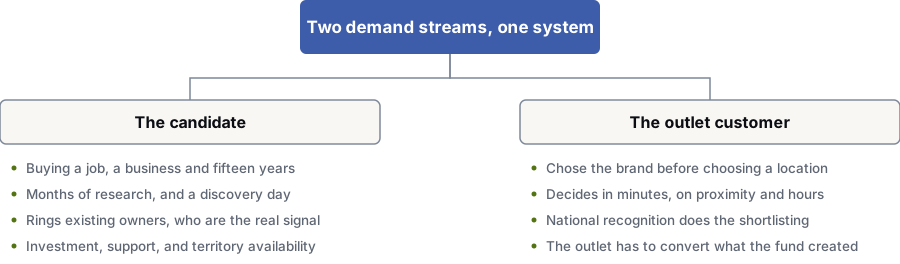
The candidate
- Buying a job, a business and fifteen years
- Months of research, and a discovery day
- Calls existing owners, the strongest signal
- Investment, support and available territory
The outlet customer
- Chose the brand before the location
- Decides in minutes, on distance and hours
- National recognition builds the shortlist
- The outlet must convert what the fund created
Where to spend
Why content and PR comes before your Google profile
In the order we'd put them. Start at the top.
Recruitment content that stays within the disclosure rules
Candidates want investment ranges, what the fees buy, what a typical week looks like and what happens if it goes wrong. Publishing that clearly sets you apart from the opportunity portals. It must be written so nothing public conflicts with the disclosure document your lawyers approved.
Business profiles owned by the system, not by one owner’s login
When an outlet changes hands, its profile, reviews and photos should stay with the territory. They should not leave with the departing owner. Decide ownership and access at group level. It is far cheaper to set up right at the start than to recover later through a support ticket.
Ad fund reporting owners will accept
Independent businesses pay into the fund and can ask what it bought. Reporting has to answer per unit, in plain terms: enquiries sent to this outlet, customers it brought, and what national spend did for a town that never sees it directly. Build this first. It decides how much freedom the centre gets for everything else.
Your website
What to fix on your website
- A franchise opportunity section kept separate from the consumer site, so candidates and customers never land in each other’s path
- Investment figures that match the disclosure document exactly, with no hint of likely earnings
- An up-to-date territory availability view, because asking about an area already awarded quickly sours a candidate
- A described award process with named stages, so a candidate knows what a discovery day is and what comes next
- Outlet pages built from details the local owner supplies, not paragraphs head office writes for them
- An asset library owners can reach without asking, with local customisation built in
- A published lead routing rule, so owners can see how enquiries near a boundary are assigned
- A pre-opening checklist that runs the same way for every new unit, from profile verification to launch campaign
The rules
Keep your ads compliant
Many markets have franchise disclosure laws, and in practice they limit what you may say in public to what the disclosure document says. Earnings claims are the sharpest edge. In several jurisdictions, an earnings claim in an ad, on a website or at a discovery day must be backed up and disclosed in a set way. The safe rule is simple: no revenue or profit figure goes into marketing unless your franchise lawyer has confirmed it belongs there.
The rules differ by country, and in some countries by state or province. So do registration requirements. A recruitment campaign that shows in a market where you are not registered to sell franchises is a real risk, and geographic targeting can create it by accident. We target only the markets you are cleared for, and you confirm that list with your advisers.
A franchisor can be held responsible for claims a franchisee makes locally. That is why the non-negotiable list exists. Advertising claims, regulated wording and anything about price, availability or results belong to the centre, not to individual owners.
How the ad fund is spent is a contract matter as well as a marketing one. Franchise agreements often say what the fund may pay for, whether admin costs may come out of it, and what reports owners are entitled to. We work within your agreement and will not propose spending outside it.
None of this is legal advice, and the details change. Confirm your duties with your franchise lawyer and the regulator in each market where you recruit. Any marketing claim about the opportunity needs their sign-off.
Sources
Primary sources for these rules
Each rule above, linked to the body that publishes it. Which ones apply depends on where you work. Rules change, so check the latest version.
- Earnings claims need a reasonable basis, written substantiation and inclusion in Item 19 of the FDD.
- FTC Franchise Rule 436.9
- Source: US — FTC Franchise Rule, 16 CFR 436.9 (eCFR)
- Franchises may not be offered or sold in California unless registered or exempt.
- Cal. Corp. Code § 31110
- Source: US (California) — Corporations Code § 31110
- Earnings information must be given in, or attached to, the disclosure document, with its basis stated.
- Franchising Code 2024
- Source: Australia — Competition and Consumer (Industry Codes—Franchising) Regulations 2024
Measuring results
How we measure success
These numbers show if your marketing brings in customers. Website visits alone don't.
- Franchise agreements signed, and cost per awarded unit alongside cost per candidate enquiry
- Candidate progress by stage: application, qualification call, discovery day attended, award
- Ad fund spend matched against enquiries and customers credited to each territory
- How widely central assets and campaigns are used across the network
- Time from a unit opening to its local marketing being fully live
- Franchisee satisfaction with marketing support, measured as a score
- Enquiries routed per territory, with the share disputed or reassigned tracked openly
- Franchise renewal rate, because a system losing owners cannot fix that by recruiting
Questions
Your franchise marketing questions, answered
How do we get franchisees to use what we produce centrally?
Make it the easiest option they have. An owner deciding how to promote a slow Tuesday will use whatever they can get working by Thursday. If that's a local designer and not your portal, the portal loses, however good it is.
In practice: assets already localised, requests handled in days not weeks, and a few rules instead of a manual. Low adoption is usually a supply problem, not an attitude problem.
Our owners bid on our own brand name. How should we handle it?
With a written policy, not a string of arguments. The usual position: brand terms get bought centrally, not by individual units. Two parts of the same system bidding on the same term just raises the price you both pay.
The policy is easier to accept with local reporting. Owners bid on brand terms because they want visibility they can see and measure. So show each owner what the central campaign delivered in their territory.
Can we publish what our franchisees earn?
Not on your own judgement. In several jurisdictions, any statement about revenue, profit or performance made to prospective franchisees is regulated. It must be backed up and disclosed in a set format. Even a casual figure in a brochure or a conversation can count.
Decide with your franchise lawyer what may be said, then keep everything public inside that limit. You can say a great deal about investment, fees, support and the work itself without making any earnings claim.
How should we split marketing between the fund and the individual owner?
The fund pays for anything that helps the whole system or is best done once: brand, national campaigns, the website, the asset library and technology. Local spend pays for activity that helps only one territory.
The line blurs around local campaigns run centrally, and that's where disputes start. Agree how those are treated in advance, in writing, and report against it monthly.
Should franchise recruitment and consumer marketing share a website?
They should share a domain and little else. A customer looking for opening hours and a candidate weighing a large investment want different things. Mixing them clutters the consumer site and weakens the recruitment material.
A clearly separate section works well: shared branding, its own navigation, content and measurement. It also keeps material with disclosure risk in one place, which makes review much simpler.
We are opening twelve units this year. What should happen at each one?
The same sequence every time, starting before the doors open: profile created and verified, outlet page live with local details from the owner, launch campaign built from the standard template, review requests running from week one, local partnerships lined up in advance.
The value is in doing it the same way. A repeatable opening plan gets better with each unit. Twelve improvised launches teach you nothing, and give the weakest owners the worst start.
Want to know what you could win?
Start with the free checkup. It shows what to fix first on your website, with no sign-up. Want the full plan for your franchise business? Book a call, and we'll look at your market, your competitors and the searches that bring in customers.
Prefer to talk it over? Book a free call
Your BOOSTD score improves within 90 days, or your next month is free. After 6 months, more traffic or leads, or we keep working free (up to 6 free months in any 12 months). Read our guarantee
References
Sources for franchise marketing agency
The official documents and research this page is based on. Platform rules change, so check the source before you act on a detail.
Related
More on franchise marketing
Last updated · Published by Zubair Afzal, responsible editor