
Startups & Scale-Ups marketing
Startup marketing agency built around your runway
Startup marketing planned around your runway: what proves traction before the next board date, and what keeps working after the budget stops.

What people search
Searches like “fractional cmo for startup”
Deciding what marketing to buy
Searched by a founder just told to produce a growth number, working out what to do next.
- fractional cmo for startup
- first marketing hire vs agency
- how much should a startup spend on marketing
- growth marketing agency for seed stage companies
- when to hire a head of marketing
Getting the first customers
Early searching. You’ve got a product and no repeatable way of selling it yet.
- how to get first 100 b2b customers
- signs of product market fit
- founder led sales process
- cold outbound vs inbound for early stage
- startup positioning framework
Board and investor metrics
Researched before a board meeting or a raise. These are the terms you’ll use to judge any agency.
- cac payback period benchmark
- series a marketing metrics investors expect
- how to present growth in a board deck
- ltv to cac ratio explained
- what counts as traction for a seed round
Fast-traction tactics
The shortcuts you reach for under time pressure. Worth answering clearly — most rent attention and build nothing lasting.
- is a product hunt launch worth it
- startup pr agency cost
- paid ads for a startup with a small budget
- growth tactics that still work in b2b
- how to get press for a startup launch
These are example searches from keyword research and public search data. Before we suggest anything, we check how often people search for them in your area.
Timing
Busy months and quiet months
Cash sets the planning horizon, and it moves. A raise, a slow quarter or a hiring decision changes the runway, and with it the channels you can use. Revisit the plan at each of those moments.
Board and investor calendars create fixed reporting dates. Progress gets judged at a meeting someone booked months ago. Agree before the engagement starts what will be shown at that meeting and what counts as progress. That stops a programme getting cancelled the quarter before it pays off.
Demand for the product may not show up in search yet. In a new category, people describe the problem and rarely name a solution. So the first question is whether anyone searches for anything. Research answers that in a fortnight.
Fundraising creates a second demand cycle next to the commercial one. In the months before a raise, investors, their analysts and their portfolio companies research the business. What they find feeds due diligence, whatever your marketing intended.
Hiring competes for the same attention. Early operators and engineers judge the company the way customers judge a product. In a competitive market, your public presence is recruiting whether anyone planned it or not.
What sets the deadline
Three questions that rule channels in or out before your next raise
The plan runs on cash here, and the amount left keeps moving. Each answer below rules out work that would make perfect sense for a company with more time.
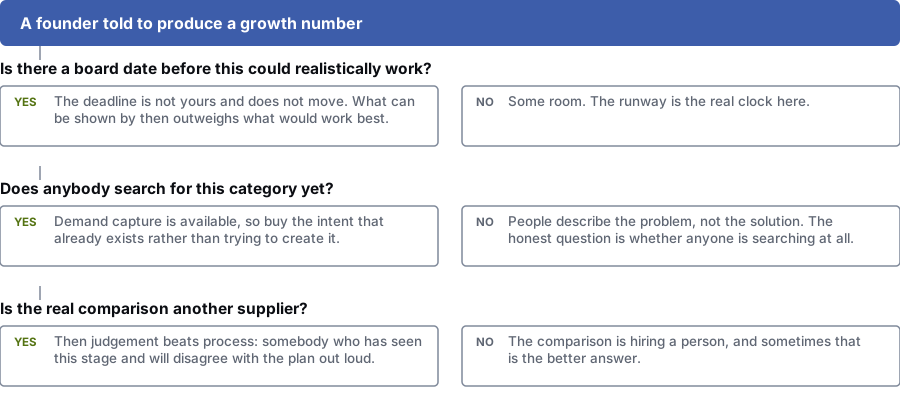
Is there a board date before this could realistically work?
Yes: The deadline is not yours and will not move. What you can show by then outweighs what would work best.
No: Some room. Runway is the clock that matters here.
Does anybody search for this category yet?
Yes: Demand capture is open, so buy the intent that already exists. Creating demand comes later.
No: People search for the problem. Check first whether anyone searches at all.
Is the true comparison another supplier?
Yes: Then judgement beats process. Pick someone who has seen this stage and will argue with the plan openly.
No: The comparison is a hire, and sometimes the hire is the better answer.
How they choose
How customers decide who to hire
Know how they choose and you know where to show up.
- You’re choosing against a deadline you didn’t set. Whether a supplier can show something meaningful before the next board meeting often matters more than which approach is better over three years.
- Founders test whether you’ll disagree with them. They’ve heard plenty of optimistic plans. They look for a supplier willing to say a channel is out of reach at this stage, or the timing is wrong — it suggests the forecasts mean something.
- Founders judge cost as a share of runway more than as a monthly fee. A retainer that eats an uncomfortable slice of remaining cash feels very different from the same fee at a larger company.
- They want to know what happens if it doesn’t work. Notice periods, what can be handed over, who owns the accounts and assets, and whether anything’s left behind all matter to a company that may have to stop spending at short notice.
- Relevant judgement beats process. A founder wants someone who’s seen this stage before and can say which of their four worries matters most. A documented methodology counts for less.
- The decision is often weighed against an internal option. The true comparison is frequently a hire, and sometimes the hire is the better use of the money.
Common problems
Common startup and scale-up marketing mistakes
A funded company’s marketing problem looks different from most. You’ve got a number due by a date, a set amount of runway before it, and a board that’ll decide something based on what happens in between.
Every sensible recommendation starts from those three facts. The question is never which channel is best in general. It’s which channels can produce evidence in the time you have, and which ones you start now and judge later.
- The plan is longer than the runway.
- A programme gets agreed on the basis that a channel matures in nine to twelve months. Meanwhile you have cash until next spring and a board review before that. The plan is sound — you just can’t reach it in time. Size the plan against payback, and accept that some of the most effective channels are out of reach at this stage. Start the compounding channels at a scale you can sustain, without assuming a raise.
- The positioning is still moving, and the spend is already scaling.
- You describe yourself differently to two customer groups, changed the homepage twice this year, and are buying traffic for both versions. Money spent scaling a message that’s about to change buys the wrong customers. It causes churn that looks like a marketing failure. Then you pay again to rebuild the pages, the accounts and the search coverage. Learning who converts costs less than amplifying a guess.
- Everything is rented, and nothing compounds.
- Paid ads produce evidence fast, which is why they dominate early plans. They also stop the day the budget does. A company two years in with no owned demand, no search rankings built up and no audience of its own is back where it started, with a bigger burn rate. Start the compounding channels while the paid ads are producing evidence, well before the budget runs out.
- The founder is the whole distribution channel, and the hours ran out.
- Early traction usually comes from the founder: their network, their posts, their outbound, their willingness to do things that don’t scale. It’s the cheapest acquisition the company will ever have. It’s also capped by one calendar, and stops when the founder is raising, hiring or delivering. Moving to something that runs without them is a specific project with a date.
- Nobody can tell a working channel from one lucky customer.
- At low volumes, one large deal makes a channel look excellent, and its absence makes the same channel look dead. Companies then change strategy every quarter based on noise. Agree in advance what evidence would justify carrying on. Split results by customer fit and skip the blended number. Some questions can’t be answered at this volume — decide those on judgement, and don’t pretend the data settled them.
Where to spend
Start with keyword research, then organic search
In the order we'd put them. Start at the top.
Find out in a fortnight whether the demand exists
Before committing a year to organic search, check whether anyone searches for the problem, what words they use, and which existing tools they compare. That takes weeks and often changes the whole plan. A category with no search demand needs a different strategy — a bigger content budget won’t fix it.
Start organic search now. Judge it later.
Organic search is usually too slow to be the evidence a board wants this quarter. It’s also too valuable to postpone, since it’s the only channel that keeps producing after the budget stops. Start it now at a scale you can sustain. Weight it towards the pages that convert soonest, and agree openly that it’ll be judged later than the paid ads.
A testing rhythm sized to your cash
A set number of experiments each quarter, each with a clear question, a cost ceiling and a decision rule agreed before it runs. That structure turns a small budget into learning instead of a list of things you tried. It also gives your board what it wants between milestones: evidence that you’re learning fast.
Your website
What your website needs
- A homepage that says who the product is for and what it replaces, in the words a customer would use
- Pricing or a pricing model published, because a company nobody can evaluate loses the evaluation without knowing it
- Proof you can back up: named customers with permission, true numbers, and nothing that would embarrass you in due diligence
- A site structure that survives a positioning change without losing the URLs and search rankings already built
- A careers section that treats candidates as an audience, since early operators judge the company the way customers do
- Enough company detail for an investor doing due diligence: who’s behind it, where it’s registered, what it does
- Analytics and conversion tracking working from day one, because the big decisions here rest on small numbers
- A contact route that reaches a founder, while the company is small enough for that to be an advantage
The rules
Before you publish an ad
Investors read public claims about traction, customers, revenue and growth during due diligence. A figure on your website that doesn’t match the data room is a problem in a funding process, not just a marketing exaggeration. Anything published is backed by evidence and dated. A number that was true nine months ago gets updated or removed.
Customer names, logos and quotes need permission, which early companies often skip in the rush. A handshake agreement from a founder-to-founder conversation isn’t a licence, and larger customers often have policies that restrict public references. Record permission with a scope and a date, so it survives the person who arranged it leaving.
In regulated categories, marketing can run ahead of a licence, and that’s a serious error, not a technicality. Health, finance, insurance, legal and employment-adjacent products all have limits on what can be advertised and by whom. The checks happen before launch.
Data protection duties apply from the first customer. Fixing consent, tracking and retention later costs far more than building them properly on a site nobody’s visited yet. Requirements differ across the markets you sell into.
Comparative and superlative advertising claims fall under advertising standards in every market we work in. A young company taking on an incumbent is more likely to make one carelessly. We flag anything that looks unsupportable, and confirming what your company can claim in each market stays with you and your advisers.
Sources
The rules in full
Each rule above, linked to the body that publishes it. Which ones apply depends on where you work. Rules change, so check the latest version.
- Marketers must hold evidence for objective claims, and comparisons with competitors must be fair.
- CAP Code, section 3
- Source: UK — CAP Code, section 3: Misleading advertising (ASA)
- Permits naming competitors in advertising, provided the comparison is truthful and not deceptive.
- FTC 16 CFR 14.15
- Source: US — FTC Statement of Policy on Comparative Advertising (eCFR)
- Data protection must be built in when the means of processing are decided, not added afterwards.
- GDPR Article 25
- Source: EU — Regulation (EU) 2016/679, Art. 25 (EUR-Lex)
Questions
Before you hire a startup and scale-up marketing agency
We have nine months of runway. What should we do first?
Start by ruling things out. A channel that takes longer to pay back than the time before your decision point is out of reach, however good it is. Build the plan from what can produce evidence in that window: paid ads on demand that already exists, direct outreach and the founder’s own reach.
Alongside that, start the compounding channels at a scale you can sustain, and agree openly that they’ll be judged later. Don’t fund a twelve-month programme with nine months of cash and hope the raise lands.
Is it too early for us to hire an agency?
Sometimes, yes. If the product still changes every week, if you haven’t sold to anyone outside your personal network, or if you can’t say who the product is for without changing the answer, paying to scale that means paying twice.
At that stage the useful steps are small: find out who converts, sharpen the position, get the measurement right. If what you need is a hire, the hire is the better use of the money.
How do we show progress to the board before revenue arrives?
Agree in advance what will be shown and what counts as progress. That’s a different conversation from promising a number. Early on, it means qualified pipeline, conversion by segment, activation and experiments run to a conclusion.
At the same time, set the point when the programme can fairly be judged on revenue. Many programmes get cancelled one quarter before they’d have paid off, because nobody wrote down when to look.
Should we spend on paid ads or build organic search?
Both, in that order, for different reasons. Paid ads produce evidence within a quarter and stop the day you stop paying. Organic search produces little for months, then keeps producing after the budget ends.
A company with a runway needs the first to get through the board meeting and the second to avoid being in the same spot next year. The mistake is picking one. Fund only paid and you buy a year of rented attention. Fund only organic and you’ve nothing to show at the review.
Our category doesn’t exist yet. Does that change the plan?
Yes — it changes what search can do for you. Search can’t create demand for a term nobody types. You need research to confirm that, and it takes weeks.
What usually does exist is searching around the problem and around the tools people use today. That’s the ground you can win. Anything aimed at creating the category itself is a brand programme with a longer horizon. Fund and measure it as one.
Want more customers from Google?
Start with the free checkup. It shows what to fix first on your website, with no sign-up. Want the full plan for your startup and scale-up business? Book a call, and we'll look at your market, your competitors and the searches that bring in customers.
Prefer to talk it over? Book a free call
Your BOOSTD score improves within 90 days, or your next month is free. After 6 months, more traffic or leads, or we keep working free (up to 6 free months in any 12 months). Read our guarantee
References
Sources for startup marketing agency
The official documents and research this page is based on. Platform rules change, so check the source before you act on a detail.
Related
More on startup and scale-up marketing
Guides for startup and scale-up
Other enterprise businesses
Last updated · Published by Zubair Afzal, responsible editor