
Fintech & Payments marketing
Fintech marketing that grows users and partners, inside the rules
Fintech marketing that grows users and partner banks at the same time, with every promotion built to pass the rules and platform review.

Common problems
Common fintech marketing mistakes
Fintech marketing gets judged in two rooms at once. In one, a consumer decides in ninety seconds whether to trust you with their salary. In the other, a bank’s risk committee spends four months deciding whether to let you near their licence.
Both read the same website and see the same ads. The rules on what you can say were written with the incumbent in the second room in mind. Nobody wrote them for a growth team in the first.
- Ads get pulled and nobody can say which rule was broken.
- An ad gets disapproved. An app listing gets rejected. A referral scheme gets switched off. Usually it’s one of three things: unfinished financial-services verification for that country, wording that turns a rate or approval outcome into a regulated promotion, or a hint of protection you don’t hold. All three are cheap to avoid at the brief stage and expensive to fix at launch.
- Your launch date belongs to a regulator.
- A licence application, a permission variation, a sponsor bank’s onboarding, a scheme approval — none of these come with a published date. Book a campaign on a hopeful guess and it either runs before you can take customers, or gets cancelled at a cost. Treat the approval as a range, not a date, and run a pre-approval programme that doesn’t need the product to exist yet.
- Installs go up. Funded accounts stay flat.
- Install campaigns optimise for whatever event you feed them, and installs are easy to produce. The events tied to revenue are passing identity checks, funding a balance and completing a first transaction — each behind a drop-off point. Until those events feed back to the ad platforms, your spend is just training the system to find people who download things.
- Your website is written for users and read by partners.
- A sponsor bank, an acquirer, a platform partner and an enterprise buyer all research you before they ever talk to you. What they find is a consumer landing page — no company detail, no named leadership, no security information, nothing on which entity is regulated where. That makes the growth pages look unserious to a risk team and the corporate pages look cold to a user. A clear split, with a proper partner section, is usually the most valuable change.
- The "is my money safe" question gets answered in the footer.
- Every prospective customer wants to know who holds their money and what happens if you fail. Most fintech sites answer in small print, or not at all. Be specific. Name the licensed institution that holds the funds. Say whether it’s safeguarding or deposit protection, what it covers and what it doesn’t, and where you’re authorised. Specifics convert better than reassurance, and regulators challenge them far less than a vague claim of being "protected."
What people search
“Is [app] safe to use” and similar searches
Is my money safe
The question that decides a signup. Searches jump whenever a peer fails, and almost nobody answers it clearly.
- is [app] safe to use
- is my money protected with an e money account
- what happens if a fintech goes bust
- is [app] a real bank
- who holds the money in a digital wallet
Choosing an account or provider
Comparison searching, much of it through review sites and aggregators. Clear fees win these more often than features.
- best business bank account for freelancers
- [app] vs [bank] fees
- cheapest way to send money to [country]
- business account with no monthly fee
- multi currency account for small business
Integration and partner checks
Searched by a developer or product lead at a partner. This is your second audience — it never visits the consumer homepage.
- embedded payments api documentation
- banking as a service provider comparison
- how to become a payment facilitator
- open banking data aggregator integration
- card issuing api sandbox
Regulatory and status checks
Made by partners, journalists, larger customers and sometimes regulators. What they find must match the public register exactly.
- is [company] fca authorised
- [company] money services business registration
- [company] safeguarding arrangements
- emi licence vs banking licence difference
- [company] leadership team
These are example searches from keyword research and public search data. Before we suggest anything, we check how often people search for them in your area.
How they choose
Why they pick one business over another
Know how they choose and you know where to show up.
- Consumers and small businesses weigh three things: fees they can find, whether the feature they need exists, and whether their money looks safe. The third stops more signups than anything, and most companies explain it least clearly.
- App store ratings and recent reviews act as the shortlist. A run of one-star reviews about frozen accounts or failed verification does more damage than any campaign can repair.
- Business buyers of payments and embedded finance start with integration. Does the API do what they need? How long does setup take? How does settlement work? They read the documentation before any marketing page.
- Partner banks and platforms judge the company more than the product. Ownership, funding, compliance staff, financial crime controls, complaints handling and how you handled your last incident count for more than your roadmap.
- Switching is painful, and that shapes the whole decision. Moving a payroll, a card or a payments integration takes effort. The first choice tends to stick, so help with moving across becomes a selling point of its own.
- Anyone with money at stake checks your regulatory status directly. Registers are public, and partners look you up. Imply something the register doesn’t say, and the conversation ends there.
Two audiences, two clocks
A user decides in a fortnight. A partner bank takes quarters.
A consumer signup and a partner integration both count as growth. Each has its own rules, evidence and timeline. Only one of them ever sees the homepage.
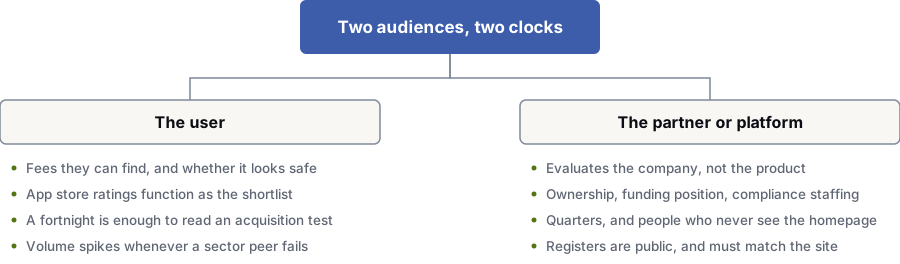
The user
- Fees they can find, and whether it looks safe
- App store ratings act as the shortlist
- An acquisition test can be read in a fortnight
- Searches jump whenever a sector peer fails
The partner or platform
- Judges the company more than the product
- Ownership, funding and compliance staff
- Takes quarters, and never sees the homepage
- Checks the public register against the site
Where to spend
Start with B2B search, then call and form tracking
In the order we'd put them. Start at the top.
Ranking for the searches your partners make
Developers, product leads and risk staff at the firms you want to be embedded in search for integration questions, settlement models, licensing comparisons and setup timelines. Almost every competitor writes only for end users, so this ground is wide open — and it gives your champion inside a partner something to share internally.
Optimising for funded accounts, not installs
What matters is passing identity checks, funding the account and completing a first transaction — each behind a drop-off nobody’s measuring. Feed those events back into the ad platforms and your reports, and the system stops finding people who download the app and never open it again.
Press coverage that stands in for decades of history
A company with no history has to borrow credibility from sources the reader already trusts. Coverage in outlets a partner’s risk team recognises, original market data, and named executives with a public record all do something your own channels can’t.
Your website
What to fix on your website
- A clear statement of which legal entity is regulated, by whom, in which markets and under what permission
- Who holds customer money and what protection applies, written in plain language
- A separate partner section with integration detail, settlement model and setup timelines, kept apart from the consumer pages
- Public API documentation that search engines can crawl, kept current and linked from the marketing site
- Named leadership with full backgrounds, because a risk committee checks the people before the product
- A security and status page covering controls, incident history and how customers hear when something breaks
- Fees shown in full, including the ones at the edges, since hidden charges are what app store reviews complain about
- A support and complaints route that’s easy to find, because larger partners judge how you handle failure
The rules
The rules that apply to you
A financial promotion covers more than most growth teams expect. Depending on the market, it can include app store titles and screenshots, paid social ads, influencer and affiliate content, referral schemes, push notifications and email, as well as the website. In several jurisdictions, an authorised person must approve a promotion before it goes out, and keep it on file afterwards.
Some words carry legal weight that marketing copy often ignores. Bank, deposit, protected, insured, guaranteed — restricted in various markets to entities with specific permissions. Using them without that permission is a supervisory matter, not a wording choice. Where a partner institution provides the underlying service, how you disclose that relationship is usually prescribed too.
Marketing can’t lawfully run ahead of the permission. Promoting a product before the licence, variation or scheme approval is in place is a common and serious mistake here, and it damages the partner relationships that made the product possible. Pre-launch activity should market the company and the problem it solves, never an offering you can’t yet sell.
Requirements differ sharply between Canada, the US, the UK and the UAE — which regulator applies, how promotions must be approved and recorded, what you can say about protecting funds, and the rules on incentives and referral rewards. Material cleared in one market gets reviewed again before it’s used in another.
These paragraphs describe the kinds of rules we design around. They aren’t legal or regulatory advice. Confirming what your entity can say, in which market and under whose approval, stays with your compliance function and your counsel. We don’t accept that responsibility on your behalf.
Sources
The rules in full
Each rule above, linked to the body that publishes it. Which ones apply depends on where you work. Rules change, so check the latest version.
- A financial promotion may only be communicated by, or with the approval of, an authorised person.
- FSMA 2000, s. 21
- Source: UK — Financial Services and Markets Act 2000, s. 21
- Prohibits misrepresenting that a product is FDIC-insured, or the extent of that insurance.
- 12 CFR 328, Subpart B
- Source: US — FDIC, 12 CFR Part 328 Subpart B (eCFR)
Measuring results
What good looks like
These numbers show if your marketing brings in customers. Website visits alone don't.
- Applications that pass identity and onboarding checks, and the drop-off at each step
- Accounts funded, and the share that go on to a first completed transaction
- Cost per funded account by channel, set against contribution, never against install cost
- Partner pipeline created, and integrations moved to live production
- Monthly active customers retained, since a funded account that goes quiet earns nothing
- Promotions approved first time, tracked as a cycle time your marketing team controls
- Share of acquisition that depends on any single platform, watched as a concentration risk
- App store rating and the themes in recent reviews, read as a product signal, never a vanity number
Questions
New to fintech marketing? Start here
Our ads keep getting rejected. Is that a creative problem?
Usually not. The three common causes: missing advertiser verification for financial services in that country, restricted wording about rates, returns or approval in the ad or landing page, and a hint of licensed or protected status you don’t hold there.
Build the platform policy and the promotion rules into the brief from the start. A campaign built to that standard runs for months.
We’re waiting on a licence. Is there anything worth doing now?
Yes, as long as none of it promotes a product you can’t offer yet. Build partner material, documentation, your founding team’s public record, market data nobody else has published, and search coverage on the problem you solve. All of it is lawful, and it takes months to mature anyway.
What fails is booking a launch campaign against a date the regulator hasn’t given you. Plan the spend as a range with a trigger, and keep the pre-approval programme separate from the approval itself.
How do we build trust without a track record?
Be specific where incumbents are vague. Name your regulated entity and its regulator. Say who holds customer money and what protection does and doesn’t apply. Publish your leadership team with full histories. Show what happened in your last outage, and skip any promise that there’ll never be one.
That persuades better than reassuring phrases, and it’s much safer. Vague claims of being "protected" or "secure" are exactly what a regulator will challenge. A precise description of the arrangement is both defensible and rare.
Should our consumer and partner audiences share a website?
Share a domain, but give each audience its own front door. Someone deciding whether to move their salary and a bank deciding whether to sponsor you want opposite things. One mixed site makes you look flimsy to the bank and cold to the customer.
A clear split works best: shared brand and shared facts, with separate navigation, content depth and measurement. It also keeps the material with regulatory risk in fewer places, which speeds up review.
We have plenty of installs and very few funded accounts. What’s going wrong?
Almost always two things at once. Campaigns optimise for installs because that’s the only event passed back. And onboarding loses people at identity checks and funding without anyone measuring where.
Fix the measurement first. Once passed checks, funded accounts and first transactions are visible and fed back to the platforms, the ad system starts finding a different kind of customer. The onboarding drop-off then becomes a specific problem you can fix.
Want more customers from Google?
Start with the free checkup. It shows what to fix first on your website, with no sign-up. Want the full plan for your fintech business? Book a call, and we'll look at your market, your competitors and the searches that bring in customers.
Prefer to talk it over? Book a free call
Your BOOSTD score improves within 90 days, or your next month is free. After 6 months, more traffic or leads, or we keep working free (up to 6 free months in any 12 months). Read our guarantee
References
Sources for fintech marketing
The official documents and research this page is based on. Platform rules change, so check the source before you act on a detail.
Related
More on fintech marketing
Last updated · Published by Zubair Afzal, responsible editor · We check this page every three months. Next check: .