
Cybersecurity marketing
Cybersecurity marketing that skips the scare tactics
Cybersecurity marketing for testing, compliance and detection firms that wins technical buyers with method and research, not scare tactics.

Common problems
Where cybersecurity marketing budgets leak
You’re selling against a loss that hasn’t happened, and might never happen, to a buyer who is sceptical by profession and has seen plenty of statistics with no source.
Most of the sector responds by shouting louder. Do the opposite: show your method, state your limits, and let a buyer who tests things for a living reach their own view.
- Your ads rely on fear, and the buyer is immune to it.
- Breach cost figures with no source. Attack frequency claims lifted from a vendor report. Wording that suggests a purchase removes the risk entirely. A technical evaluator reads each of these as a sign you don’t understand your own subject, and the campaign backfires. What persuades this audience is detail: how a test is scoped, what tooling and manual testing it involves, what a report looks like, and what the engagement deliberately leaves out.
- Enquiries only come after someone’s been attacked.
- Incident enquiries convert fast and at a premium, but they’re unpredictable and few. A business built on them is waiting for other people’s emergencies. The bigger, more predictable demand comes from audits, regulatory deadlines, insurance renewals and customer security reviews. All of these sit in someone’s calendar months ahead, and almost nobody markets against them directly.
- Buyers want a price for a scope they can’t describe.
- A prospect asks what a penetration test costs without knowing if they need an external network test, a web app assessment, a full internal exercise or a red team. You can’t answer, and the conversation stalls. Publish how scoping works, what changes the price, what each exercise tests and roughly what a small engagement involves. That does most of the qualifying before a call.
- Every client is confidential, so you have no visible proof.
- Security engagements run under non-disclosure terms, and security-minded clients have good reasons not to be named. Many firms decide they can publish nothing and end up with a site full of adjectives. The proof you can show is different: published research and disclosures, sanitised methodology, sample report structures, accreditations held, your team’s credentials and speaking record, and your own security set-up — which a buyer checks first.
- The credibility sits with consultants who have no time to write.
- The people who earn trust here are the testers, and their time is billable. The audience spots copy written by anyone else within a paragraph. What works is an hour of a practitioner’s time, captured properly and drafted by someone else for their approval. Set a research allowance as a marketing budget line, so nobody sees it as unbilled downtime.
How they choose
What customers check before they choose
Know how they choose and you know where to show up.
- The buyer is checking whether you know your subject, and they check by reading the detail. Method, tooling, scoping, report structure and the testers’ credentials all get inspected before anyone asks about price.
- Your own security set-up gets checked as a test of competence. A security firm with weak transport settings, a neglected disclosure route or a site full of third-party trackers has failed the one test a buyer can run without your permission.
- Accreditations and framework alignment act as eligibility filters. For many engagements, a buyer, auditor or insurer needs the assessment done by a firm on a recognised list. If you’re not on it, nothing else counts.
- A named requirement usually drives the whole purchase. A customer’s vendor assessment, an insurer’s conditions, a contract clause or a regulatory deadline sets out what’s needed. The buyer searches for that requirement by name, rarely for "security services" in general.
- Incident buyers choose in minutes, on availability. During a live incident they ask if you can start today, whether you’ve handled this kind of event before, and whether retainer terms are already agreed. Price barely comes up.
- References get asked for privately and carry huge weight, because they can’t be published. A call with a client in a similar sector, arranged in advance, often decides a competitive selection.
What started the purchase
The audits, incidents and budget requests that start a purchase
Four things start this purchase, and three have dates set before the buyer ever thought of you. Know which one you’re answering, and the whole conversation changes.
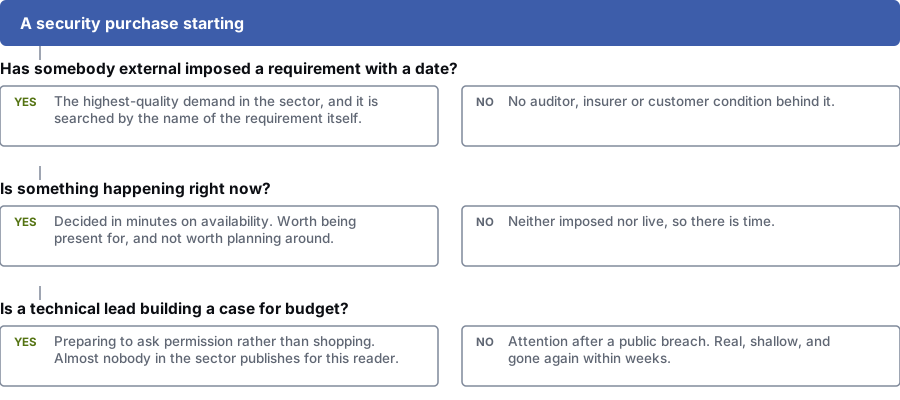
Has someone outside set a requirement with a date?
Yes: The best demand in the sector. Buyers search for it by the requirement’s name.
No: No auditor, insurer or customer condition behind it.
Is something happening right now?
Yes: Decided in minutes on availability. Worth being there for, not worth planning around.
No: Nothing imposed and nothing live, so there’s time.
Is a technical lead building a case for budget?
Yes: Getting ready to ask for sign-off before shopping. Almost nobody writes for this reader.
No: Attention after a public breach. Shallow, and gone again within weeks.
Where to spend
Spend on content strategy first, then digital PR
In the order we'd put them. Start at the top.
A publishing plan built around the four triggers
Audits, insurance conditions, customer assessments and regulatory deadlines start the search, so the publishing plan follows them, not a threat calendar. That means pages named after the requirement, written at the technical depth the reader expects, and open about what an engagement involves and where it stops.
Original research in place of borrowed statistics
Original findings, responsible disclosures and analysis of something your team found are the only assets here a competitor can’t copy. They earn coverage and citations, and show a technical reader your capability in a way no case study can.
Proof you can show when clients can’t be named
Confidentiality removes the usual evidence, so you organise the substitutes on purpose: a few clients who’ve agreed in advance to take reference calls, reviews on platforms buyers check, sector-and-size descriptions in place of logos, and accreditation records kept current and easy to verify.
What people search
Searches like “soc 2 compliance help”
A requirement has been imposed
Someone outside has set a condition with a date. The best demand in the sector, searched by the requirement’s name.
- soc 2 compliance help
- iso 27001 certification timeline and cost
- customer security questionnaire we cannot answer
- insurer requires multi factor authentication evidence
- pci dss self assessment questionnaire support
Scoping and buying a test
The buyer knows they need testing and can’t say what kind. Answering this in public qualifies the enquiry before the call.
- penetration test scope and cost
- red team vs penetration test difference
- what does a pen test report look like
- internal vs external network testing
- how often should we run a penetration test
Something is happening now
Small volume, instant conversion, decided on availability. Worth being there for, but not worth planning around.
- we think we have been breached who to call
- incident response retainer providers
- business email compromise investigation
- data breach notification obligations deadline
- emergency forensic investigation firm
Building the internal case
Searched by a technical lead getting ready to ask for budget. Almost nobody publishes for them.
- how to justify a security budget to the board
- vciso pricing and what it includes
- building a security programme from nothing
- security roadmap for a company with no security team
- what controls does cyber insurance require
These are example searches from keyword research and public search data. Before we suggest anything, we check how often people search for them in your area.
Your website
What your website must have
- How engagements are scoped, what changes the price, and what each type of exercise tests
- Accreditations, scheme memberships and assessor listings shown accurately, with the scope and expiry of each
- A sanitised sample report or a detailed description of the deliverable, since the report is what the client buys
- Named practitioners with certifications, published research and speaking history, in place of an anonymous capability page
- Your own security set-up: disclosure policy, a contact route for researchers, and a site that would pass inspection
- A clear statement of what an engagement doesn’t cover, which buyers read as a sign of competence
- A clearly signposted route for a live incident, because that buyer is reading while something’s on fire
- Framework and requirement pages named the way the buyer’s auditor or insurer names them
Measuring results
The numbers we report
These numbers show if your marketing brings in customers. Website visits alone don't.
- Qualified enquiries split by trigger: audit, insurance condition, customer assessment, incident or referral
- Scoping calls held, and the share that lead to a written proposal
- Engagements won, and your win rate against the competitors you meet
- Retainer and repeat-testing conversions, since a client’s value builds over several years
- Certification and readiness engagements completed, tracked until the client passes the audit
- Pipeline from panel, insurer and broker referrals, reported apart from direct demand
- Average engagement value by service line, so low-margin commodity testing shows up before it takes over
- Research and disclosure output linked to enquiries and inbound reference requests
The rules
What regulators expect
Testing without authorisation is a criminal matter in most jurisdictions. Scope, written permission and rules of engagement belong in the contract, not as an afterthought. Marketing that implies an engagement can start at once, or describes techniques as if used outside an authorised scope, causes a problem for the buyer’s legal team before it causes one for yours.
Client confidentiality here is stronger than in most sectors and usually lasts indefinitely after the engagement ends. Findings, environments, architecture detail, and often the relationship itself, are restricted. Proof has to come from research, method and accreditation, rarely from case studies. Where anything client-specific is published, written, scoped and dated permission is the minimum.
Accreditation and certification claims can be checked, and they are. Holding a scheme accreditation, employing people with a qualification, aligning to a framework, and being able to test against it are all different things. Buyers, insurers and assessor bodies check which one applies. Overstate it, and you get removed from lists it took years to join.
Statistics in this field are often recycled without a source. Using them hurts credibility and, in some markets, raises an advertising standards issue. Any figure you publish needs a verifiable, citable public source and a date. Without one, make the argument in words.
Some jurisdictions license or restrict offensive security services, incident response and forensic work. Several impose breach notification duties that shape what you can say publicly about an incident. Requirements differ across Canada, the US, the UK and the UAE. We flag anything that looks overstated, but confirming what your firm may claim in each market stays with you and your counsel.
Sources
Rules and where to read them
Each rule above, linked to the body that publishes it. Which ones apply depends on where you work. Rules change, so check the latest version.
- Makes unauthorised access to computer material a criminal offence.
- Computer Misuse Act s. 1
- Source: UK — Computer Misuse Act 1990, s. 1
- Makes accessing a protected computer without authorisation a federal offence.
- 18 U.S.C. § 1030
- Source: US — Computer Fraud and Abuse Act (Cornell LII)
- Personal data breaches must be notified to the regulator and, where high risk, to the people affected.
- GDPR Articles 33–34
- Source: EU — Regulation (EU) 2016/679, Arts. 33–34 (EUR-Lex)
Questions
Got questions about cybersecurity marketing?
Everyone in our market advertises with breach statistics. Should we?
No, and taste is only part of the reason. Most figures in circulation have no source, or come from vendor reports with obvious incentives. The buyer knows it, so using them signals you’re not technical.
What works is detail. Explain how you scope, what your report contains, what your own research found, and what an engagement won’t cover. That persuades a sceptical reader far more than a number they won’t believe.
We can’t name a single client. What proof can we show?
Published research and responsible disclosures, sanitised methodology and a sample deliverable. Add the certifications and scheme memberships you hold, the credentials and conference record of the testers who’d be assigned, and your own security set-up.
Alongside that, arrange references privately. A few clients who’ve agreed in advance to take a call from a prospect in a similar sector do more in a competitive selection than a logo wall — and it breaches nothing.
How do we get demand that isn’t somebody else’s emergency?
Market against the requirements, not the threat. Audits, regulatory deadlines, insurance renewals and customer security reviews create demand on dates that already exist, and buyers search for them by name.
Getting onto the panels and approved lists that insurers, brokers and assessor bodies keep matters just as much. For many engagements you’re either eligible or invisible, and eligibility comes from applications and paperwork — no campaign replaces it.
Should we publish prices for testing?
Publish how you price, even where you can’t publish a number. Explain what drives the cost: number of applications, external footprint, whether testing is authenticated, how much manual testing is involved, what the report includes. That answers the question the buyer was asking.
It also filters. A prospect who understands why a proper engagement costs what it does is a different conversation from one comparing an automated scan with a manual assessment on price alone.
How is this different from marketing a managed IT provider?
The buyer and the proof are different. An IT provider sells an ongoing contract to a business with no in-house technical team, mostly within a travel radius, chosen largely on trust and responsiveness.
A security firm usually sells a specialist engagement to someone technical, often alongside or checking up on an existing provider. It’s delivered remotely and gated by accreditation far more than geography. A security buyer wants to see method and research — response times matter much less.
Show me what to fix
Start with the free checkup. It shows what to fix first on your website, with no sign-up. Want the full plan for your cybersecurity business? Book a call, and we'll look at your market, your competitors and the searches that bring in customers.
Prefer to talk it over? Book a free call
Your BOOSTD score improves within 90 days, or your next month is free. After 6 months, more traffic or leads, or we keep working free (up to 6 free months in any 12 months). Read our guarantee
References
Sources for cybersecurity marketing
The official documents and research this page is based on. Platform rules change, so check the source before you act on a detail.
Related
More on cybersecurity marketing
Guides for cybersecurity
Other technology businesses
Last updated · Published by Zubair Afzal, responsible editor