
B2B SaaS marketing
B2B SaaS demand generation for committee buying and expansion
B2B SaaS demand generation for software a whole team buys: content for every approver, a faster security review and growth from existing accounts.

How they choose
How buyers choose between you and a rival
Know how they choose and you know where to show up.
- A group decides, and each member asks something different. The champion needs a case for change. The budget holder needs cost and risk. The technical owner needs integration details. The reviewer needs controls and evidence. The deal stops wherever someone has nothing to read.
- The strongest competitor is doing nothing. Staying with the current tool or spreadsheet needs no approval and carries no career risk. Material that shows the cost of standing still beats material listing your advantages over a named rival.
- Peer evidence beats vendor claims at every stage. Buyers ask people in similar roles, read community threads and increasingly ask an AI assistant to sum up what others say. So the view forming about you is built from sources you didn’t write.
- Existing integrations are a hard filter. If the product doesn’t connect to the systems the customer already relies on, the evaluation ends there, however much better everything else is.
- Larger buyers check security and compliance early, and mid-market buyers increasingly do too. A published certification status and a clear answer on where data is stored can move you from “being reviewed” to “shortlisted” before any sales call.
- Renewal is a new purchase decision with more information. Usage, support experience and whether the promised roadmap arrived all feed in. The promise made at signing shows up two years later as growth or shrinkage.
The competitor nobody prepares for
The hardest thing to beat is doing nothing
Every deal has a third option that costs nothing, needs no approval and carries no career risk. Most sales material argues against the wrong opponent.
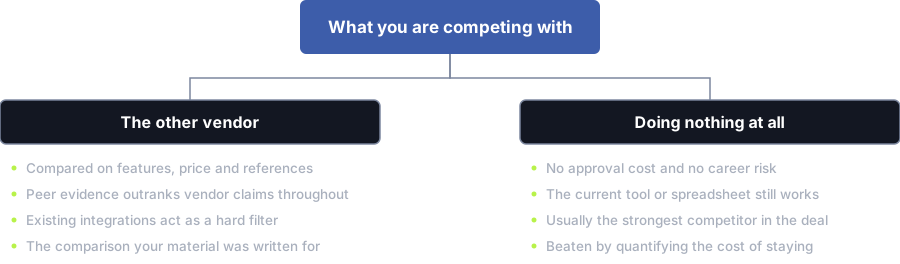
The other vendor
- Compared on features, price and references
- Peer evidence beats vendor claims throughout
- Existing integrations act as a hard filter
- The comparison your material was written for
Doing nothing at all
- No approval needed and no career risk
- The current tool or spreadsheet still works
- Usually the strongest competitor in the deal
- Beaten by showing the cost of staying put
What people search
Searches like “how to justify [category] budget to finance”
Building the internal case
Made by a champion who isn’t shopping yet. They’re preparing to ask permission.
- how to justify [category] budget to finance
- [category] roi calculation
- business case template for software purchase
- cost of not replacing [legacy process]
- how to run a software evaluation internally
Vendor risk and security review
Searched by a reviewer with a veto and no interest in your product. Almost nobody publishes for them.
- [vendor] soc 2 type ii status
- [vendor] sub-processors list
- [vendor] data residency options
- [vendor] penetration test summary
- standard security questionnaire responses [category]
Procurement and contracting
Where deals stall without anyone saying so. The material that unblocks them is rarely public.
- [vendor] terms of service liability cap
- [category] enterprise agreement negotiation
- software vendor onboarding requirements
- annual versus monthly billing software procurement
Fit, integration and rollout
Asked by the person who will own the tool after purchase. A common source of late objections.
- [product] [system of record] integration
- how long does [category] implementation take
- [product] user provisioning sso
- migrating from [incumbent] to [category]
- [product] admin permissions and roles
These are example searches from keyword research and public search data. Before we suggest anything, we check how often people search for them in your area.
Measuring results
Track the leads that pay
These numbers show if your marketing brings in customers. Website visits alone don't.
- Net revenue retention, shown next to new business in the same report
- Expansion revenue from existing accounts credited to marketing activity
- Account coverage: the share of target accounts with more than one engaged person
- Number of different roles engaged per open deal, since single-contact deals stall
- Qualified demos held with the right mix of committee members, not just demo count
- How long security and procurement reviews take, tracked as a cycle time marketing can shorten
- Pipeline and won deals split by contract size, never blended across sales processes
- Cost of winning recurring revenue, judged against profit contribution, not booking value
Common problems
B2B SaaS marketing problems to fix first
B2B software isn’t consumer software with a longer signup form. The person who wants your product can’t buy it alone, and the people who can stop them will never visit your homepage.
B2B SaaS demand generation has to work with that: a group approves the purchase, a review nobody warned you about delays it, procurement negotiates it, and then it grows or shrinks over the next three years. Self-serve, trial-led products are covered on the SaaS marketing page instead.
- The deal disappears after the champion is convinced.
- The demo goes well, the champion is keen, and then nothing happens for five weeks. Inside the customer, a business case goes to a finance approver, whoever owns the affected systems reviews it, and someone responsible for vendor risk gets involved. None of them received anything from you. Deals rarely stall because the champion lost interest. They stall because the champion ran out of material.
- Security review arrives as a surprise and costs six weeks.
- A questionnaire arrives with a hundred and forty questions on access control, encryption, sub-processors, breach notification and business continuity. An engineer answers it between other jobs, sends it back incomplete, and gets more questions. Companies that publish this information in advance take that whole phase off the critical path. Reviewers find them directly, which is faster for everyone.
- Procurement asks for documents marketing has never seen.
- Insurance certificates, proof of financial stability, data processing terms, accessibility statements, supplier codes of conduct and customers you may name as references. Buyers ask for these routinely. Sellers treat them as an interruption. Having them ready and consistent is worth more in a competitive deal than another feature comparison, because it shows you’ve done this before.
- Growth is reported as new logos while the base leaks.
- New customers are visible, well tracked and celebrated. Losses, such as seats removed at renewal, downgrades and quiet cancellations, are reported elsewhere, later, by another team. A business adding good new revenue and losing nearly as much from existing customers looks like growth in one report and flat in another. Marketing usually works from the first report.
- One sales process is stretched across very different deal sizes.
- Self-serve signup works for a team buying five seats on a card. It can’t handle a two-hundred-seat purchase needing legal review, single sign-on, a security assessment and an invoice. One process for both either adds friction for small customers who would have bought alone, or gives large buyers a process their organisation can’t accept.
Where to spend
B2B search first, then content and PR
In the order we'd put them. Start at the top.
Ranking for the questions each reviewer asks
Business case searches, integration questions, rollout timelines and vendor risk queries come from people who never look at a homepage. Publishing well for them puts your answer in front of the people who hold a veto. The ground is open, because almost every competitor writes only for the champion.
A trust centre and proof a committee can quote
A public page with certification status, sub-processors, data location, uptime history and a completed standard questionnaire takes a whole phase out of the sales cycle. Original data and named authors give your champion something credible to attach to the case they must defend internally.
Measurement that covers retention and expansion
We connect your marketing tools, CRM, product usage and billing, so revenue splits into new, expansion and losses. Until then, marketing chases the half of the business it can see. In a seat-based model that is often the smaller half.
Your website
What a good site does
- A trust centre anyone can reach without a sales call: certification status, sub-processors, data location, uptime history
- A completed standard security questionnaire available on request, and a public note saying so
- Procurement documents ready and consistent: data processing terms, insurance, business continuity, accessibility
- A page for each seat on the committee, alongside the pages for the champion
- Integration pages with real detail for each core system, since a missing connector ends the evaluation
- Setup and onboarding described clearly, including what the customer must supply and how long it takes
- Pricing that fits how the purchase is approved: contract terms, seat structure and what moves a customer up a tier
- Named customer references cleared for publication, with permission recorded, never presumed
- A path for existing customers that avoids sales pages, because expansion starts with people already inside
The rules
Stay inside the ad rules
Security and certification claims must be exactly right, and the differences matter commercially. Holding a completed audit report, being mid-audit and following a framework without an audit are three different things. A buyer’s risk team will ask for proof of whichever one you claimed. Overstating it can end a deal at the last stage, and people remember.
Your contracts decide whether you can name a customer or use their logo. Many agreements restrict public mention of the relationship. Some need written approval for each use, and buyers in regulated sectors often refuse entirely. Record each permission with a date and scope. Never assume it from a friendly chat.
Material you receive during procurement usually comes under confidentiality. Questionnaire answers, architecture documents, tender material and pricing benchmarks can’t be reused in marketing, even if nothing sensitive is quoted. The restriction often lasts after the engagement ends.
Accessibility conformance is becoming a procurement requirement, especially for public sector and large company buyers. The standard differs by country. If you sell into those markets, the product and the marketing site both need to meet it, and you need to be able to prove it.
Claims about automated or AI-driven features face growing scrutiny in several markets, including rules on disclosing how customer data is used. Describe what the product does today, not what is planned, and have your own lawyers review it.
Sources
Go to the source
Each rule above, linked to the body that publishes it. Which ones apply depends on where you work. Rules change, so check the latest version.
- Sets the accessibility standards for information technology procured by US federal agencies.
- Section 508, 36 CFR 1194
- Source: US — Section 508 standards, 36 CFR Part 1194 (eCFR)
- Sets accessibility requirements for listed products and services sold in the EU, including e-commerce.
- EU Accessibility Act
- Source: EU — Directive (EU) 2019/882 (EUR-Lex)
- People must be told the purposes of processing when their personal data is collected.
- GDPR Article 13
- Source: EU — Regulation (EU) 2016/679, Art. 13 (EUR-Lex)
Questions
What people ask about B2B SaaS marketing
Our deals stall after the demo. What should marketing produce?
Material for the people your champion has to convince. That usually means four things: a cost and risk summary for the budget holder, an architecture and integration note for the technical owner, a security and controls pack for the reviewer, and contract and reference details for procurement.
Most companies have one of the four. The deal then stops at whichever person has nothing. It gets recorded as a lost deal, so the missing content never gets written.
Should we publish our security documentation publicly?
Publish what doesn’t need gating: certification status and dates, sub-processor list, data location options, uptime history, and a summary of how you handle access and incidents. Keep the full report and penetration test details available on request.
You gain twice. Reviewers find answers without waiting for your team, so the questionnaire phase gets much shorter. And search puts it in front of exactly the person who would otherwise delay your deal.
We focus on expansion but are measured on new business. Now what?
Change what gets reported first, then what gets done. Split revenue into new, expansion and losses, with retention next to acquisition. That usually reframes the conversation, because the net number often looks very different from the gross.
Then the work follows: adoption and onboarding material, content for nearby teams inside existing customers, and campaigns triggered by product usage. It builds up in a way acquisition doesn’t.
We sell self-serve and to larger organisations. Should the marketing be split?
Split the sales processes and keep one brand. Below a certain contract value, a human sales process can’t pay for itself. Above it, a self-serve path can’t meet the review and contract needs that come with the money.
What works is a self-serve route that stays self-serve, a separate route for larger buyers, and a clear handover point set by seat count or contract value.
Our market is a few hundred companies. Is that too small for marketing?
No, but it rules out volume thinking. With a list that size, the goal is coverage of the accounts and the roles inside them. Search volume becomes a poor guide, because twenty of the right searches a month can be a strong channel at enterprise contract values.
It also changes measurement. Judge that programme on lead count and it will look like a failure. Engaged roles per account and places in evaluations show what is happening.
How is this different from your SaaS page?
The SaaS page covers software products in general, including self-serve products one person can buy alone. This page covers the narrower case where a team buys, a committee approves and a review process stands in the way.
The difference is where the effort goes. A self-serve business works on removing friction between a visitor and first use. A committee sale works on material for people who will never touch the product, and on the retention and expansion revenue that comes after the first contract.
Get a free website check
Start with the free checkup. It shows what to fix first on your website, with no sign-up. Want the full plan for your B2B SaaS business? Book a call, and we'll look at your market, your competitors and the searches that bring in customers.
Prefer to talk it over? Book a free call
Your BOOSTD score improves within 90 days, or your next month is free. After 6 months, more traffic or leads, or we keep working free (up to 6 free months in any 12 months). Read our guarantee
References
Sources for B2B SaaS demand generation
The official documents and research this page is based on. Platform rules change, so check the source before you act on a detail.
Related
More on B2B SaaS marketing
- SaaS marketing for self-serve and trial-led products
- SEO for SaaS companies
- pipeline for a committee sale
- selling to large organisations
Guides for B2B SaaS
Other technology businesses
Industries close to B2B SaaS
Last updated · Published by Zubair Afzal, responsible editor