
SaaS SEO
SaaS SEO that brings in trials and demos
SaaS SEO judged on trials and demos, not traffic. We build comparison and alternatives pages first, then category pages, then early-stage content.
Your free checkup
ExampleScore 58 out of 100. Could reach 74
Tap a check to see what we’d fix first. Anything big waits for your approval.
Google Business ProfileNeeds work
Pick the main category people search for and list every service you offer.
Mentioned in AI answersMissing
Answer the questions customers ask, clearly, on the pages AI tools read.
Speed on phonesGood
Nothing to fix now. We keep an eye on it as you add pages.
Pages Google can findGood
All found. New pages get linked from your menu so they stay that way.
In every planIncluded in Local or Growth, from $149 a month. Every plan has every feature; they differ by size.
Compare plansWhere the money is
The three stages a SaaS buyer goes through
Struggling software content programmes are usually heavy at one stage and empty at another.
| Dimension | Bottom of funnel | Middle of funnel | Top of funnel |
|---|---|---|---|
| What the searcher is doing | Choosing between named tools, often from a shortlist. | Working out what kind of tool solves the problem and what good looks like. | Trying to solve the problem, maybe without buying anything. |
| Typical page | You versus a named competitor, alternatives to a competitor, a pricing explainer, an integration page. | Category explainer, buying guide, evaluation checklist, list of requirements. | How-to guide, template, calculator, glossary entry. |
| Search volume | Small | Moderate | Large |
| What to measure it on | Trials and demo requests started from the page. | Assisted conversions, and readers moving on to late-stage pages. | Email sign-ups, return visits and later assists. Never direct sign-ups. |
| How it usually goes wrong | It never gets built, because naming competitors felt awkward. | It reads like a keyword essay with no view on how to choose. | Lots gets published, it is judged on visits, and it gets mistaken for the whole programme. |
| If this is all you have | Pages convert well, but you run out of searches quickly. | You look credible but never make the shortlist. | Your board likes the traffic chart but not the pipeline number. |
The searches that matter
What software buyers search before they decide
Example patterns, not volume claims. Most software companies avoid the first group, and it converts best.
Comparison and alternatives
Late-stage, low volume, and the highest-intent searches in your category. Someone is already answering them about you.
- competitor name alternatives
- tool a vs tool b for small teams
- is competitor name worth the price
- cheaper alternative to enterprise tool
- competitor name reviews from actual users
Category and evaluation
The searcher knows they need to buy something but has not picked what. A clear view on how to choose wins here.
- best tools for revenue forecasting
- what to look for in a compliance platform
- requirements checklist for choosing a helpdesk
- open source versus commercial options for this
Integration and technical fit
Often an engineer or admin who can block the purchase but rarely appears in a marketing persona.
- does this integrate with our accounting system
- api rate limits for this platform
- export data from legacy tool into new system
- single sign on support for this product
The problem before the category
Where a new category starts to catch on. These people do not know your category name and would not search for it.
- how to stop spreadsheet version conflicts across a team
- why do our monthly reports take three days
- manual process for tracking renewals template
These are example searches from keyword research and public search data. Before we suggest anything, we check how often people search for them in your area.
Two decisions teams often get wrong
Programmatic pages and where your content should live
Programmatic content earned a bad name when it meant pushing city names through a template. The data behind generated pages decides whether they are useful. Four hundred integrations, each with setup steps, field mappings, limits and a screenshot, make four hundred useful pages.
If only a name in the heading changes, you have built what Google calls scaled content abuse. We check the data before recommending this, and more often than not the answer is no.
The second decision is where things live. Software companies end up with a marketing site, app, docs, community, status page and blog, each on whichever domain a team could set up fastest. Every split weakens internal linking and spreads authority thin.
The rule: anything a prospect might read before buying belongs on your main domain. Anything only logged-in customers see can live wherever is easiest. Docs and help centres sit in the middle and deserve a proper discussion, because they are often the most linked-to content a software company has.
The same method, two results
One build process can make useful pages or spam
The method is the same in both columns. The data behind the pages separates them, so we check it before recommending anything.
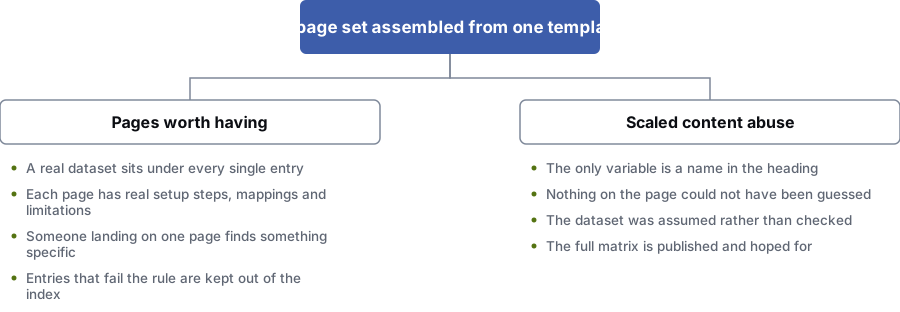
Pages worth having
- Useful data sits behind every entry
- Each page has setup steps, mappings and limits
- Someone landing on one page finds something specific
- Pages that fail the quality rule stay out of the index
Scaled content abuse
- The only thing that changes is a name in the heading
- Nothing on the page is new to the reader
- Nobody checked the data before building
- Every possible page is published in the hope it works
What we do
How we run SaaS SEO, starting from the bottom of the funnel
The reverse of how most content programmes are built, on purpose.
Late-stage pages
Comparisons, alternatives, pricing explainers, use cases and integrations. Small volume and hard to write well, but they tend to bring in a large share of organic trials.
Product-led content
Content where the next step is inside the product: a free tool, a template that opens in the app, or a calculator with a result worth saving.
Programmatic pages with a quality check
Where there is good data, we build generated pages with a written rule for what makes each worth publishing. Pages that fail the rule stay out of the index.
Keeping the library in shape
Most software companies need to review the articles they have, not write more: which to update, merge, redirect or remove. Some attract readers who will never buy and outrank the pages that would convert.
How we work
What we commit to on a software account
What we commit to
- Reporting on trials, demos and qualified pipeline, with visits as background
- Writing comparison pages that say when a competitor is the better fit
- Checking the data before recommending programmatic pages, and saying no when it is thin
- Recommending that pages be removed or merged when they cost more than they earn
- Working from the same positioning document your product marketing team uses
- Telling you when people search for something your product does not do
What we will not do
- Publish generated pages where only a word in the heading changes
- Write competitor comparisons that misrepresent what the competitor does
- Chase searches from people who could never buy your product
- Judge a six-month sales cycle on last-click numbers and call it the full picture
- Promise a trial or pipeline number before we have sized the demand
Questions
What growth leads ask before starting
Why is our blog traffic not turning into trials?
Usually because the articles answer questions people ask months before they buy. Someone searching a general how-to question is not ready for a trial, so there is no sensible next step on the page.
Better versions of those articles rarely fix it. Build the late-stage pages (comparisons, alternatives, integrations and use cases) and let the early-stage articles point readers to them.
Should we publish comparison pages against named competitors?
Yes, if you can. Someone is already answering those searches, usually a competitor, an affiliate review site or a forum thread. Staying out does not keep you out of the comparison. It just means you have no say.
The pages that work admit when the competitor is the better choice. That makes the rest believable and filters out trials that were never going to convert.
Is programmatic SEO safe?
It depends on the data behind it. Pages built from a dataset people want, such as every integration you support, every template in your library or the rules in every region you serve, are useful pages.
Pushing city names or job titles through a template with nothing behind them is what Google calls scaled content abuse. The method is the same; the data decides which one you have built.
Our category does not exist yet. Can SEO work?
Not for the category name, because nobody searches for a term they have never heard. But people still do the job an older, painful way, and they search for that all the time.
So we target searches about the problem, the workaround and the tool people use today. Search catches demand that already exists. The category itself gets built through channels that reach people who are not searching.
Should content live on our marketing site or on the app subdomain?
On your main domain wherever your platform allows it. That is where your authority sits, and splitting content weakens internal links.
A help centre or community on a third-party tool that only supports a subdomain is fine. The problem is a marketing site, blog and help centre on three domains with no links between them.
See who shows up when people compare you
Before the call, we check what ranks for your brand name plus "alternatives", "vs" and "reviews". It is usually a competitor or an affiliate site, which tends to settle the debate about building those pages.
Prefer to talk it over? Book a free call
References
Sources for SaaS SEO
The official documents and research this page is based on. Platform rules change, so check the source before you act on a detail.
Related
More on saaS SEO
- what moves an SEO timelineThe factors that set how fast search results come.
- SEO for buying committeesMost software bought above a certain price is a group decision.
- SaaS marketing beyond search
- improving trial conversionOrganic visits are wasted if people drop out of the signup flow.
- expanding into new marketsSoftware companies usually face this decision earlier than most.
- building B2B pipeline
- B2B SaaS demand generationPaid, outbound and pipeline work that runs alongside search.
- how the platform works for software companies
Where saaS SEO matters most
More SEO services services
Last updated · Published by Zubair Afzal, responsible editor