
Enterprise Organisations marketing
Enterprise marketing for when the constraint is the organisation, not the market
Large organisations rarely fail at marketing for want of budget or ideas. They fail because three units count leads differently, procurement takes a quarter, security reviews the vendor before anyone reviews the work, and legal sees the copy last.
Prefer to talk it through? Book a strategy call
Measurement
Enterprise numbers we report on, and what we ignore
Sessions are not on this list. These are the numbers that tell you whether the marketing is producing customers.
- Qualified opportunities created by business unit, against one agreed definition
- Pipeline and closed revenue by first touch and by assisted touch, reported side by side
- Account coverage: the share of target accounts with more than one engaged stakeholder
- Number of distinct roles engaged per opportunity, since single-threaded deals stall
- Time from first engagement to shortlist inclusion, and to contract award
- Security and procurement review duration, tracked as a marketing-relevant cycle time
- Share of relevant tenders and framework opportunities you were invited into
- Contribution to renewal and expansion revenue, not only to new logos
What usually goes wrong
Where enterprise marketing tends to fail
Large organisations do not usually have a marketing problem in the ordinary sense. They have budget, they have people, and somebody in the building already knows what should be done.
What they have instead is an organisation between the decision and the outcome: units that measure differently, reviewers who arrive late, a procurement process that predates the work, and a roster of suppliers with gaps between them. That is the material this page is about.
- Every business unit reports a different number.
- One unit counts a lead at the point a form is completed, another at the point a salesperson accepts it, a third at the point an opportunity is created. Each set of numbers is internally consistent and none of them can be added together. The consequence is not just poor reporting: budget gets allocated on the basis of whichever unit defines success most generously, and the units doing harder work with tighter definitions are penalised for it.
- Security review happens after the commercial conversation.
- A supplier is selected, terms are agreed, and only then does an information security questionnaire arrive asking about data residency, sub-processors, access controls and breach notification. Weeks disappear, sometimes the engagement dies, and the marketing team is left explaining a delay they had no visibility of. Bringing that review forward costs nothing and routinely saves a quarter.
- Legal receives the work at the end and removes the argument.
- A campaign is written to be persuasive, sent for review, and returned with every specific claim softened into something nobody would dispute or act on. The reviewers are doing their job correctly; the process put them in the wrong place. Claim boundaries agreed at the briefing stage produce material that is both defensible and worth reading, and they turn review into a check rather than a rewrite.
- The roster has gaps nobody owns.
- A brand agency, a media agency, a systems integrator and an internal platform team each own part of the estate, and the work that falls between them belongs to nobody. Site architecture, structured data, the technical quality of campaign landing pages and the measurement layer are the usual casualties, because each party can reasonably say it is not their scope. This is a contracting problem that presents as a performance problem.
- Marketing is reaching the champion and nobody else.
- Enterprise purchases are approved by a group, and most enterprise marketing addresses exactly one member of it. The champion gets a case for change; the economic buyer gets nothing on cost and risk, the security reviewer gets nothing on architecture, procurement gets nothing on contract terms and continuity. Deals then stall at whichever seat has no material, and the pipeline report describes it as a lost opportunity rather than a content gap.
Search behaviour
Enterprise searches, grouped by intent
Requirement framing by the champion
Made early, usually while building an internal case rather than while shopping.
- how to build a business case for [category]
- [category] implementation timeline enterprise
- total cost of ownership [category]
- replacing [incumbent system] risks
- [category] rfp requirements template
Risk, security and assurance
Searched by reviewers who will never speak to a salesperson and whose approval is nonetheless required.
- [vendor] soc 2 report request
- [vendor] data processing agreement
- vendor risk assessment questionnaire [category]
- [vendor] sub-processor list
- accessibility conformance report vpat [category]
Procurement and commercial terms
The seat almost nobody publishes for, and a common place for deals to stall silently.
- [vendor] master services agreement terms
- enterprise pricing [category] negotiation
- [category] supplier framework agreement
- vendor onboarding requirements checklist
Vendor comparison and reputation
Where a committee assembles its view from sources you do not control.
- [vendor] vs [vendor] enterprise
- [vendor] customer references
- analyst report [category] leaders
- is [vendor] financially stable
- [vendor] implementation problems
These are examples of how customers in this market search, drawn from keyword research and public search data. They are illustrative, not a volume claim: we size the demand in your area before recommending anything.
Buying behaviour
How enterprise customers decide
Strategy follows this, not the other way round. Everything on this page is downstream of how the decision gets made.
- The buying group is larger than anyone plans for, and several of its seats will never speak to a supplier at all. A deal moves at the pace of whichever one has been served worst, and that is rarely the person the sales team is talking to.
- Incumbency is the strongest force in the room. Doing nothing carries no career risk, so a challenger competes against the cost and disruption of change rather than against another supplier. Quantifying what the current arrangement costs does more work than describing a better one.
- Risk avoidance beats upside for most of the committee. Only the champion is rewarded for a good decision; the reviewers are exposed solely when something goes wrong, so stability, certifications and checkable references carry disproportionate weight.
- Formal processes decide the shortlist before persuasion begins. Approved supplier lists, framework agreements, tender thresholds and existing master agreements determine who may be considered at all, and a supplier not on the relevant list is frequently excluded without ever being evaluated.
- Analyst coverage, peer reference and what a search or an AI assistant returns about you all function as pre-screening. Several members of the committee will form a view without contacting you, and that view is assembled from whatever is publicly available, including material you did not write.
- Procurement negotiates on the parts marketing never sees. Payment terms, liability caps, service credits and exit provisions can decide an award between two technically equivalent suppliers, which makes having those documents ready a competitive advantage.
The seats that never call
Most of the buying group will never speak to you
A deal moves at the pace of whichever seat has the least incentive to move. Several of those people will form their entire view of you from material you will never see them read.
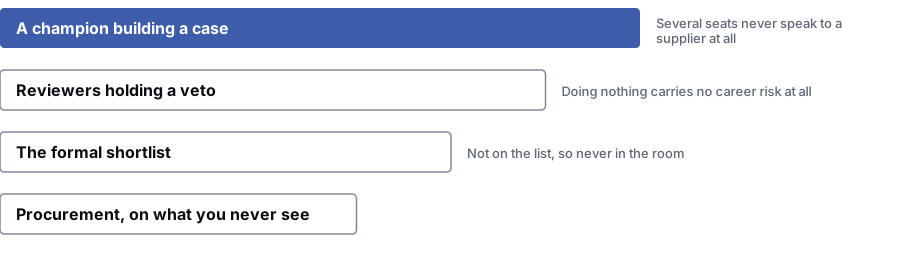
- 1A champion building a case — Made early, while an internal argument is being written rather than while anybody is shopping. The buying group is larger than anyone plans for.Several seats never speak to a supplier at all
- 2Reviewers holding a veto — Risk, security and assurance, searched by people who are exposed only when something goes wrong. Only the champion is rewarded for a good decision.Doing nothing carries no career risk at all
- 3The formal shortlist — Approved supplier lists, framework agreements, tender thresholds and existing master agreements decide this before persuasion begins.Not on the list, so never in the room
- 4Procurement, on what you never see — Payment terms, liability caps, service credits and exit provisions can decide an award between two technically equal suppliers.
Where the money goes
The enterprise marketing channels that earn their place
In priority order for this business, not a menu. Anything not on this list is something we would need a specific reason to recommend.
Coverage of a named list, seat by seat
When the realistic market is a few hundred organisations, the objective is not reach but presence across every relevant seat in each account. That means knowing which roles hold a veto, producing something for each of them, and measuring account engagement rather than form volume. It is the only approach that matches how the purchase is made.
Being findable while you are not in the room
Most of the committee will research without contacting you, and several of them are searching for assurance and commercial detail rather than for your value proposition. Organic coverage of those questions puts your own material in front of people the sales team will never meet, on a site large enough that this is a delivery exercise as much as a content one.
Reaching the seats that never search
Finance, security and procurement stakeholders rarely search for a category and cannot be reached through demand capture. Targeting by organisation and role puts a relevant message in front of them during an evaluation they are part of but not driving, which is frequently the difference between a stalled deal and a progressing one.
Proof a committee is willing to cite internally
Somebody has to defend this decision to a steering group. What helps them is material with standing: original data, a documented method, named authorship and third-party coverage. That is a different asset class from campaign content, it takes longer to produce, and it does work no advertising can substitute for.
One definition of a lead across every unit
Before anything else can be judged, the organisation needs a single agreed measurement model: what counts, at which stage, recorded where, and reconciled with the systems finance uses. This is routine, politically difficult and the precondition for every budget conversation you will have for the next three years.
The website
What an enterprise website has to do
- A trust centre carrying certifications, sub-processors, data residency and current status, reachable without a sales conversation
- Procurement-ready documents available on request and referenced publicly: processing terms, insurance position, business continuity, accessibility conformance
- A page written for each seat on the buying committee rather than one page written for the champion
- Regional structure that reflects where you contract, including the legal entity a customer would be signing with
- Accessibility conformance treated as a procurement requirement, because in public sector and regulated buyers it is one
- Customer references and named proof cleared for publication, with the permission recorded rather than assumed
- Facts an analyst or journalist would need, published somewhere findable rather than supplied by email each time
- A clear route for an existing customer to find expansion and support information without passing through acquisition content
Constraints
Enterprise advertising rules: what is allowed, and what is not
Advertising claims made by a large organisation attract scrutiny that a small business never encounters. Competitor comparisons, performance claims, environmental and sustainability language and anything implying an outcome usually require substantiation held on file, and in several markets regulators have become notably more active about the last of those. We write to a claim standard agreed with your legal team at the start rather than defending sentences one at a time at the end.
Accessibility is a procurement gate, not only a design preference. Public sector and many regulated buyers require conformance evidence for digital estates, and the applicable standard differs by jurisdiction. Where you sell into those markets, the site and its campaign pages need to meet the relevant requirement and be able to demonstrate it.
Data protection obligations vary by region and shape measurement design as much as copy. Consent requirements for analytics and advertising, cross-border transfer terms and retention rules differ across the EU, the UK, Canada, Australia and the Gulf states, and they are decided at the start of an engagement because retrofitting them means rebuilding the reporting.
Listed companies carry an additional constraint that catches marketing teams out. Statements about future performance, unannounced products or financial expectations can engage disclosure rules, and material issued in a quiet period is treated differently. Anything in that territory goes through your investor relations and legal functions, not through us.
These are descriptions of the kinds of constraint we design around, not legal advice. Requirements differ by market and by sector regulator, and confirming what applies to your organisation remains with your own counsel and compliance function.
Primary sources
The enterprise rules above, at source
The rules this page refers to, linked to the regulator or rule-maker that publishes them. Which apply depends on where you operate, and they change, so check the current version.
- Environmental marketing claims must be qualified and substantiated so they do not deceive.
FTC Green Guides
Environmental marketing claims must be qualified and substantiated so they do not deceive.
- Environmental claims must be truthful, clear, substantiated and must not omit material information.
CMA Green Claims Code
Environmental claims must be truthful, clear, substantiated and must not omit material information.
- Restricts offers of securities before a registration statement is filed, the basis of the quiet period.
Securities Act § 5
Restricts offers of securities before a registration statement is filed, the basis of the quiet period.
Questions
Enterprise marketing questions, answered
Our three business units cannot agree on what a lead is. Where do we start?
With a definition exercise before any campaign work, however unappealing that sounds. Agree the stages, what evidence moves a record from one to the next, which system holds the truth, and how it reconciles with what finance reports.
It usually takes a few weeks and it is the highest-return work available, because until it exists every budget conversation is an argument about whose numbers are right rather than about what to do next.
Can a smaller agency get through our procurement and security review?
Frequently yes, and the way to find out is to start the review early rather than after selection. The common blockers are insurance levels, data processing terms, sub-processor disclosure and evidence of access controls, all of which are answerable in advance.
What we will not do is claim a certification we do not hold in order to clear a gate. If a requirement rules us out, that is better established in week one than in month four.
We already have an agency of record. What would you actually do?
Usually the work that falls between the roster contracts. Site architecture, search, structured data, landing page quality and the measurement layer often belong to nobody in particular, because each supplier can reasonably say it is outside their scope.
That means our first task is to map who owns what and say plainly where we would and would not add anything. Adding a supplier to a crowded roster without a clear boundary creates coordination cost and little else.
How do you produce anything persuasive when legal reviews every word?
By moving the review to the front. Rather than negotiating each asset, we agree once what can be stated as fact, what needs a qualifier, what requires a named source, and which subjects need a specialist reviewer.
Inside an agreed boundary, work clears quickly and keeps its argument. Outside it, everything is negotiated twice and the version that survives is the version nobody remembers reading.
Our sales cycle is eighteen months. How would we know this is working?
Not from pipeline in the first two quarters, and anyone promising that is describing a different business. Early indicators that are open about what they are: coverage of the target account list, the number of distinct roles engaged per account, inclusion in shortlists and tenders, and how far conversations progress.
Alongside that, agree in advance when the programme can fairly be judged and what would count as failure. Setting that at the start is what prevents a programme being cancelled one quarter before the deals it created would have closed.
Find out what is winnable for your enterprise business
Start with the free Growth Scan: an indicative read of your website and the few things to fix first, with no sign-up. BOOSTD is in early access, so the fuller picture for your enterprise business — your area, your competitors and the searches that matter — is worked through with our team on a strategy call. If we do not think we can move it, we will tell you.
Prefer to talk it through? Book a strategy call
If we don't deliver the work we agreed to deliver for reasons within our control, you don't pay for the undelivered work. Read our guarantee
References
Sources
The primary documents and published research this page relies on. Platform rules change, so check the source before acting on a detail.
Related
Where to go next
More to explore
Guides that answer the same questions
Last updated · Published by Zubair Afzal (responsible editor), on owner authorisation