
Enterprise SEO
Enterprise SEO that gets fixes shipped on large sites
Enterprise SEO for large sites. We turn findings into sprint-sized tickets and get them through release, brand and legal review.
Your free checkup
ExampleScore 58 out of 100. Could reach 74
Tap a check to see what we’d fix first. Anything big waits for your approval.
Google Business ProfileNeeds work
Pick the main category people search for and list every service you offer.
Mentioned in AI answersMissing
Answer the questions customers ask, clearly, on the pages AI tools read.
Speed on phonesGood
Nothing to fix now. We keep an eye on it as you add pages.
Pages Google can findGood
All found. New pages get linked from your menu so they stay that way.
Managed SEODone by our specialist team on top of the platform, with a monthly meeting and a price agreed with you.
See Managed SEOWhat slows large sites down
Why enterprise SEO fixes rarely reach the live site
Most large organisations already know what is wrong with their site. What they lack is a way to get the fixes live.
Enterprise audits are often correct and rarely delivered. Nobody turned the findings into tasks that a development team, a brand team and a regional stakeholder would each accept.
So we spend less time finding problems and more time writing specs, planning the order, managing stakeholders and getting changes into releases.
Where fixes get stuck
Five reasons SEO fixes never go live
- The recommendation was never written as a task.
- A spreadsheet row that says "improve internal linking" has no owner, no size and no acceptance criteria. Developers cannot pick it up, so it sits in the backlog until the next audit finds it again.
- Four teams own different parts of the same page.
- The header is a shared component, the content comes from a content team, product data from a service owned elsewhere, and legal controls the footer. One ticket is four negotiations. Knowing this up front is the difference between a six-week change and a six-month one.
- It missed the release.
- Large organisations ship on a schedule with cut-offs, freezes and regression tests. Miss two cut-offs and a quarter has gone. Planning around the release calendar is worth more than a perfect priority order.
- Brand or legal review watered it down.
- A page goes into review specific and useful, and comes out approved but vague. Reviewers were asked to approve wording before anyone agreed the limits, so every sentence became its own negotiation.
- A platform change undid it.
- A component library upgrade changes heading levels site-wide. A cookie banner blocks rendering. A cache serves an old canonical tag. None of it shows until organic results drop, by which time the release that caused it is three sprints back.
Why the same fix ships or stalls
Two routes the same SEO fix can take
The change is identical in both columns. What differs is what it is attached to, usually decided in the first two weeks.
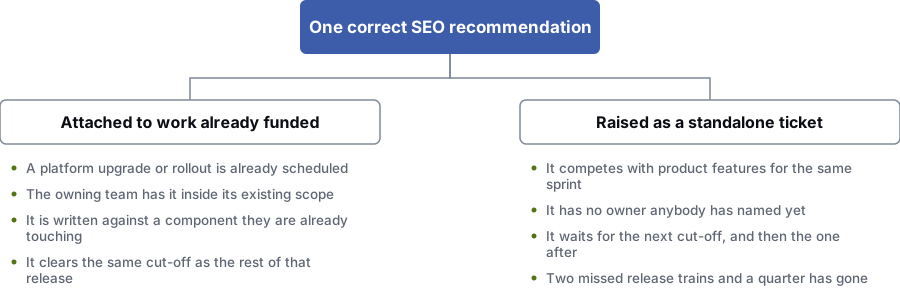
Attached to work that already has budget
- A platform upgrade or rollout is already planned
- The owning team already has it in scope
- It is written against a component they are already changing
- It meets the same cut-off as the rest of that release
Raised as a standalone ticket
- It competes with product features for the same sprint
- Nobody has been named as its owner
- It waits for the next cut-off, and then the one after
- Two missed releases, and a quarter has gone
How we work
How we get SEO changes through a large organisation
People and process come first. Most programmes leave them until they block progress.
Map who can say yes and who can say no
Before any technical work, we find the owner of each template, component, service and content area, how they approve changes and which release calendar they follow. This takes two weeks and saves months.
You get: A decision map with owners, approval steps and release dates
Find a funded release to join
There is almost always something already planned, such as a platform upgrade, a design system refresh or a regional rollout. SEO requirements attached to funded work ship far more often than standalone tickets.
You get: A plan sequenced to fit your existing roadmap
Write specs your developers can build
Each item fits in a sprint, is written against the component or template it changes, and includes acceptance criteria, test cases and what happens if it is skipped. In the format your teams already use.
You get: Sprint-ready specs in your own ticketing system
Agree review limits once
One session with brand, legal and compliance to agree what can be said and how, written up as a guide new starters can follow.
You get: An approved claims and review guide
Add a pre-release check
A short automated and manual check before every release covers redirects, canonicals, robots rules, structured data, headings and rendering. It catches the decline large sites cause with their own releases.
You get: A pre-release checklist built into your deployment process
Standardise reporting, then train the team
One definition of organic performance, one Search Console setup and one reporting schedule across markets. Then documents and training so the standard holds after we leave.
You get: A measurement framework and training materials for your team
Our commitments
What working with us looks like on a large site
What we commit to
- Writing every recommendation so your developers can pick it up and size it
- Working inside your release process, without asking for exceptions
- Naming the owning team for every item before it goes into a backlog
- Telling you when a fix is not worth the effort it takes to deliver
- Writing standards down so they survive staff changes on both sides
- Giving your in-house team the credit and the evidence when the idea was theirs first
What we will not do
- Hand over a four-hundred-row spreadsheet and call it a strategy
- Recommend changes your platform clearly cannot support
- Go around your governance to push a change in faster
- Report different numbers to different business units to make each look better
- Promise a traffic or revenue result before we understand what limits delivery
What we run
The four parts of an enterprise SEO programme
Platform
Templates, components, rendering, crawling, sitemaps and indexing across millions of URLs. Changes here are slow and far-reaching, so we write detailed specs.
Governance
The standards, review steps and owners that stop new problems appearing faster than old ones are fixed. Without this, a programme spends all its time cleaning up.
Measurement
One agreed set of organic numbers. On large sites, the biggest reporting problem is four teams showing different versions of the same quarter.
Training
Documents, training and templates so regional teams and new starters do the right thing by default, long after we stop being involved.
Questions
What digital leaders ask before they start
We already have an in-house SEO team. What would you add?
Two things: capacity for tasks that never reach the top of an internal list, and the weight of an outside view. In-house teams are often right and unheard, and a written outside view can move a decision stuck for a year.
We work as part of your team, giving your in-house lead evidence, specs and time back. We will not duplicate what they already do well.
How do you get SEO work into a full development backlog?
We write tickets your developers will take on: sprint-sized, written against a component or template, with acceptance criteria, test cases and a note of what breaks if it is skipped.
We also attach SEO fixes to releases that already have budget. A requirement bundled into a redesign or platform upgrade ships far more often than a standalone ticket.
Our platform is old and cannot do half of what agencies recommend.
That is common. First we separate what the platform cannot do from what nobody has tried yet. The second list is usually longer than people expect.
For real limits, we compare the cost of a workaround with the cost of living with it. The answer might be an edge setting, a headless front end for one section, or accepting the limit and spending the budget elsewhere.
What does SEO governance mean in practice?
A few written standards, a review step inside a process you already run, and a named owner for each. For example: no URL changes without an approved redirect map, every new template checked before release, and regional teams publishing within an agreed site structure.
Good governance still works after the people who wrote it have left. If it depends on someone remembering, it will fade.
How long before anything changes?
The first fixes usually go out with an already planned release, within a sprint or two. Bigger changes in organic results depend on how structural the backlog is and how fast your organisation takes on change. At this scale, that is measured in quarters.
We set that expectation at the start, based on how fast your organisation moves.
Show us the audit nobody has put into practice
If findings were never delivered, the first question is why. We review the recommendations, their owners and your release process, and show which items are blocked and which were badly written.
Prefer to talk it over? Book a free call
Your BOOSTD score improves within 90 days, or your next month is free. After 6 months, more traffic or leads, or we keep working free (up to 6 free months in any 12 months). Read our guarantee
References
Sources for enterprise SEO
The official documents and research this page is based on. Platform rules change, so check the source before you act on a detail.
Related
More on enterprise SEO
- how long SEO takes on a large siteThe factors that set the pace of search results.
- technical SEO for large platformsThe engineering side of an enterprise programme.
- SEO across several countriesMost large companies face this and governance at the same time.
- SEO for hundreds of locationsWhen the company also has hundreds of physical sites.
- measurement across business units
- how we run our engagements
- an SEO audit firstA sensible first step before planning a full programme.
Where enterprise SEO matters most
Problems enterprise SEO can fix
More SEO services services
Last updated · Published by Zubair Afzal, responsible editor